Once I solve a Rubik's Cube I obviously want to start again. I just scramble it until it seems to be enough; however, sometimes when I then solve it, I can skip entire steps from the beginner's method. Is this normal or was the cube not scrambled enough? How can one determine if the cube is scrambled enough?
Asked
Active
Viewed 2,075 times
15


-
2there is always a chance that when you reach the end you can skip a step – ratchet freak May 15 '14 at 11:26
4 Answers
16
Each set of moves is designed to correct a parity error in the cube's layout, but each group of parity it corrects is essentially independent and random. Each step has a chance of already having the right parity. For instance, the way I do it is solve the bottom two layers and then attack the parity errors on the top one at a time
- Make sure all the edges are right-side-up
- 3 possibilities
- Make sure the corners are in the right order
- 3 possibilities
- Make sure the corners are right-side-up
- Not exactly sure. 5?
- Make sure the edges are in the right order.
- Not quite sure either. 5?
- on a 4x4 there can be a flipped edge
- 2 possibilities
- on a 5x5 there are a couple other funny edge things
- 5?
Now, the probabilities probably aren't equal for each parity state, but at each step there is a fair chance at already being in the right state. That's just how randomness works.
I'd say if you need most of the steps most of the time, you're doing fine. After all, when you practice you are really just training yourself to recognize and correct the errors. As long as you're encountering all of them once in a while, that's all that really matters.


-
-
@Emrakul only the 3x3 doesn't; the 5,7... All have a large number of edge parity cases – Xetrov Jul 27 '17 at 11:30
3
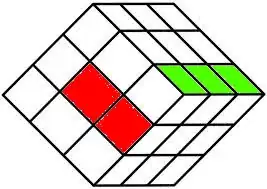
A good, scrambled Rubik's cube, in my opinion, has no lines of 3 of the same color on one side (green). It also has none of the same colors on a touching center and corner piece (red).

-
1When I scramble I usually look for matching squares and I split them for a "good scramble". I aim for no 2 matching squares, even though I never actually get there. But I realized this may result in an easier solve. It is easier to assemble a layer when the colors don't match instead of when the colors match but are still in the wrong place. In the second case you have to move the piece away before you can put it back where it belongs. – Florian F Feb 20 '15 at 16:41
1
Skipping steps (especially with the beginners method) is absolutely normal and happens all the time. As far as scrambles go, there isn't really a way to figure out a whether a hand scramble is good or not. It's best to use a scrambler (usually a part of timer software), such.as cstimer. The official WCA scrambler is called TNoodle.

Tomáš Král
- 111
- 1
1
There are lots of places for scramblers, and provide a very good scrambler, because of the fact that the scrambles can reach all 44 quintillion positions. Here are scramblers, along with timers:
Or, for an official scrambler, download TNoodle (No link, because not enough rep.)

Seanliu
- 11
- 1
-
1Welcome to Puzzling Stack Exchange! Please take a moment to read our guidelines on self-promotion. I've edited your blog link out of your answer, as it does not appear to directly support your answer. – Feb 20 '15 at 15:34