27

This is a puzzle was inspired by the board game labyrinth, which I very much enjoyed as a kid.

It either requires very good 3D-visualization skills in your brain or some paper & scissors work. (Hence mechanical puzzle).

Thanks to Kevin, there is now also a Javascript simulator for this puzzle, which makes things way easier.


Goal

Imagine you have a labelled board of 25 fields like the following: board

You also have 25 dice which are all build up by the same mesh: dice mesh

These dice are placed on a 5x5 field grid to create a labyrinth with the faces showing upwards.
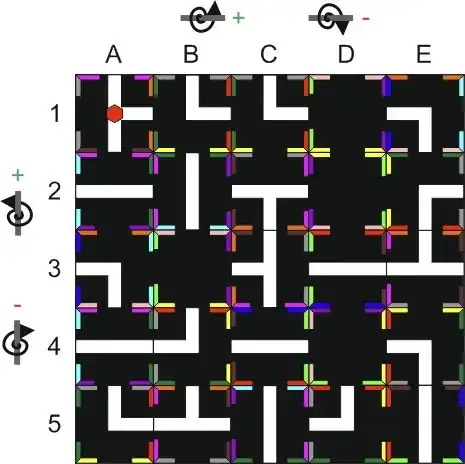
Starting position

You start out on the top-left position (A1), and you goal is to reach all other three corners (E1, E5, A5 ) in arbitrary sequence. You want to do this with minimum amount of steps. Note that 'passing through' one of the corners in a single move is valid for the purpose of the goal. (You do not have to end a move in a corner. )

Rules

  • A single step consists of the sequence of first tilting a row or column and then moving from your current location along 'open paths' for an arbitrary distance. (You may do only one of the two, but not change the sequence order.)

  • When tilting, you have to tilt all dice of the row/column in the same direction by 90 degree. (Fixed tiles of the row/column stay obviously unchanged.)

  • You must not tilt a row/column which includes your current position on the grid.

  • the board does not warp around. It is not possible to leave it on one side and renter from the other side.

Notation

  • Tilt-notation includes either the letter (column) or the number (row) of the tilt, and either + or - to indicated direction (see example below).

  • Move-notation includes start and end position given by the grid-coordinates (see example below).

Example

Starting from the start position given above, you first all dice of column B in + direction. (Imagine the top of the dice tilting downwards.)

Tilt-Notation: (B+)

Tilt1

Now you move the marker.

Move-Notation: [A1 -> B1]

enter image description here

So the whole step would have the notation:

Step 1: (B+) [A1 -> B1]


The puzzle question:

What is the minimum number of steps you need to visit all 4 corners of the grid (starting in A1) from the given starting situation:

Starting position

You have to give all steps in the notation explained above.

The current record for this puzzle is 7 moves.

BmyGuest
  • 18,141
  • 1
  • 69
  • 147
  • 1
    Shall I assume wrapping is not allowed? – Warlord 099 Dec 02 '14 at 19:37
  • Do the dice move when you tilt them? For example, in the tilt B+, does the die at the top of the column then become the die second from the top, or does it rotate but stay at the top of the column? – Kevin Dec 02 '14 at 22:40
  • My understanding is the dice stay where they are and just rotate themselves accordingly – Warlord 099 Dec 02 '14 at 22:45
  • Are you required to move to a new spot after a "tilt" is made? or is [A1->A1] acceptable? – Warlord 099 Dec 02 '14 at 22:47
  • 1
    If I move through a corner but don't end the turn on the corner, does that count as "reaching" the corner? Ex. If I do "D1 -> E2". – Kevin Dec 03 '14 at 13:40
  • 4
    I've programmed a tool that helps you test out move sequences. It is available here. – Kevin Dec 03 '14 at 18:32
  • 2
    update to previous comment: now with undo functionality. – Kevin Dec 03 '14 at 19:04
  • @Kevin Will your tool stay under this link "for long"? If so, I would like to link it up from the main question. It's actually good fun to use it.(if you want, you could add a variable puzzle size and random goal-points, and hurray you (we) have created a puzzle-game app. ) – BmyGuest Dec 06 '14 at 10:26
  • @BmyGuest, yes, that link should remain valid for the foreseeable future. The web site owner says that scripts are stored permanently. (Of course, we can't rule out the possibility of catastrophic failure, ex. a meteor landing on his data center, so it may be prudent to save a local copy) – Kevin Dec 08 '14 at 13:20

2 Answers2

6

NEW ANSWER: 10 Turns (I used Kevin's interactive tool for this one)

(2-)
(2-)
(3+)
(4+)
(4+)
(C+), [A1 -> C5]
(4-)
(3-)
(2+), [C5 -> E1]
(3+) [E1 -> E5]

OLD ANSWER: 13 turns

Just to get the ball rolling my moves are as follows (I created an interactive version in Excel, so there is plenty of margin for error.):

(B+)
(C+)
(D+)
(E+)
(E+) [A1->E1]
(2-)
(3+)
(4+)
(5-) [E1->E5]
(4-)
(B+)
(B+)
(A+) [E5->A5]

Warlord 099
  • 1,784
  • 1
  • 11
  • 13
6

Here's a 7-move answer.

(B+),
(C+),
(D-),
(D-),
(2+), [A1 -> E1],
(B-), [E1 -> A5],
(D-), [A5 -> E5]

Also, obviously, done with help from Kevin's tool.

Monk
  • 84
  • 1
  • 4
  • Hi @Monk, welcome to Puzzling SE! It's really great to find impressive answer from a new user like you! :D Hope you enjoy being here~ – athin Feb 27 '19 at 13:06
  • Certainly a better answer! I've moved my check, well done. – BmyGuest Feb 27 '19 at 18:29