48

A friend of mine made a simple bar bet, in which he wrote down a list of ten words. Turning it around to show me, he covered up the first two words with his hand. The eight words below his hand were the following:

THIRD
FOURTH
FIFTH
SIXTH
SEVENTH
EIGHTH
NINTH
TENTH

He bet me \$20 that I would not be able to guess the first words on the logically-ordered list on my first try, though I could name them in any order. Of course, I'm thinking, I'll just say 'FIRST' and 'SECOND', easy $20. So I did. And he removed his hand. And much to my surprise, I was out twenty bucks for my haste.

What were actually the first two words on the list?

Len
  • 8,936
  • 2
  • 30
  • 65
generalcrispy
  • 6,031
  • 2
  • 36
  • 45

3 Answers3

52

WHOLE
HALF

were the first two words.

Gamow
  • 45,573
  • 10
  • 147
  • 381
wbogacz
  • 1,022
  • 2
  • 13
  • 22
  • Correct. At first glance, one sees a sequence of ordinal numbers, but if the first two are WHOLE and HALF, they're a sequence of ever-decreasing fractions. – generalcrispy Oct 23 '14 at 20:45
  • 21
    Although note that this only really works in American English - A British English speaker would likely never use "A fourth" instead of "A quarter". – Jon Story Oct 23 '14 at 22:41
  • @JonStory Don't think this works in American (or Canadian) English either; we say "quarter" too. – Trenin Oct 28 '14 at 19:46
15

Senior and Junior. The list was suffixes for descendants with identical names, such as King George IV, which is King George the Fourth.

EDIT: Answer 2 Whole and half. One whole, one half, one third, etc.

mdc32
  • 2,743
  • 1
  • 19
  • 39
  • 1
    It's a good answer, but it's not the one I'm looking for. Normally, in that context, you wouldn't use "Third", "Fourth", etc... you'd use Roman numerals. – generalcrispy Oct 23 '14 at 20:38
  • 6
    I'd also argue that this isn't true. The current British Monarch, for example, is Queen Elizabeth the Second. I've never heard of a monarch referred to as Senior or Junior. – Jon Story Oct 23 '14 at 22:40
  • 1
    @Jon This isn't specifically referring to monarchs. Many times, in the US at least, if a father and a son have the same first and last name, they are referred to as Junior and Senior. – mdc32 Oct 23 '14 at 22:43
  • 2
    Ah my apologies, the use of King George as a reference confused me :) – Jon Story Oct 23 '14 at 22:46
  • Yeah, it's just not common to see a name passed down to a 3rd generation, and fairly rare to see it passed down to a 4th generation. The most accessible example people will be familiar with is historical royalty. – Jason Oct 24 '14 at 19:30
  • @generalcrispy: Why the heck does it matter how you would write it down? – ThePopMachine Oct 31 '14 at 23:22
  • If I made this bet and gave this answer I'd be pretty mad if I didn't get the $20. And I'd immediately find this and get even madder: http://en.wikipedia.org/wiki/Suffix_%28name%29 – Todd Wilcox May 08 '15 at 21:01
14

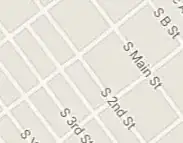
They could be “Main” and “Second”. In the town I live in (and perhaps in some other small towns) west-side streets parallel to Main are $2^{nd}, 3^{rd}, 4^{th}, 5^{th}$ etc. (East-side streets are B, C, D...; ie, Main does double duty standing in for $1^{st}$ St. and A St.)

map snip

James Waldby - jwpat7
  • 1,798
  • 14
  • 19