4

As everyone knows, in Sudoku the sum of each row and column is 45. So all Sudoku solutions are some kind of magic square. My question is:

Has anyone seen a Sudoku puzzle combined with the magic square rule for all nine 3x3 squares? (even without diagonal sum)

Is it even possible to have such a puzzle?

edit: The same question about 4x4 squares.

bobble
  • 10,245
  • 4
  • 32
  • 80
Rafe
  • 5,756
  • 4
  • 29
  • 51

2 Answers2

14

It is not possible, for the simple reason all 3x3 magic squares have the 5 in the center spot of the 3x3 block. Therefor you'll always get 3 rows and columns in the 9x9 that hold 3 5's, rendering the sudoku part impossible.

Reference on the possible 3x3's: Dr Mikes math games for kids

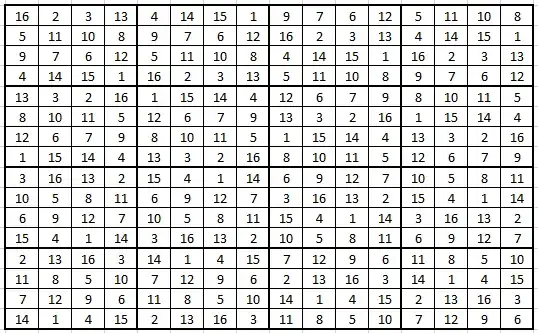
EDIT: to add to the answer, here's a possible solution for 4x4's: 4x4 solution

Notice how I start in the upper left, I fill the top row by putting 4x4 blocks of which the rows are permutated. From there downwards, I build new 4x4 blocks by permutation columns in the 4x4 blocks from the top row.

As far as I can see all diagonals within the seperate 4x4's work aswell.

Tim Couwelier
  • 4,349
  • 21
  • 37
  • Oh how silly of me! thanks! what about 4x4 squares? – Rafe Sep 04 '14 at 07:39
  • That might be a trickier question, with numbers going from 1 to 16... I think there is limited options on what 4x4's are possible, one would have to check if there's viable permutations/symmetries there to get the 'sudoku part' right. There may actually be options. – Tim Couwelier Sep 04 '14 at 07:51
  • Curiousity got the better of me. I was frankly quite surprised how many manipulations could be done with them this easily. – Tim Couwelier Sep 04 '14 at 13:13
  • "(even without diagonal sum)" should solve the centered '5' of the 3x3 squares. – Alix Eisenhardt Jun 02 '17 at 14:58
2

It is possible for a 9×9 Sudoku if you drop the requirements that the diagonals have the same sum; for example:

5 7 3   2 9 4   1 8 6
1 6 8   7 5 3   9 4 2
9 2 4   6 1 8   5 3 7

6 8 1 3 7 5 2 9 4 2 4 9 8 6 1 7 5 3 7 3 5 4 2 9 6 1 8

4 9 2 1 8 6 3 7 5 3 5 7 9 4 2 8 6 1 8 1 6 5 3 7 4 2 9

Of the 18 diagonals, only 6 have sums not equal to 15; three sum to 12 and three sum to 18.

2012rcampion
  • 18,915
  • 3
  • 66
  • 98