I believe that the answer by user @0x5453 can be equalled, but not improved. This is based on an understanding that where we see a L-shaped piece, it is a single piece, i.e. a rectangular piece partly covered by another piece.
There are 25 areas and I have labelled them a to y.

The problem of laying larger pieces is compounded by the fact that some colours overlap each other. For example 1p overlaps 3g, 1r overlaps 3t, and 3t overlaps 1b. Similarly 2s overlaps 3g and 3u overlaps 2e.
First I wrote a C program that attempted to permute the placing of merged combinations of the same colour but it probably won't even find @0x5453's solution before hell freezes over. On closer examination I found that the search space can be reduced, because there are 10 areas that overlap which can't be placed until last, individually, and there is no chance of merging them because they will break already laid areas.
When I removed those 10 areas from the problem, it left a single 4 and a single 5 so they can be done last too. This image show those 12 areas n to y in grey.

Leaving those 12 until last gives 13 pieces to fiddle, with only four colours: 1 (3 of), 2 (3 of), 3 (2 of) and 6 (5 of). Analysing what is left, where in each case —
- If we begin with colour 6 as @0x5453 did, any attempt to pair or triple up the other colours will overlay one or more of the 6 pieces, cancelling any saving.
- Next, if we begin by filling with 2, and then covering only 3 of 6, these 2 placings cover 6 areas:

with 7 pieces to place individually, then the other 12 (not shown). 2 + 7 + 12 = 21, equalling @0x5453.

- Next, if we begin with filling with 1, and then covering just 2 of 2, and then only 2 of 6, these 3 placings cover 7 areas:
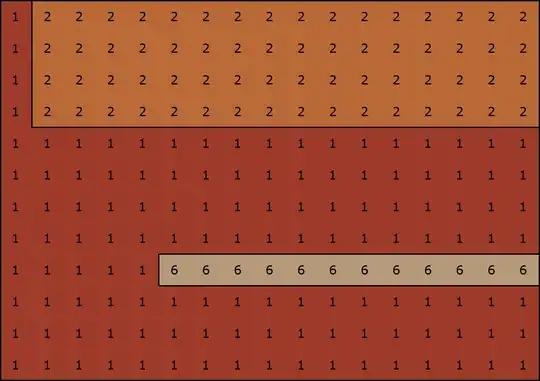
with 6 pieces to place individually, then the other 12 (not shown). 3 + 6 + 12 = 21, equalling @0x5453.

- Lastly, if we begin with filling with 3, and then some 3 of 6, the 2 placings cover 5 areas leaving 8 to place individually. 2 + 8 + 12 = 22, worse than @0x5453.


