Simple. The duck can always escape, no matter how fast the wolf runs.
If it's a 'puddle duck' then it can do a vertical-takeoff from the middle of the pond, without going near the edge.
If it's not a puddle duck then it must be a 'diving duck', which means it has a food source handy (at the bottom of the pond), so it can just wait for the wolf to get hungry and leave.
(As the duck is on a pond, that seems to exclude the possibility of it being a seaduck).
Puddle Duck (aka 'Dabbling Duck')
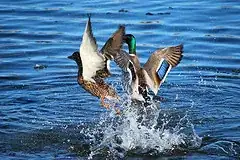
Another distinguishing characteristic of puddle ducks when compared to diving ducks is the way in which they take flight when spooked or are on the move. Puddle ducks spring straight up from the water, but diving ducks need to gain momentum to take off, so they must run across the water a short distance to gain flight.
Wikipedia: Anatinae
The silhouette of a puddle duck sits higher on the water than
diving ducks and when they want to take off, they lift directly upward. Their diving cousins need to run along the water before gaining altitude.
Puddle Ducks;
Order Anseriformes;
Family Anatinae;
Subfamily Anatini, York County Conservation District
Dabbling ducks in comparison to diving ducks have larger wing areas relative to their body weight. Their wings are longer, rounder, and have really well developed wingtip slotting. All of this improves their ability to land and take off in tight spaces. Taking off vertically out of the water requires the duck to push with their wings and their feet simultaneously. Usually facing the wind, the dabbler will create airflow past the wings by flapping backward up and forward down, angling the primaries (largest flight feathers) to produce the maximum thrust. Lift occurs when airflow on the wing has lower pressure just above the wing, and higher pressure below. Divers wings are more streamlined, which helps with swimming and diving, but requires a build up of speed in order to take off.
Ask a Biologist: What are the mechanics/biomechanics which allow puddle ducks to perform a vertical take-off. They seem to just elevate straight up with minimal forward motion. How do they accomplish this?, Delta Waterfowl
Diving Duck (aka 'Pochard' or 'Scaup')

If it's a diving duck, it just stays in the middle of the pond, feeding from the bottom of the pond as necessary, until the wolf gets hungry and goes away to find some other dinner. The duck can outlast the wolf because the duck has a convenient food source right there to hand - the wolf has to go away to find something (other than the duck) to eat.
Diving ducks dive and feed at the bottom, often many feet below the waters surface.... Since some diving ducks do not like to leave the water it is necessary to place food dishes at the waters edge or place food on the water itself.
British Waterfowl Association: Diving Ducks


