21

Yeah. I think this puzzle will be the hardest puzzle on Puzzling...

I'll add one hint per 3 days, I'll add a VERY helpful tag on the 3rd week, and I'll post the answer and explanation on the 4th week.

Edit: I've completely managed to ignore this...

Yeah, here's the puzzle: (Thanks to @squeamishossifrage)
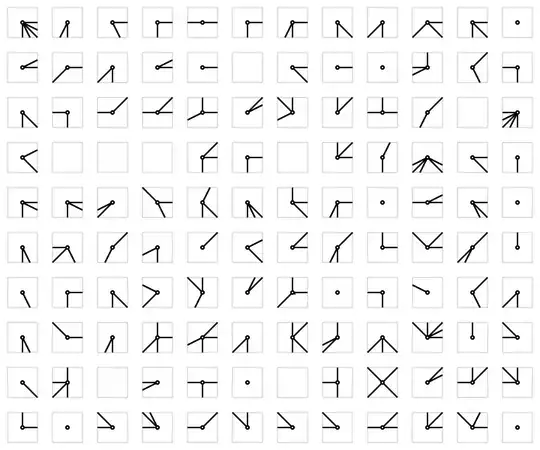
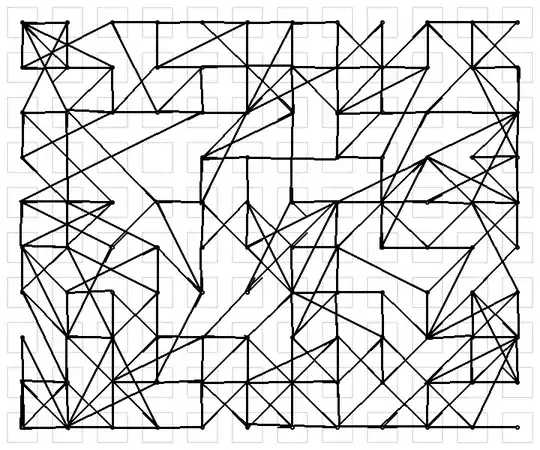
PUZZLE

This is the correct way to look at it.
All tangents from the positive x are ±0, undef, ±2, ±1/2, ±1.
Read from top-left to bottom-right
Find the 3-digit code!!!!!

So, what is the three digit code that is described by these seemingly random lines?

Hint:

This puzzle will have a EUREKA moment, almost like my last puzzle here

Hint 2:

The comments below have a lot of helpful hints, especially the ones on March 27

Hint 3:

Ivo Beckers is missing something else from his picture... For every single one, he has forgotten two lines.

Hint 4:

The EUREKA moment has nothing to do with math.

awesomepi
  • 2,969
  • 15
  • 50
  • 3
    Hmmm, a week between every hint? I think that would make the problem not attractive...I'd suggest a hint every 2-3 days if you want this to be solved slowly. – leoll2 Mar 25 '15 at 17:06
  • Sure, fine, whatever – awesomepi Mar 25 '15 at 17:09
  • 3
    @awesomepi I would request you to add the instruction to your question body. It is very difficult to understand what is written on the paper. ... I agree with "Gosh... I suck at writing" :P – Ashutosh Nigam Mar 25 '15 at 17:12
  • 1
    @AshutoshNigam There we go – awesomepi Mar 25 '15 at 17:27
  • I've redrawn the puzzle, but I need someone to check it for me. I can fix errors quite easily, but if you want to do it yourself, the Python source code is here. – r3mainer Mar 25 '15 at 20:50
  • @squeamishossifrage I appreciate the work. I saw one error, but I am on a phone and in not sure whether that's the only one. It is a very important one, however, and cannot be overlooked.The one Six down and seven over is wrong. – awesomepi Mar 25 '15 at 21:07
  • "The hardest puzzle on Puzzling" ... that's a very high bar to aim for! Check out Avigrail's riddles (reciting the words of some of them makes me cringe even now!), or Noctis Skytower's "Justice and Fairness" (with 30 or 40 hints posted). – Rand al'Thor Mar 26 '15 at 02:09
  • @randal'thor I know, It's SUPER high... but I'll have to say, this is REALLY hard. If there's a LOT of interest, I may postpone the dates. Or I might procrastinate. – awesomepi Mar 26 '15 at 02:23
  • @randal'thor I wouldn't know tho, I suck at puzzle solving. I did try my hand at the riddle on the A gold ring? A... one, and that was made in a total of 10 minutes. I make puzzles all the time tho, it's one of my hobbies. – awesomepi Mar 26 '15 at 02:34
  • 2
    A thing I notice is that the dots along the border never have lines pointing outwards making me think that you have to extend the lines until they reach another dot – Ivo Mar 27 '15 at 13:23
  • 3
  • @JRichardSnape I'm sorry, that edit was not by me, but I failed to catch the mistake. I also edited the tangents so that it makes more sense. – awesomepi Mar 27 '15 at 16:57
  • @JRichardSnape The tangent values as given mean exactly what you have in your linked diagram. The tangent of a horizontal line is 0, a 45° diagonal is ±1, and a vertical line is undefined. The ±2 and ±1/2 values correspond to the approximately 26.6° and 63.4° lines you drew (2 over, 1 up and 2 up, 1 over). It is just saying that all of the lines are at one of those angles. – GentlePurpleRain Mar 27 '15 at 18:49
  • @GentlePurpleRain I had it wrongly written earlier. – awesomepi Mar 27 '15 at 20:58
  • 1
    Could this be a graph-colouring question, with the extended property of first requiring the completion of the graph itself? I also notice only one instance of two lines pointing directly at each other, namely the (4,1) and (5,1) points (where the 1 is the row number). Could this be a hint of some sort? – Glen O Apr 05 '15 at 13:30
  • @glen and the last node is the only to be 1st order – Seb Apr 05 '15 at 16:53
  • @GlenO The two pointing together were not meant to be that way, I'm sorry for the conclusion. I accidentally copied my original version wrong, but no, it does not matter. – awesomepi Apr 05 '15 at 22:40
  • My first thought was that since there's 16 possible positions for a given line, then it might be something encoded in hex, but between the "nothing points off the edge" and "no two lines point at each other", that seems highly unlikely. – Bobson Apr 12 '15 at 19:46
  • Ivo's graph, while great, seems to have two omissions. The square one right and one down from the top-left; and the square one above the bottom right, both have unextended lines. That's all I have to say, I have no idea how to solve this. – Lopsy Apr 12 '15 at 20:56
  • 1
    @awesomepi When you say "Read from top-left to bottom-right", do you mean left-to-right then top-to-bottom or top-to-bottom then left-to-right? Or would answering this question be a big giveaway ;) – Allan Apr 12 '15 at 22:37
  • @Allan None of the above :) It's complicated – awesomepi Apr 12 '15 at 22:39
  • @awesomepi is this some kind of pigpen cipher? http://en.wikipedia.org/wiki/Pigpen_cipher – Vincent Apr 14 '15 at 07:33
  • @VincentAdvocaat No, it is not. – awesomepi Apr 14 '15 at 14:09
  • 1
    Is there any reason you're spelling it "EUREAKA" rather than "EUREKA"? –  Apr 15 '15 at 05:51
  • @JoeZ. No, I just suck at typing. – awesomepi Apr 15 '15 at 17:36
  • That being said, does the EUREKA moment have anything to do with the word EUREKA? –  Apr 15 '15 at 17:41
  • @JoeZ. what are you saying? I just suck at typing... It has nothing to do with it. – awesomepi Apr 15 '15 at 18:38
  • I took a look at some of the paths connecting the top left and bottom right, and they seem to have shapes loosely resembling the digits 4, 1 and sometimes 5 appearing. Am I just hallucinating? (Likely) – namey Apr 15 '15 at 23:02
  • @namey I mean, there are an awful lot of lines there; I wouldn't be surprised if you see them. – awesomepi Apr 16 '15 at 03:08
  • it's not 256 is it? :P – Vincent Apr 18 '15 at 21:25

6 Answers6

5

I think the 3-digit code could be

269

because

the graph that is created when the lines are extended to the next dot, has 269 partitions of different sizes and shapes. (thanks to the picture posted in the question's comments by Ivo Beckers, which was missing a couple lines) enter image description here

JLee
  • 18,202
  • 2
  • 55
  • 172
  • Actually, in the square directly above the bottom-right, you missed a line, which actually brings the total up to 268. –  Apr 12 '15 at 21:10
  • And in the second from the top, second from the left, making it 269. –  Apr 12 '15 at 21:11
  • @Joe Yes! good eye! thanks. I started making the connected graph on my own, but then got lazy and decided to use the one that was posted. – JLee Apr 12 '15 at 21:17
  • Only this seems disregard the instruction "read from top-left to bottom right", which suggests to me that the answer should be something that can be read digit by digit, but I don't know. – String Apr 12 '15 at 22:23
  • Nice answer, nice angle, but it's still incorrect. – awesomepi Apr 12 '15 at 22:24
  • @String good point. I thought of that when I was counting, but thought I'd try it anyway, since I didn't have anything better – JLee Apr 12 '15 at 22:42
  • 1
    @awesomepi Is this a graph coloring problem? if so, can we get some direction? or a hint? if it's not a graph coloring problem, then what level of mathematics is needed to be able to solve it? i just don't want to waste time on a problem that requires some crazy high amount of math knowledge. – JLee Apr 12 '15 at 23:01
  • also, was the "Eureka moment" the extending of the lines to the next dot? if not, then is it still unmentioned in any of these comments? – JLee Apr 12 '15 at 23:19
  • @JLee It was neither of those actually. – awesomepi Apr 12 '15 at 23:25
4

Try #4

(EDITED to reflect the actual answer, although I went with 342 at first)

Could the 3-digit code be

345

because the path resembles those numbers (see below)

enter image description here

JLee
  • 18,202
  • 2
  • 55
  • 172
  • 1
    I hate to say this (no i don't) but your 2nd option is like claiming there's a face on mars.

    We so desperatly want to see patterns that we see them when they're not there. if you want it to to resemble numbers you have to take all the blocks in account, there are many unused blocks below 2 and cel number 5 ruins your 3 not to mention the squigle inbetween 3 and 4.

    nicely thought but it is extremely far fetched :P

    – Vincent Apr 18 '15 at 21:21
  • The answer is actually 345 based on the shapes, but I'll give it to you. – awesomepi Apr 19 '15 at 02:05
  • @VincentAdvocaat It would be a LOT clearer without the boxes. – awesomepi Apr 19 '15 at 02:05
  • @awesomepi I thought about it being 5 at first, but then, the 2 looked so intentional that I changed it to a 2, thinking that the 5 looked a bit weak. – JLee Apr 19 '15 at 02:40
  • 2
    I really like the first part of the puzzle where you have to realize it's a maze. But the way of turning that maze into a 3-digit number feels arbitrary :/ – Lopsy Apr 19 '15 at 05:54
  • @awesomepi the answer is 345? Jlee could you replace the image with a correct one and make it clear 345 is the answer. – Vincent Apr 19 '15 at 09:26
  • @awesomepi I really like the puzzle overall. The first 2 digits are fine, but the last digit needed to be more clearly a 5. Also, I know a puzzle like this would take lots of time to check before posting, but it would have improved the process greatly. – JLee Apr 19 '15 at 14:12
  • 1
    I showed the final path to my wife and asked her what 3 numbers she saw in it, and she immediately said 345, so I guess it's more of a perspective thing. (I thought it was 342) – JLee Apr 19 '15 at 14:37
  • 1
    @JLee except in your edited version there is no reasoning for the path you've taken. So it is still unclear why you took this particular path. – Vincent Apr 20 '15 at 12:16
  • 1
    @VincentAdvocaat I have been wondering the same thing. Why THIS path over the others? I honestly don't know. I created this path in response to a hint given by the OP, by combining the 1st part of the path in my 2nd attempt, with the last part of the path in my 3rd attempt. Do you have any insight as to why this path should have been chosen? – JLee Apr 20 '15 at 14:10
  • 2
    I'm gonna go with the face on mars here. I went over some of the possible paths including this one and while the middle sort of looked like an intentional 4 (and in other paths, it looked like an intentional 1), the others were plain daydreams. – namey Apr 21 '15 at 19:54
3

The number is

913

Because

that is the number of different non-self-intersecting paths there are that start in the upper left corner and end in the lower right corner.

Take note that

the graph is directed. Just because you can go from (0,0) to (0,1), doesn't mean you can go from (0,1) to (0,0). (with the single exception of the fourth and fifth cells in the first row, but they were a mistake). This was what Ivo Beckers' illustration was missing; "For every single [line], he has forgotten [to add] two lines [to the end of the current line, to make it into an arrow]."

Kevin
  • 6,449
  • 1
  • 31
  • 30
2

Try #2

I think the 3-digit code is

991

Kevin's answer helped me a lot, although I am still not sure this is the correct answer. The shortest path I could find from top left to bottom right is

1,13,3,28,29,49,63,52,53,66,79,93,105,118,119,120 which sums to 991

To get the numbers above, I numbered each cell from 1 to 120, going first from left to right, then top to bottom. enter image description here

JLee
  • 18,202
  • 2
  • 55
  • 172
2

Try #3

I think the 3-digit code is

216

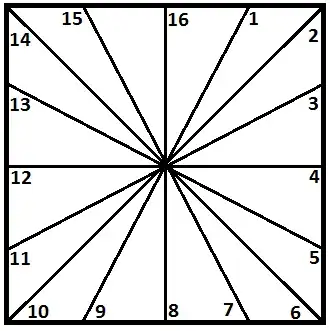
I made a dial, based on the layout of a clock, that assigns a value to each of the 16 directions away from a cell.

enter image description here

After the last edit to the question, the shortest path (based on summing the values) from the upper left cell to the lower right cell is

enter image description here

JLee
  • 18,202
  • 2
  • 55
  • 172
  • Close, try combining the first half of your path in the earlier answer to the next half of this answer. – awesomepi Apr 18 '15 at 14:29
1

This might be too simple, but could the code be

107?

That seems to be

the number of dots that can actually be reached from the top-left square (by following the lines in the original picture, not Ivo Beckers' one, i.e. taking directionality into account as noted in Kevin's answer).