27

Supporters of free childcare, parental leave and other parental perks often claim that the lack of such benefits is the root cause of low fertility rates in the US and other developed nations. And yet, Nordic countries have low birth rates too despite having free childcare and other progressive policies supported by Left wing parties in other nations.

How can this discrepancy be explained? Examples of such claims are:

JonathanReez
  • 50,757
  • 35
  • 237
  • 435
  • 2
    Your second article clearly states that these are only part of the reason for the decline in birth rate, not the sole reason for it. This appears to be an attack on the idea that providing these things as parental rights isn't a good thing. – Joe W Aug 28 '23 at 12:54
  • 6
    @JonathanReez: All of the linked sources say that the reason given for delaying pregnancy is that it's too expensive to have children. This is a feature of the economy: ever-rising prices and stagnant wages, meaning that a low SES household needs two incomes to get ahead at all. Free childcare and parental leave are tools that allow a household to have children without giving up one spouses income. It isn't an incentive; it's a relief. – Ted Wrigley Aug 28 '23 at 13:08
  • @TedWrigley the data from the Nordics seems to show that high costs of having children aren't actually a problem for people who want them, though? So, sure, you could give parents some relief (as you could to any other group) but it doesn't seem to help at all with solving the birth rate issue. – JonathanReez Aug 28 '23 at 13:10
  • And the articles you provided say that is only part of the problem while you seem to be saying that there are claims these are the entirety of the problem. – Joe W Aug 28 '23 at 14:48
  • How is this a political question? – JimmyJames Aug 28 '23 at 15:06
  • @JimmyJames because childcare subsidies are a huge fighting ground in US and Canadian politics. – JonathanReez Aug 28 '23 at 15:31
  • @JonathanReez So are lots of things but this is about whether a certain (social) science claim has evidence. It's also the case that there are other arguments for childcare subsidies such increasing workforce participation. – JimmyJames Aug 28 '23 at 15:36
  • 3
    Compared to whom? Last thing I heard is that Nordics and France are among leaders in EU birthrate statistics. France also having a long history of pro-natalism. – alamar Aug 28 '23 at 15:44
  • 1
    Are you asking about low fertility rates or low birth rates? The two can be connected but are distinct and very different. The former is all about biology while the latter is a combination of many different factors, ranging from fertility through personal choice to economics. – terdon Aug 28 '23 at 16:27
  • @terdon the technical term is TFR = total fertility rate – JonathanReez Aug 28 '23 at 16:51
  • Precisely, TFR which is not to be confused with birth rate. Either is a perfectly valid thing to ask about but since your question seems to use both terms interchangeably, it's a bit confusing. I'm no expert, so I may well have misunderstood something, but as far as I can tell, one is a measure of how many children could be born, while the other measures the number actually born. – terdon Aug 28 '23 at 17:22
  • Real talk here, is this answerable? I'm skeptical of the facile claims in those type of thinkpieces linked in the question, and I'm equally skeptical of just-so stories in the other direction. People have or don't have children for lots of reasons, there's a clear trend towards lower birthrates in first world countries across the board, etc etc. – Jared Smith Aug 29 '23 at 11:11

8 Answers8

49

The main factors that are seen as contributing to a lower birth rate include:

  • Improved educational opportunities for women
  • Lower child mortality
  • Access to effective contraception
  • Social welfare and pensions
  • High costs of raising children
  • Cultural factors, such as expectation of family size

(sources: 1 2)

Providing "parental perks" can offset some of the high costs of child rearing, but it has little effect on the other factors. In particular, in Nordic countries there is a functioning health and social welfare system, so firstly, few children die. And secondly children are not used as an insurance policy against old age. Culturally, the Nordic countries have been Lutherian protestant, with no religious code against contraception.

Other factors being equal, increasing the costs of child rearing does tend to lower the birth rate. But even with the many "perks", it is still economically rational (in a narrow sense) to remain childless.

terdon
  • 1,009
  • 1
  • 10
  • 18
James K
  • 120,320
  • 22
  • 366
  • 478
  • 2
    One could add that the overall effect on fertility of policies under government control like child care access is very small. The first three bullet points dominate and any effect on fertility of child care policies will be neglible in comparison. – quarague Aug 28 '23 at 06:06
  • 1
    Are there any "American or Canadian politicians" who "support free childcare, parental leave and other parental perks" and use these factors to "explain why Nordic countries have low birth rates despite having such policies"? If so, please name them. If not, this answer does not address the question. – phoog Aug 28 '23 at 08:24
  • 1
    @phoog as per feedback I've edited the question to remove the focus on politicians alone – JonathanReez Aug 28 '23 at 12:52
  • 1
    I have a nordic and germanic background and "economically rational (in a narrow sense)" seems like a perfect (if incomplete) description of most of my extended family members. – Todd Wilcox Aug 28 '23 at 21:18
  • 2
    To the cultural factors we can add part of the population who has as cultural values to not have children because of population increasing on other parts of the planet, or even some cases of allowing more space for diversity. – vsz Aug 29 '23 at 04:26
  • 2
    I don't believe the protestant part matters much any more in 2023. Portugal and Spain have some of the lowest birth rates in the world, and Polands is also quite low. Even in catholic countries, it appears (almost) nobody cares what the Vatican says about contraception. – gerrit Aug 29 '23 at 08:43
  • @gerrit that's an interesting observation, have you seen any studies or data that indicate Catholics in Europe don't adhere to church doctine on birth control? If so, to what extent does it hold true for Catholics outside Europe? – retriever123 Aug 29 '23 at 19:52
  • @retriever123 No studies or data except anecdata and my own opinions, which have been formed in a secularised calvinist context that doesn't have a particularly high regard of catholics generally speaking. – gerrit Aug 29 '23 at 21:45
  • @phoog TFR is higher in Sweden and Denmark than Italy and Spain and Poland. The birth rates in Estonia/Lettand/Latvia is up comparedd with 2010. – Stefan Skoglund Aug 30 '23 at 16:56
  • 2
    @retriever123: At least among American Catholics as of 2016, 89% of them say contraception is either morally acceptable, or not a moral issue at all, with just 8% agreeing with the church's position that it is morally wrong. Even among those who attend mass weekly, only 13% say it's morally wrong. And American Catholics are fairly conservative relative to the worldwide church last I checked. – ShadowRanger Aug 30 '23 at 19:17
40

The Nordics have Among the Highest Birth Rates in Europe

So it looks like those perks must be working.

Denmark, Sweden, and Iceland all have birth rates of 1.7 births per woman. (Norway and Finland are lower at 1.5 and 1.4, respectively, but 60% of the population of the Nordics are in Denmark, Sweden or Iceland.)

So the only European countries with higher birth rates are Turkey (1.9), and France, Ireland and Moldova (1.8).

European countries with lower birth rate than the best of the Nordics include: Belgium, Hungary, Latvia, Netherlands, Slovakia, Slovenia, and the UK (1.6), Germany, Austria, Poland, Serbia, and Switzerland (1.5), Greece and Portugal (1.4).

European countries with birth rates lower than all the Nordics include: Italy, Spain, and Ukraine (1.3).

reinierpost
  • 103
  • 2
codeMonkey
  • 1,624
  • 7
  • 11
  • Of course, 60% of the Nordics are in Denmark and Sweden by themselves. – Azor Ahai -him- Aug 28 '23 at 22:15
  • 2
    And of course, most European countries have similar perks too. It's yet another thing that spurs fierce debates in the US, but is standard in most of Europe. Education and work opportunities are generally better for women, there is little expectation that social security will be provided by your kids (or parents), and for the past decade or two, there is a quite pressing sense of "there's too many people already anyway" and climate change (there's been some poll in Germany recently that has shown that something like 30% of women want to be childless forever). – Luaan Aug 29 '23 at 07:20
  • IIRC teachers in France can go to early retirement as soon as they have three children. – gerrit Aug 29 '23 at 08:22
  • Hungry I hope they are not too hungry to make children. :D – AnoE Aug 29 '23 at 08:33
  • 3
    Does birth rate in European countries correlate with immigrant population? – gerrit Aug 29 '23 at 08:42
  • 2
    Looking at past fertility rate may also be interesting. The fertility rate in Sweden increased from 1.56 between 1990-1995 to 1.90 2020-2015. I wonder how much of that is due to policy, immigration, or other factors. – gerrit Aug 29 '23 at 08:52
  • 3
    @gerrit Within Germany, those regions with fewest immigrants (and most accessible childcare btw) used to have the highest birth rates, see https://www.destatis.de/DE/Presse/Pressemitteilungen/2016/10/PD16_373_126.html . However, this has changed in recent years because those regions are also those with the oldest population. So my impression is that hidden variables may be more important than immigration itself. – Jan Aug 29 '23 at 09:27
  • 3
    @gerrit According to swedish statistics, there is some difference between women born in Sweden and women born abroad, but it is not that large post-2020: https://www.scb.se/en/finding-statistics/statistics-by-subject-area/population/population-projections/population-projections/pong/tables-and-graphs/children-per-woman-by-country-of-birth-19702022-and-projection-20232070/ – Jan Aug 29 '23 at 09:55
  • @gerrit the TFR for Sweden could be influenced by that, though our experience is that the first gen immigrant gets a 'larger' family but the next one becomes 1-2 child families. – Stefan Skoglund Aug 30 '23 at 16:59
  • @gerrit the economic crisis in Sweden (500 % on rates) delayed the first child for a fair number of couples. Ie a lot of 30+ women became mothers from 2000 and on. – Stefan Skoglund Aug 30 '23 at 17:01
  • 1
    And France has been pursuing precisely the types of interventions carried out by Sweden. – Italian Philosophers 4 Monica Sep 05 '23 at 18:47
19

Childcare is heavily subsidized in Finland, though there is an income-dependent fee. Typically around 50 EUR but up to about 300 EUR per month.

The paid parental leaves dictated by law and collective work agreements are perceived to cause increased costs to employers. This can reduce the willingness of employers to offer long-term employment contracts to young people, especially young women. Many people want to have a stable job before getting children, so while the parental leave makes being a parent easier, it can postpone becoming a parent.

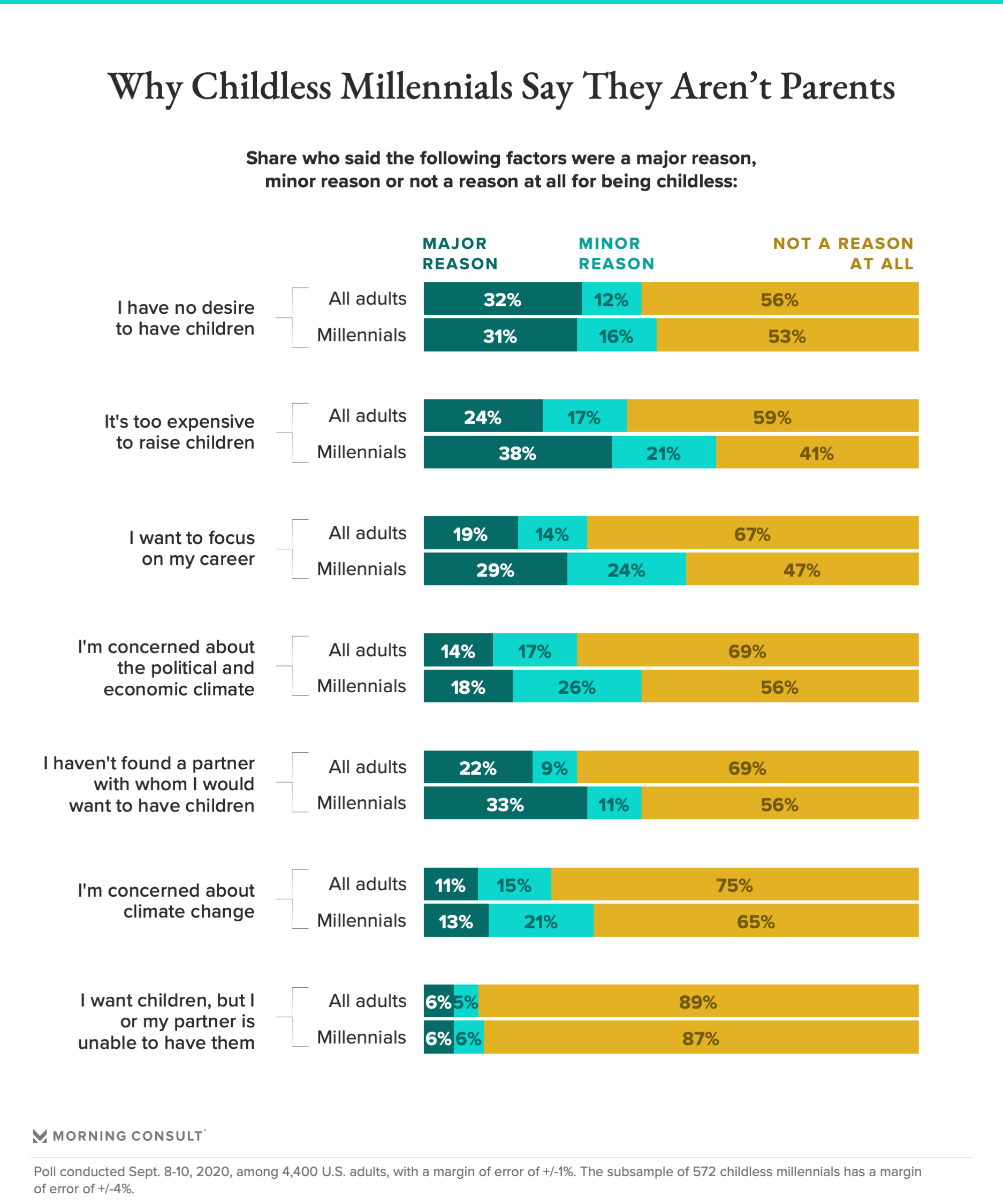
A 2022 study by association Family Federation of Finland questioned people on effect of 30 common reasons to postpone or to not have children at all. As a representative summary, here are a few of the more common reasons for age group 20-34 and percentage who said that it affects a lot:

  • Want to do other interesting things (38%)
  • Studies not complete (22%)
  • Lack of suitable partner (22%)
  • Focus on work career (20%)
  • Home too small (20%)
  • Family economic situation (17%)
  • Difficulties of combining work and parenthood (17%)

The policies seem effective in the regard that economic means are not the limiting factor for most people. On the other hand, people can rely on the government to provide basic care of the elderly, and having children is by no means a necessity.

jpa
  • 668
  • 4
  • 7
  • 1
    Thanks, those study results add a lot of value to the overall discussion here. However to conclude the policies have been effective at reducing the perceived financial drivers of low fertility rates, we would need to have a similar study somewhere like the U.S. to see how much economic burden factors into family planning, without those social supports. – retriever123 Aug 29 '23 at 20:02
  • 1
    @retriever123 There is a somewhat similar questionnaire linked through OP money.com article. Though questionnaires are very easily biased by wording and available choices, so it's not trivial to compare. – jpa Aug 30 '23 at 05:53
14

Believe it or not, having children is hard - both physically giving birth, and taking care of them until they're adults. Most people who can give birth would, given the full freedom to choose, either significantly limit the number of times they do it or not do it at all. Having lots of children, on the other hand, is usually a result of:

  • lack of access to or knowledge about birth control and abortion
  • lack of social safety nets combined with belief that children will take care of you in old age
  • societal and legal norms that allow exploitation of children as free labor
  • pressure from family, partner, or society/culture to have many children
  • internalization of belief that one's self-worth is tied up in having children

As such, it's completely expected that societies with social safety nets, good education, and respect for the rights of women and children will have relatively low birth rates. There's nothing bad or unusual about this.

12

These countries do not have lots of peasants or fishersmen who can work without much education, or none at all. Comparably many are middle class, qualified workers for whom raising the next generation "just like me" is expensive. Humans are different from dandelions. They plan only as many children as they can support all the way up to the professional maturity, and many understand "maturity comparable to mine", not some low paid unqualified work.

Of course, a housewife makes childraising cheaper while the kids are small, but when the time for the university comes, two parents may pull more.

The fact that a country provides reasonable help is by itself not a proof that without this help the birth rate would suddenly skyrocket.

Stančikas
  • 21,514
  • 1
  • 52
  • 113
  • 4
    Norway still does have a lot of fishermen, but they tend to be quite well educated. – James K Aug 28 '23 at 19:46
  • 3
    @JamesK Relative to other industrialized countries yes but as a proportion of the total workforce fishermen are neglible in Norway as well. Some quick googling gave 12900 fulltime equivalents (in a pdf file so no good link to post) for a country with around 5 million inhabitants. Ballpark estimate, 2.5 million workers total, so fishermen are around 0.5% of the total workforce. – quarague Aug 30 '23 at 06:16
8

I think your question is putting the cart before the horse in asserting that the "normal" expectation would be for the birth rate to rise because daycare is subsidized. That's a claim that needs verification. Asking us to (dis)prove the negative is not the correct approach here.

Firstly

People say "I'll have more kids if I have free childcare" on surveys

I think this is a misrepresentation of a more correct "I'll be more inclined to have kids if I have free childcare". The latter does not attest to an increase in the amount of children, only a more eager approach to deciding to have them.

If you consider that people tend to stabilize financially as they age; the effect might merely be a matter of what age you have your children, rather than what number of children you end up having.

Secondly, the assumption that removing a restriction therefore triggers something is a logical fallacy.

My car won't start. The fuel tank is empty. I fill up the fuel tank. Will the car now start?

You cannot judge this accurately because you have not considered if there are any other blockers to the problem that you have not yet addressed. Your question is rooted on an assumption that the cost of childcare is the only reason people are not having the children that they want to have, and you've provided no evidence to support that claim.

Thirdly, any assumption that the amount of children that are born is therefore indicative of the amount of children that people wanted to have is affected by people who have children by accident or who do not engage in (accurate) pre-emptive family planning.

You cannot look at the amount of children being born and use this as a measure of how many children people want, nor how people's plans with regards to the amount of children they want to have might change over time.

Fourthly, you claim the birth rate is "low". Compared to what?

The only surefire comparison to make would be a comparison between the same culture/country/... either having or not having subsidized childcare. It seems like you're assuming an equality in birth rate between different cultures/countries/...

While there are some reasonable comparisons that could be made when you account for the variables, I'm not convinced that you've accounted for the differences between different cultures/countries/... enough that you can conclude that one specific key concern (childcare subsidization) lies at the heart of a difference in birth rates between the different cultures.

To put it differently, just because my neighbor earns more than me does not necessarily mean that he has (or should have) a car that costs more. There may be myriad life circumstances that lead to me and my neighbor spending our money differently, and it's not just related to income.
Similarly, who says that the Nordic countries don't just start from a significantly lower birth rate than what you're comparing it to if you assumed neither had subsidized childcare, and the subsidization actually does increase the birth rate, just not particularly in a way that it overtakes the other region you're trying to compare it to?

Overall, I think your premise is flawed. It's built on an assumption that is not backed up by any evidence that I've seen, it oversimplifies the problem space by omitting several key concerns that are not at all addressed by childcare subsidization (or lack thereof), and it uses a metric that is at best inaccurate.

Flater
  • 857
  • 6
  • 8
3

Others have pointed out already that the fertility rate of the Scandinavian countries is actually among the higher ones in Europe.

This means that the policies and possibly other factors do work, to a degree. Here is an animated chart which shows that the Scandinavian countries had a higher birth rate than most of Europe for much of the past 15 years, even though the difference is lower today.

There is a very accessible policy paper for the IMF which discusses the main drivers of the choice to have a child, or not. The paper isn't long; I'll give a few key points here.

  • Traditionally, there are strong negative relationships between fertility and
    • income
    • female labor force participation
    • female education.
  • The usual explanations are that parents focus on quality (for a single child), and the higher "opportunity cost" in lost income when women have (especially high-earning) jobs.
  • Sweden and Denmark are explicitly quoted as examples where high female employment rates coexist with relatively high fertility, due to the availability of child care.
  • Contributing factors include parental leave policies, tax policies, and the length of the school day.
  • A difficult job market for returning mothers is a factor.
  • Fertility is higher "in countries where where fathers engage more in childcare and housework". In countries with more traditional gender roles (the authors mention Japan) fertility is comparatively lower.
  • Social norms outside the household, like (dis)respect for full-time working mothers, play a role as well.
  • The inverse relation between female education and fertility has recently reversed in some places and for some groups. For example, U.S. women with more than 16 years of schooling (which basically amounts to a postgraduate degree, if I'm not mistaken) have now on average more children than those with "only" 16 years. Since the opportunity cost is not lower, the other factors above come into play. Generally spoken, highly educated women have children if that does not end their careers.
  • This realization leads to concrete policy suggestions regarding workplace regulation and childcare. Investments here will lead to sizeable medium- an long-term benefits.
Peter - Reinstate Monica
  • 9,705
  • 1
  • 26
  • 48
1

Because children doesn't make you happy

https://www.bps.org.uk/psychologist/think-having-children-will-make-you-happy

and the Nordic countries are the most individualistic in the world

https://www.worldvaluessurvey.org/images/Map2023NEW.png

Ask yourself, why would an adult want to spend a lot of time with a three or thirteen year old child? They are a PITA, in different ways, depending on their age, and they don't give an real "value" in return (as opposed to a e.g., a partner, friend or a dog).

Since Nordic societies are so individualistic the balance tips to not having, or having fewer, children. Imagine that being forced to spend a lot of time with a three year old bears an emotional cost of -10 but the emotional cost of going against those around you, in a traditional society, is -20 then the rational choice is to have a child. However, if the cost of going against those around is just -5, the rational choice changes.

This is easy to prove: the expectation on men compared to women to have children is much lower in, basically, all (?) societies around the world - and consequently, it is much more common for men to not have children. In the Nordic countries that expectation gap is probably smaller than in most other countries, hence women and men make similar decisions.

More sources:

https://web.archive.org/web/0/http://www.ingentaconnect.com/content/bpl/padr/2005/00000031/00000003/art00001

https://link.springer.com/article/10.1007/s13524-015-0413-2

d-b
  • 1,702
  • 10
  • 26
  • 2
    This "economic" paradigm of looking at the decision to have children or not may not be the entire truth, but it is certainly part of it. (That said, even if you look at the most intimate of all human relations from a cost-benefit angle: The "return of investment" from your child depends on the child, which in turn is partly a result of the upbringing. Just sayin'. ;-) ) – Peter - Reinstate Monica Aug 29 '23 at 14:49
  • @Peter-ReinstateMonica Indeed. Very few people would admit that they think about children this way, but I am absolutely sure they do it subconsciously. Compare with dogs - I believe many dogowners at least informally do a cost-benefit-analysis before they get the dog, and dogs fulfil a similar role as children. Except they aren't a PITA for more than a few months in the beginning. – d-b Aug 29 '23 at 15:00
  • In all reality, a good education -- including sex ed -- will enable you to think about the economics of child-bearing at all. Many in my generation (end of the boomers) were "accidents": No economic consideration whatsoever entered these young minds ;-). My partner and I, by contrast, knew what we were doing, had lots of fun (also before we met) but were also very careful. As a result, we had a child when we wanted to, with the partner we wanted to have it with. But by then it was almost too late. – Peter - Reinstate Monica Aug 29 '23 at 15:46
  • 4
    @d-b This is the strangest thing I've heard. How can dogs fulfil a similar role as children, and be less of a PITA? It's the complete opposite! The child (if properly raised) will give you increasing levels of satisfaction (and reasons to be proud of them, and by extension proud of yourself), whereas taking care of a dog's needs never stops being a PITA, while the dog is limited regarding the level to which they can develop and reach. No matter how much care you take of your dog, he/she could never draw, sign, talk, or become a president, or an astronaut, or a scientist. – Sorin Postelnicu Aug 29 '23 at 20:49
  • 4
    This answer is steeped in misconceptions and oversimplification, but none more than the claim that men have less children because society expects it less of them (compared to women). You're arguing that children are only had as a form of peer pressure, which is rather consistent with every other anti-child opinion you're added to this answer; but is simply not indicative of an objective opinion. If you don't want to have children, fine. But phrasing an answer as if your opinion is the driving opinion of society at large is several bridges too far. – Flater Aug 29 '23 at 23:01
  • @Peter-ReinstateMonica In Scandinavia, the last people to not get proper sex ed are probably in their 80s today (relevant since the question concern those countries). – d-b Sep 02 '23 at 12:31
  • @SorinPostelnicu Have you ever had a dog?? Dogs become family members, and they are friends, company etc - but non-demanding. Your typical family dog spends the days asleep until you call upon it and then it is very happy to see you. Not even taking it out for a walk is usually an annoyance, even if it is raining or generally bad weather you usually appreciate some fresh air and a break from whatever you are doing. You are fooling yourself when you describe the return on the investment in a child. There is an endless line of conflicts etc. In contrast, the dog always loves you. – d-b Sep 02 '23 at 12:36
  • @Flater Not at all. However, expressing these thoughts are a big taboo in a lot of contexts. The whole thing is pretty obvious and logical. Why would an adult wants to spend a lot of time with a 3 or 13 y/o? Some adults want to do that, they work on kindergarten or in schools, but most people prefer to spend their time with persons of similar age (and culture, ethnicity etc). Furthermore, human sex drive isn't triggered by the idea of children, but "targets" another adult. More sources for you https://www.sciencedirect.com/science/article/abs/pii/S0959378013000575?via%3Dihub – d-b Sep 02 '23 at 12:46
  • @Flater Furthermore, in almost every (?) society where people have good access to knowledge and methods to control child bearing the overall tendency is a steep decline in the number of children people have. In Sweden children are subsidized with some SEK 150 000-200 000/year (€15 000-20 000), most of that is free schools and kindergarten (the numbers in the other Nordic countries are similar) (as well as a very favourable legislation), and people STILL don't want a lot of children. Imagine if you removed that subsidy, or subsidized cars or travel with that amount. – d-b Sep 02 '23 at 12:57
  • @Flater More sources for you https://link.springer.com/article/10.1007/s13524-015-0413-2 – d-b Sep 02 '23 at 12:57
  • @Flater This is slightly OT but still interesting in the context of this discussion https://www.sciencedirect.com/science/article/abs/pii/S0049089X14001276#%3A~%3Atext%3DMore%20intelligent%20men%20and%20women%20are%20more%20likely%2Cnot%20men%2C%20are%20more%20likely%20to%20become%20childless. – d-b Sep 02 '23 at 13:30
  • @Flater Answer the question then and falsify my assumption. Bet you can't. The thing is that basically no adult ever voluntarily spends a lot of time with "external" children, simply because adults don't enjoy spending time in sandpits or whatever teenagers do. There isn't exactly a line of adults that want to babysit a child. You are in denial if you don't see this. – d-b Sep 04 '23 at 15:15
  • I don't equate that. My assumption is that, if you take away the social context, adults don't want children at all. For a comparison, adults want partners and friends even if there is no social pressure on them to get that. And dogs. – d-b Sep 04 '23 at 15:17
  • Your analysis is based on erroneous prejudices about my opinions. Please quote where I claim an inverse correlation between birthrate and education. – d-b Sep 04 '23 at 15:19
  • @Flater a. No that is not what the question is about. b. It is a popperian assumption, i.e. the currently best hypothesis, backed by research.. c. That's not what you generally refer to with the term "education". – d-b Sep 05 '23 at 06:42