6

When discussing foreign policy, at least in English, many political leaders will mention the importance of working with their country's allies.

A case in point would be the US and recent statements about Russia (re. war with Ukraine) and China (re. militarization of the South China Sea).

Question: In official public statements, which countries (if any) does China characterize as its allies?

Answers can draw from (but should distinguish between) official statements directed to international audiences (more likely to have official English translations), and those directed to Chinese citizens (less likely to have official translations, but may still be translated by academics who specialize in China).

uhoh
  • 16,541
  • 3
  • 76
  • 172

3 Answers3

13

The only country with which China has a mutual defense treaty is North Korea. So that would be their strongest ally in legal terms, although as with all asymmetric relationships between a great power and a smaller country, it mostly goes in one direction.

China has also [re]declared it has a "no limits" friendship with Russia, just before the latter invaded Ukraine, although that insofar hasn't translated in much military aid from China to Russia. (According to Western sources, Russia has recently bought drones from Iran rather than from China.) But there are other signs of this partnership being effective in the military sphere, including several joint naval maneuvers (which more recently have included Iran as well). (The joint drills also involving Iran have been low-key however, in terms of number of ships & location, compared to the bilateral China-Russia ones, typically carried out around Japan.)

The Shanghai Cooperation Organisation would be another (formal) level/layer, but one has to take this one with a larger grain of salt because it includes India as well, but India has unresolved border conflicts with China including border skirmishes (albeit down melee weapons in recent times). The other members are mostly from Russia's CSTO: Kazakhstan, Kyrgyzstan, Russia and Tajikistan. Only Uzbekistan and Pakistan are in SCO but not in CSTO.

Also on the level of probably interesting, UNGA voting patterns of some of these countries tracks China's close enough. According to that analysis, North Korea had the highest correlation, followed by Cambodia and Pakistan, although there other more surprising results thereafter, perhaps, including Brunei.

enter image description here

This chart uses older data compared to the analysis at the link, up to 2013 rather than 2017, so Cambodia ranks lower in this chart. According to a 2021 analysis, Cambodia has been recently moved closer in China's orbit, which kinda matches/explains that. Other sources also describe Cambodia as China's closest ally within ASEAN. A Chinese envoy has recently described their relationship with Cambodia as "iron-clad partnership." (The feeling appears to be mutual, with Cambodia's PM declaring themselves to be “China’s most trustworthy friend”. There's also a "China Index" project according to which Cambodia ranks first as the most China-influenced country, but the rest of list can be (quite) a bit more controversial, as it's followed by Singapore, Thailand, Peru, Kyrgyzstan, Philippines, Tajikistan, Malaysia, Taiwan, Australia, Kazakhstan, South Korea, Indonesia, Germany and the US, as the top 15. (North Korea, Pakistan, or Russia were not evaluated. [That was when I initially wrote this answer. I see that project has now evaluated Pakistan, and it ranks first.]))

There's a 2016 paper that lists the somewhat large amount of terminology that China uses to describe various partnerships. As one might guess Russia and Pakistan have special terms (but even Germany and the UK have one unique), but beyond that it's a bit hard to summarize. Newsweek has attempted to rank the terminological varieties in somewhat fewer bins, resulting in this map:
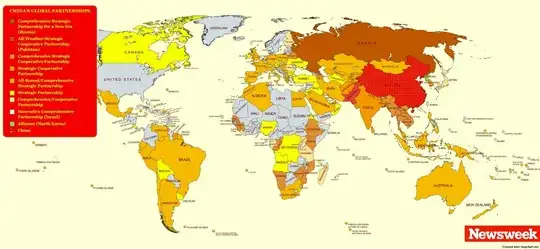
enter image description here

There are some differences compared to more detailed paper, e.g. India actually gets a unique term in the former.


sfxedit said in a comment that Russia and China do have mutual defense clause in their Friendship treaty. Well, it's not quite as explicit as the one in the China-DPRK treaty.

Compare:

The Chinese side supports the Russian side in its policies on the issue of defending the national unity and territorial integrity of the Russian Federation.

The Russian side supports the Chinese side in its policies on the issue of defending the national unity and territorial integrity of the People's Republic of China.

with China-DPRK:

In the event of one of the Contracting Parties being subjected to the armed attack by any state or several states jointly and thus being involved in a state of war, the other Contracting Party shall immediately render military and other assistance by all means at its disposal.

the gods from engineering
  • 158,594
  • 27
  • 390
  • 806
  • 1
    Voting pattern correlations could also be coincidence, unless the votes were on specific issues only relevant for China. – NoDataDumpNoContribution Aug 12 '22 at 16:21
  • According to another paper, China has made increasing efforts over time to tier their partnerships. – the gods from engineering Aug 15 '22 at 00:36
  • @Trilarion Doesn't seem likely considering there's been thousands of votes since 1971. – M. Y. Zuo Aug 24 '22 at 17:08
  • Note though that Russia and China do have a "Friendship treaty" that says they will come to each others defence if they are invaded. – sfxedit Mar 01 '23 at 22:21
  • @sfxedit: not quite that explicit, but I see that article 4 could be read that way. "The Russian side supports the Chinese side in its policies on the issue of defending the national unity and territorial integrity of the People's Republic of China." (and vice-vesa) – the gods from engineering Mar 01 '23 at 22:24
  • @sfxedit: compare to the much more clear wording in the China-DPRK treaty "In the event of one of the Contracting Parties being subjected to the armed attack by any state or several states jointly and thus being involved in a state of war, the other Contracting Party shall immediately render military and other assistance by all means at its disposal." – the gods from engineering Mar 01 '23 at 22:29
  • @Fizz It does mean that - India also once had a similar treaty with Russia. And during the Bangladesh liberation war, when the United States and the United Kingdom sent their nuclear fleet to attack India, India invoked this treaty and asked for Russian help. The Russian Navy engaged them in a stand-off near India and both UK and US backed off from attacking India to prevent a possible nuclear war. – sfxedit Mar 01 '23 at 22:41
  • @sfxedit: "the United States and the United Kingdom sent their nuclear fleet to attack India" LOL, that's pure BS propaganda. Said a lot in India these days though. – the gods from engineering Mar 01 '23 at 22:42
  • @sfxedit: there's not even a [UK] admiral called "Dimon Gordon" as that story claims. https://history.stackexchange.com/questions/14724/did-the-us-and-soviet-navies-really-come-close-to-blows-in-the-indian-ocean-in-1 – the gods from engineering Mar 01 '23 at 23:33
  • @Fizz Don't attack someone just because you are ignorant about the facts. That 8 year old link you cited clearly needs updating and is just another typical example of the western narration tilt on SE. In fact, do actually ready up on the whole Bangladesh liberation war and the now declassified Kissinger-Nixon Tape. – sfxedit Mar 02 '23 at 00:07
  • @sfxedit: I've read a lot about the tapes. They don't support your claim. – the gods from engineering Mar 02 '23 at 00:11
  • @Fizz Obviously not well enough - In the face of Soviet pushback, Nixon took an even harder line with the Soviets and used additional signals, some public and some private, to reiterate the importance of preserving West Pakistan. To increase pressure on India and demonstrate to the Soviet Union that the US was serious about West Pakistan, Nixon authorized the movement of the USS Enterprise task force to the Bay of Bengal... – sfxedit Mar 02 '23 at 00:24
  • @sfxedit: yeah, so? He even said “The Indians must not forget that the US has allied commitments with respect to defending Pakistan from aggression.” But while he said he wanted to prevent India from "secur[ing] a complete victory” he also said that in East Pakistan "the situation is rather complex and politically complicated", which is hardly a signal that he was going to to intervene there. – the gods from engineering Mar 02 '23 at 00:33
7

Unlike the USA, China isn't vocal about designating countries as its allies. However, China's allies can be discovered differently.

The following are my proposals.

  1. We can check which countries are the largest importers of Chinese arms; (also here).

enter image description here

  1. We can check which countries host Chinese overseas bases.

enter image description here

  1. We can check which countries adopted Hua Wei's 5G technology. During Trump's presidency, Huwa Wei's 5G technology was one of the USA and China's most prominent points of contention.

enter image description here

  1. We can check which countries are part of China's BRI (Belt and Road initiative) projects. There is a good reason for that. The USA didn't take BRI very well. It considers BRI a threat to Western dominance. As far as I recall, during Trump's presidency, the USA pressured Pakistan to cancel BRI projects which Pakistan refused. Therefore, very recently, Joe Biden declared a competing project called BBBW (Build Back Better World).

enter image description here

user366312
  • 1
  • 7
  • 54
  • 117
  • 2
    Meh, the last map is pretty misleading. One could conclude Estonia is more of an ally of China than Russia is. – the gods from engineering Aug 07 '22 at 05:13
  • @Fizz, I know. That is why it is kept in the last place. Also, these are all proposals, not definite conclusions. – user366312 Aug 07 '22 at 05:14
  • "China's allies can be discovered differently" Except in the case of allowing military bases, I am not sure that the rest of these criteria can qualify as "ally detectors", although I'm hard pressed to come up with a proper definition of what an international ally is or isn't. Europe continues to buy substantial hydrocarbons from Russia, but that doesn't make them allies. I agree it's a challenging question! – uhoh Aug 07 '22 at 05:26
  • 1
    @uhoh, Europe continues to buy substantial hydrocarbons from Russia, but that doesn't make them allies --- hydrocarbons are not arms. Arms sales come with political alliances and attached strings related to the safety of the technology. E.g., the USA won't sell arms to Serbia. – user366312 Aug 07 '22 at 05:31
  • @uhoh, Except in the case of allowing military bases --- Djibouti has military bases of multiple countries. – user366312 Aug 07 '22 at 05:34
  • 2
    @user366312 can you demonstrate that China only sells arms to allies and China attaches strings related to safety of the technology? Right now you're sort-of saying that China's allies are the countries who by their arms, and so countries who buy China's arms are their allies. It feels a little circular but I still upvoted because this is overall an interesting approach! – uhoh Aug 07 '22 at 06:27
  • For a long time, Chinese propaganda speaks about not allowing any foreign military to set up bases in China and will not set up bases in other nations. (scars from the "century of humiliation") So China doesn't establish bases in other nations for a long time as much because of financial reasons as domestic political reasons. – Faito Dayo Aug 08 '22 at 00:56
  • 1
    The map of military bases is misleading, as Djibouti which hosts China's only overseas military base also hosts bases of China's enemies: the USA, France, and Japan. Djibouti cannot be considered a Chinese ally, and the rest is speculation. – Stuart F Aug 08 '22 at 09:35
  • This is a lot of speculation. As a resident of Indonesia which shows up in your lists a lot, I am pretty sure neither country considers each other an ally. – Sebastiaan van den Broek Aug 12 '22 at 15:28
  • @SebastiaanvandenBroek, As a resident of Indonesia which shows up in your lists a lot, I am pretty sure neither country considers each other an ally. --- then it could be called a 2nd person alliance. When a country is in talks with China about hosting a Chinese base, purchasing arms from China, and is a partner of BRI, ... how can it not be an ally? Probably, the people don't like China, but that doesn't stop the ID government from cozying up. – user366312 Aug 12 '22 at 15:37
  • Well, https://www.benarnews.org/english/news/indonesian/training-starts-08012022085936.html would not agree with you. Leaving me to think it’s a bit risky to just guess on this topic based on a few simple metrics. – Sebastiaan van den Broek Aug 12 '22 at 17:47
  • @SebastiaanvandenBroek, Well, benarnews.org/english/news/indonesian/… would not agree with you. Leaving me to think it’s a bit risky to just guess on this topic based on a few simple metrics. --- In the case of international relations, this is called hedging. – user366312 Aug 12 '22 at 18:36
  • While buying weapons from a country indicates a certain level of trust I'm not sure it should be seen as a sign that the countries are allies. Otherwise you'd have to consider Saudi Arabia a very close ally of US and UK. – GiantSpaceHamster Mar 02 '23 at 11:02
2

This has turned out to be a complicated question and difficult to answer directly and succinctly.

I ran across this yesterday which also sheds a bit of light. The Diplomat's Editor in Chief Shannon Tiezzi published on August 13, 2022 Which Asian Countries Support China in the Taiwan Strait Crisis – and Which Don’t?

China claims that international consensus is on its side. Foreign Ministry spokesperson Wang Wenbin told reporters on August 8 that “more than 170 countries… have voiced staunch support for China on the Taiwan question through various means.” China’s supporters “form an overwhelming majority versus the US and its few followers,” Wang added.

and

On the other end of the scale, several countries – including some listed by China as among its supporters – have used rhetoric that more closely aligns with the position taken by the United States and Taiwan, emphasizing the risks of escalation over China’s claims that its sovereignty was violated. And a few countries, close U.S. allies Australia and Japan, have explicitly condemned China’s actions as destabilizing and escalatory.

and includes this graphic which shows a map of the Earth with only asian countries drawn, color indicating the degree to which they have publicly agreed or disagreed with China's stance re Taiwan, as interpreted by folks at The Diplomat.

Australia and Japan are blue meaning agree least, Russia and Myanmar agree the most, and the rest are on a spectrum in between. There doesn't seem to be much surprising here.

Asia-Pacific Positions on the Taiwan Strait Crisis on a scale of 1-5, with 1 being closest to China's position. Source: Based on research by The Diplomat

Asia-Pacific Positions on the Taiwan Strait Crisis on a scale of 1-5, with 1 being closest to China's position. Source: Based on research by The Diplomat

Asia-Pacific Positions on the Taiwan Strait Crisis on a scale of 1-5, with 1 being closest to China's position

Source: Based on research by The Diplomat, A Flourish map

uhoh
  • 16,541
  • 3
  • 76
  • 172