32

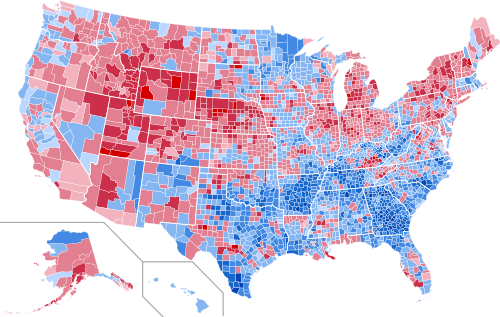
Election results and polling show that White voters in the South are the most Republican and ideologically conservative in the entire country. This is especially evident in the votes cast in counties with small Black population shares versus large ones, especially more rural ones. This also serves as a counterweight to the near unanimous Democratic support from Black individuals who are a large share of the South's population but nowhere near a majority.

I wonder why this is, and what causes it.

Number File
  • 12,103
  • 6
  • 45
  • 92

4 Answers4

61

Deep Roots

First, relative political conservatism and liberalism are remarkably stable in any given geographic area over time (even though, in absolute terms corresponding to specific policies, almost every place gets more liberal over time).

For example, even at a county by county level the 1876 Presidential election and the 1976 Presidential election look almost identical (flipping the Democratic and Republican parties, which traded places on the political spectrum in that time period). The fact that the Democratic Party and Republican Party traded places is weird, but largely just a branding issue that hides long term ideological stability.

At the state level, the relative positions of representatives of U.S. states in Congress on issues like national security, defense spending, foreign policy and social issues on a liberal to conservative scale from the 1790s are essentially the same as they are today in most cases.

Incidentally, this isn't unique to the U.S. You see ideological stability over similar time frames all over the world, for example, in regions within Germany (e.g. the modern politics of Saxony with deep historical roots and the continuing Protestant and Catholic divide in a far more secular country), Italy (e.g., between the North and the South were were united only in the 1870s), and the U.K. (e.g., differences in political attitudes and institutions between Scotland and England) associated with early modern kingdoms that predate these modern states and had not yet been fully consolidated. Outside the West, regional political differences in India, and differences in attitudes and political culture between Northern China and Southern China similarly have deep roots, as do those in Nigeria which is practically two different countries with an Islamic North and Christian/Animist South at the moment).

So, the bottom line is that the highly conservative leanings of the American South are largely legacies of the pre-Civil War slavery regime. In that environment, most of the South had free whites and lots of black slaves. The distrust between the two ran deep.

This reality is explored much more deeply, for example, by David Hackett Fischer in Albion's Seed, and by Colin Woodard in American Nations: A History of Eleven Rival Regional Cultures of North America. Also useful in understanding this sweep of American political history is Randall B. Riley, in his book, Congress: Process and Policy, the first half of which illustrates how much the federal government and its institutions were transformed from its pre-Civil War incarnations by the U.S. Civil War, and then, by the New Deal and World War II.

Little Diversity Or Disruption Due To Migration

Secondarily important is that from the late colonial era until the 1980s or so, the American South had much less immigration from outside the U.S. and from elsewhere in the U.S. than other regions of the country. So there was no one to shake up the mix very much.

This is because immigrants migrate to places that are the most economically prosperous, and that wasn't the South for most of its history.

This also means that whites in the American South, until the last 40 years or so, were extremely homogeneous culturally and in sources of ancestry.

At that time there were very few Catholics outside of Florida, Louisiana and Texas, there were almost no Lutherans, and there were very few Presbyterians or Congregationalists or Unitarians or Universalists or Jews or Quakers or Muslims or Mormons. Baptists, Episcopalians (restricted to a thin upper class), Methodists, and black Christian denominations with a shared but parallel theological origin, were pretty much it - although some rebranded as non-denominational or into splinter sects.

Some of this religious homogeneity was also because it was freshly emerged. Before the Second Great Awakening (ca. 1790 to 1840), the American South was the least religious part of the United States. This flipped at this time, with a new uniquely American style of faith emerging all at once and securing mass conversion to active, fervent Christianity. This new version of Christianity fit prevailing social attitudes at the time in the South to a "t". The Second Great Awakening "ironed out" many small ideological and cultural differences that had been present in the South between people there, before it actively embarked on uniting these folks in a common ideology and faith.

There was no significant linguistically different immigrant population and little linguistic diversity period outside old French in Louisiana and legacy Mexicans in parts of Texas. (Fun Fact: the Spanish language spoken by people native to New Mexico and Southern Colorado retains many words and language constructions from Colonial era Mexico that are no longer found anywhere else in the world.)

There were few Latinos (outside Florida and Texas). There were almost no Asians. The Native Americans who were there at the start were mostly dead, or exiled, by the time the Trail of Tears (1830-1850) was concluded.

The presence of only two very disparate cultural groups that are internally relatively homogeneous (i.e. white Southerners and black Southerners) leads to polarization.

A Narrower Range Of White Affluence Than The North

A tertiary factor is that despite our image of the South as dominated by big plantations epitomized by a home grown de facto aristocracy of plantation owners v. working class whites and black slaves in the Antebellum era, this is somewhat misleading. While there were lots of big plantations with wealthy families in them, there were almost no families that had wealth on the scale of Northern manufacturing, rail, shipping, and finance based businesses that were far more highly concentrated in wealth. The bottom also lacked the layer of dirt poor, just-the-shirt-on-their-backs new immigrants that was found among Northern whites.

During Reconstruction, many of the wealthy planter families experienced permanent or temporary total financial collapse, in part, at the hands of Northern carpetbagger financiers.

About 18% of white men in the South aged 13 to 43 died in the American Civil War (1861-1865) and Reconstruction, and many more were crippled as a result, for example, with amputated limbs.

The war destroyed much of the wealth that had existed in the South. All accumulated investment in Confederate bonds was forfeit. Income per person in the South dropped to less than 40% than that of the North, a condition which lasted until well into the 20th century. Southern influence in the US federal government, previously considerable, was greatly diminished until the latter half of the 20th century.

An effective Union naval blockade captured about 95% of the exports from the Confederate states during the war. In the short run, the war destroyed almost all 8,800 miles of Confederate railroads while the Union added about 7,300 miles to its existing 21,800 miles of railroad. The war also destroyed almost all of the South's manufacturing plants, and almost all of its cotton production, and almost all of its exports (70% of the total for the nation before the war).

(The quote is a second hand Wikipedia quote to which my link has rotted.)

The political ideology impact of the post-Civil War economic collapse in the South can be compared to the radical right influence that economic collapse in Germany after World War I in the Weimar Republic had leading to to fascism and World War II.

So, Southern whites, coming out of Reconstruction, were far more economically homogeneous than elsewhere in the U.S., which helped build a sense of solidarity.

Also, in 1860, there were about 22,100,000 people living in the Union states (only 400,000 of whom were slaves, about 2% of its overall population, of whom 340,000 were in Kentucky and Missouri) and 9,100,000 living in states that would become a part of the Confederate States of America (about 3,500,000 of whom were slaves, about 38% of its overall population). In the lowlands deep South including the Mississippi River valley, the percentage of the population that consisted of slaves was much greater.

The transition from a society where white Protestant men made up 98% of voting population to one where blacks made up 20%-50% of the voting population in particular counties and other political jurisdictions encouraged tactics of voter suppression and political unity in the face of a "common enemy" that was much more different from them than the political differences that existed among white Southerners.

Poor, Less Educated, Economically Insecure People Trend Conservative

Over all of that time, from the late colonial era to the present, the South was and remains less affluent as a whole than the North and less economically secure.

This wasn't confined to the rich either. Flush toilets and electricity for ordinary people came many decades later to the South than it did to the North too.

Literacy in the South among whites was also profoundly lower than the rest of the U.S. until long after the Civil War. A litmus test of the distinction can be seen these statistics:

In 1850…Arkansas had 97,402 white persons under twenty, and only 11,050 attending school; while of 210,831 whites of that age in Michigan, 112,175 were at school or college. Last year, Michigan had 132,234 scholars in her public common schools.

In 1850, Arkansas contained 64,787 whites over twenty, – but 16,935 of these were unable to read and white; while, out of 184,240 of that age in Michigan, only 8,281 were thus ignorant, – of these, 3009 were foreigns; while, of the 16,935 illiterate persons of Arkansas, only 37 were born out of that State. The Slave State had only 47,852 persons over twenty who could read a word; while the free State had 175,959.

Michigan had 107,943 volumes in “libraries other than private,” and Arkansas 420 volumes.

From Theodore Parker’s The great battle between slavery and freedom (1856).

And, in the long run, on average and barring intervening factors, poor, economically insecure, less educated people tend to be more conservative.

Obliquely related is that the American South was to a much greater extent a zero-sum game economy than other parts of the U.S. The South has a mostly agricultural economy until very late compared to the rest of the U.S., and almost all arable land in the South was farmed very early on.

In contrast, the Midwest and then the West allowed for win-win solutions by expanding into new territory (and displacing the Native Americans there). And, the North and Midwest also overcame the zero-sum game trap by industrializing so that agricultural land wasn't a limiting factor, an economic trend that came really a century or so later to the South than to the North.

Conservative thinking and political approaches are a better fit to a world that is a zero-sum game. Liberal thinking and political approaches are a better fit to a world where win-win solutions are widely available.

It is the liberalism of poor non-whites in the U.S., and the liberalism of whites in unions post-WWII, and not the conservatism of other poor whites in the U.S., that is the historical exception that requires explanation.

To oversimplify, poor non-whites in the U.S. are liberal because conservatism was taken by poor whites whose policies posed an existential threat to them, and working class union whites were liberal because the economy needed so many modestly skilled workers after WWII that they enjoyed unprecedented prosperity that unions helped to harness with liberal policies.

ohwilleke
  • 79,130
  • 11
  • 224
  • 303
  • 1
    A lot of good points here, but perhaps a bit overstated... In the US context, non-whites outside of coastal-urban Democratic strongholds also hold many conservative beliefs, and if not for blatant racism being the decisive factor, may well find more in common, ideologically, with white working-class Republicans than with coastal-urban Democrats of any background. Besides race, the lines of division in US politics are small-state vs big-state, due to the specific way the US constitution was designed to bring these into balance. Hence the similarity of 1876 vs 1976, with inverted polarity. – Pete W Nov 11 '21 at 02:07
  • 6
    @PeteW I totally agree that "non-whites outside of coastal-urban Democratic strongholds also hold many conservative beliefs" just as theory predicts (but still vote for Democrats for a vastly oversimplified reasons in my footnote-ish side point). I disagree that the small-state/big-state divide is a meaningful division in U.S. politics. Wyoming and Rhode Island have little in common politically. Neither do California and Texas. Small-state and big-state correlations are just the fallout from politically motivated state boundary drawing that has ebbed and flowed over time in biases. – ohwilleke Nov 11 '21 at 02:23
  • 2
    "very few Presbyterians": you seem to have overlooked the Scotch-Irish. – phoog Nov 11 '21 at 06:56
  • 6
    "county level the 1876 Presidential election and the 1976 Presidential election look almost identical (flipping the Democratic and Republican parties". Looking at wikipedia for 1876 and 1976 they actually look similar to me without flipping parties. – Dave Nov 11 '21 at 09:25
  • 6
    Yes, I was going to note the same thing as Dave. That "flipping" comment is puzzling with reference to those example years. There has indeed been a realignment of D and R, with even some politicians switching parties, but in 1976 that process was still in early stages electorally, and the old-style Democratic South was still largely intact. – nanoman Nov 11 '21 at 09:54
  • 18
    @ohwilleke urban/rural is probably the most obvious political divide outside of any identarian considerations. Texas is a sea of red with blue islands, and even liberal states like California turn a lot more conservative out in the countryside. – Crazymoomin Nov 11 '21 at 14:18
  • 1
    "This is because immigrants migrate to places that are the most economically prosperous, and that wasn't the South for most of its history." Well, the South was incredibly economically prosperous for a good 100-150 years before the Civil War... it's just that the prosperity was only among white plantation owners and the people they did business with. Southern Tobacco, and then Cotton, served the entire world. – TylerH Nov 11 '21 at 16:09
  • 5
    Great answer, but I think it's also relevant that the South is more rural. I may be biased here, but I believe my conservative beliefs are driven by self-reliance. You can hope people will help you, and help others when you can, but at the end of the day you're on your own - because the nearest grocery store is an hour away, and the nearest neighbor can be miles. – Turbo Nov 11 '21 at 16:32
  • 1
    @ohwilleke - the big-state / small-state division is more than the character of the population. It is a central structural element, via the bonus per-capita representation in the Senate given to populations of smaller population states (many but not all being inland states). This, combined with the peculiar method (combine Senators and Congressmen with 1-vote-per-state) by which the US resolves presidential elections resulting in plurality rather than a majority, makes it exceedingly difficult for more than two parties to exist in equilibrium at the national level... – Pete W Nov 11 '21 at 16:35
  • ... So, despite exceptions, the lines of argument in politics and constitutional matters often fall along whether or not a party supports redistribution of resources and various kinds of power away from coastal/urban, high population density areas; and the parallel argument of state vs federal power balance. This tendency coexists with the North/South divide, which goes back to the founding of the country. And there are very big exceptions like Texas, I take your point on that. – Pete W Nov 11 '21 at 16:37
  • @PeteW Big state v. small state, and urban v. rural are two very distinct things, and the former doesn't line up cleanly with the North v. South divide or explain differences in ideology. At most, it is an effect and not a cause. – ohwilleke Nov 11 '21 at 20:44
  • I'm suggesting that you could look at structure as an explanation for groupings, not ideology. The big state / small state divide is complex, but does have its origins in North vs South. Northern states were a bloc historically. As a bloc, they had larger population able to vote at the time the constitution was written. For this reason, the Southern states specifically required the structure being discussed in exchange for their participation in the union. Over time, the two-party division, I argue the number two is structural in origin, also took on the shape of coastal/inland &urban/rural. – Pete W Nov 11 '21 at 21:02
  • 2
    @PeteW Afroamericans tend to vote overwhelmingly democratic (80%+ iirc), regardless of whether they are coastal-urban or not. Latinos also have a strong democratic majority but not quite as extreme as Afroamericans. The other strong indicator is urban-democratic versus rural-republican. Size of the state is a marginal effect at best. – quarague Nov 12 '21 at 09:55
  • @quarague - re: African American Dem voting - as mentioned above, and it's not what I'm arguing, that statistic cannot be explained by factors other than overwhelming history of racism. Not education, not income, not religious conviction (the factors most typically cited as determining individual ideological choices). I agree completely with urban/rural. The connection to size of state is the necessity of everyone to group into just two blocs, due to the rules of the political structure. Thus alignment between urban / coastal / big-state / educated / socially-liberal. All due to structure, IMO – Pete W Nov 12 '21 at 13:44
  • thankful for this discussion to help refine how I break it down. – Pete W Nov 12 '21 at 13:45
  • 2
    I'm really rather impressed how deftly this answer avoiding talking about the area's long cultural history of White Supremacy. You know, its single most identifying feature... – T.E.D. Nov 12 '21 at 14:06
  • 2
    downvoted for "So, the bottom line is that the highly conservative leanings of the American South are largely legacies of the pre-Civil War slavery regime. " Claiming that social structure of 150y ago is relevant to present day is extraordinary claim without any evidence. – NoSenseEtAl Nov 12 '21 at 22:36
  • 4
    @NoSenseEtAl Extraordinary how? Is it not simply self-evident that, for instance, a major part of the difference in the modern histories of England and of France is down to the former having had its revolution in the mid-17th century, rather than holding off till the late 18th? The extraordinary claim would be to somehow imagine that just a few generations of time somehow lead to the total erasure of the influence of the founding culture of a region. – Kevin Carlson Nov 13 '21 at 00:59
  • 2
    @KevinArlin IIRC in 1980(only 40y ago) Singapore had GDPpc of Greece. Around 1896 Argentina and US had aproximately some GDPpc... Reagan was a governor of California in 1967... Those are drastic changes in only around 100/50 years... – NoSenseEtAl Nov 13 '21 at 08:55
  • @ohwilleke "Southern influence in the US federal government, previously considerable, was greatly diminished until the latter half of the 20th century." is an outright lie. The 3/5th compromise was abolished and even considering the death of southern men, many of these states had huge populations of slaves (more than half in the deep south in some places), and the fact that these people effectively couldn't vote due to voter suppression meant that white southern representation actually surged in congress. Also did you forget that what happened after Lincoln was assassinated? cont... – Krupip Nov 13 '21 at 18:51
  • @ohwilleke ... Andrew Johnson became acting president and stopped voting rights legislation from happening in congress. Andrew Johnson was from the opposing party due to the rules from the time. After Lincoln republicans still couldn't pass voting rights, and the US wouldn't see it for 100 years later! Don't tell people that "Those poor white southerners lost so much political power", they gained it, and continued to rob their respective states electorates and holding back the number of reps in the early 1900s at the value today. That's not a "lack of power" that's way too much of it. – Krupip Nov 13 '21 at 19:00
  • @NoSenseEtAl You really think highlighting how the descendants of the British Empire were able to industrialize and modernize incomparably more effectively than those of the Spanish and Ottoman Empires is supporting your point about the insignificance of history? – Kevin Carlson Nov 14 '21 at 17:24
  • @NoSenseEtAl Only some much supporting evidence can be crammed into an SE answer. Albion's Seed by Fischer, and American Nation by Woodard are two notable book length treatments. – ohwilleke Nov 15 '21 at 18:43
  • 1
    @Kupip It took quite a few years after the Civil War until Southern States were even re-seated in Congress. FDR's Democratic Party (which was not Southern dominated) prevailed for almost all of the Great Depression and WWII. Before that, the (then almost entirely Northern) Republicans controlled the House from 1891-1911 and 1919-1931. A Southern led Democratic Party did have control for six years after President Wilson followed Taft in 1913. But Southern influence was still weaker then, than antebellum. The South lost on giving women the vote and electing the Senate. Less power is not zero. – ohwilleke Nov 15 '21 at 18:53
  • Bringing up events of 160 years ago (the US Civil War) feels biased. There were many massive social events between now and then. Even the events close to the Civil War (such as increased use of fertilizers and laying down of train rails) were fundamental game changers. 1880: 49% of the US population were farmers. 1900: 40% of the US population were farmers. The percent of residents who were born abroad is more correlated to the universities present in those states. It's 5% in South Carolina, 8% in North Carolina, and 10% in Georgia. The Great Depression and both WW were also very impactful. – wrod Dec 01 '22 at 01:05
  • 1
    @wrod The observed fact is that the political leanings of Southern whites have been extraordinarily stable, as have the political leanings of whites in other U.S. national regions (although not quite as solidly), something that is true not just in the U.S. but elsewhere. There is a strong cognitive bias to assume that recent events have mattered more but the evidence really doesn't support that conclusion. – ohwilleke Dec 01 '22 at 01:09
  • Perhaps it would feel less bias if you presented references to such evidence in the answer. Short of that evidence, picking as the reference point that particular event, over other significant social upheavals, comes off biased. I am also not sure it's fair to call "cognitive bias" the view that the present, or immediate past, is more relevant than the distant past. I think you are onto something with the immigration, but it's more a symptom than the cause. People tend to move to where things are improving. – wrod Dec 01 '22 at 01:20
  • @wrod There are several citations in the first section. – ohwilleke Dec 01 '22 at 16:59
12

This would take a long history lesson to explain, but the basis is in three events:

  1. The Civil War (1861-5)
  2. The Reconstruction (1865-77)
  3. The Civil Rights Movement of the 1960's, specifically The Civil Rights Act of 1964

Previous to the 1960's, Southern Whites voted predominantly Democratic because Democrats supported the secession of Southern States at the beginning of the Civil War, while Republicans opposed secession and slavery.

When Lyndon B Johnson signed the Civil Rights Act of 1964, he said,

"I know the risks are great and we might lose the South, but those sorts of states may be lost anyway."2

He foresaw that the white majority in these states would move away from the Democratic party and in fact they did, as you have observed in your question.

Karlomanio
  • 1,574
  • 8
  • 29
  • 3
    "Previous to the 1960's, Southern Whites voted predominantly Democratic because Democrats supported the secession of Southern States at the beginning of the Civil War": that doesn't mean that they were less conservative. – phoog Nov 11 '21 at 07:06
  • 1
    @phoog Thanks for specifying that. I just assumed that in my answer. Political parties don't necessarily align with political ideology. Political Scientists have documented the switch between parties and ideologies throughout history. The Civil War and then the Reconstruction and then the Civil Rights movement represent these ideological shifts within the parties in the US. – Karlomanio Nov 11 '21 at 15:32
  • 3
    Indeed. It just seemed that the phrase "conservative and Republican" ought to trigger at least a mention of the fact that the two haven't always gone hand in hand, especially in an answer such as this one that considers the region's political history. – phoog Nov 11 '21 at 17:07
  • 3
    @phoog I also would like to shy away from the use of terms "Conservative" and "Liberal" because what has defined them throughout history in the US has changed. Also, the term liberal in other countries is more associated with Center right. – Karlomanio Nov 11 '21 at 18:30
  • 3
    In American political lexicon, the word "liberal" is slowly being replaced by "progressive", which is a more appropriate antonym of "conservative". The definitions of progressive and conservative don't vary with time or place, and don't imply any specific policies. Conservatism is simply opposition to change (though in practice it often involves supporting changes that would undo earlier changes). Progressivism is simply support for change (though in practice it often involves opposing changes that would undo earlier changes). – DoctorDestructo Nov 11 '21 at 21:17
  • @DoctorDestructo "Progressive" is too vague a term, imo. Change can happen in many different directions; the term "liberal" contains some implications as to which direction the change is going (generally, towards giving the previous underclass more freedom and resources), while the term "progressive" doesn't mean much more than "not conservative". – Brilliand Nov 12 '21 at 20:17
  • @Brilliand In the late 19th Century, "liberals" were not exactly in favor or the underclass getting more freedom and resources for the underclass. They believed in opening up markets and making it easier for capital to be created for privileged people. In general, for the record, I'm rather word agnostic on how to describe "left" and "right" on the political spectrum... – Karlomanio Nov 12 '21 at 22:19
5

Within the USA the political divide between Republicans (conservatives) and Democrats (liberals) is a divide between rural and urban areas. Low population density areas tend to the conservative, minimal government beliefs and perceive government programs as more of an impediment than a benefit. They tend to be more independent and self sufficient. High population density areas are much more dependent on government services and see large government programs as more of a benefit. The "blue" democratically controlled states all have large cities whose population out numbers the rest of the state. This is easily seen if you look at election results by county instead of by state.

Most "swing" voters that determine election results are from the suburban areas, not truly liberal urban areas or conservative rural areas.

As always you will be to find exceptions.

The south does not have large urban areas, nor as many. There are some exceptions, such as Miami FL, a large urban area that has a number of Cuban and Central American refugees that is very much conservative, having seen the result of leftist socialism.

Rick Smith
  • 35,501
  • 5
  • 100
  • 160
Jim
  • 542
  • 3
  • 11
  • 9
    "High population density areas are much more dependent on government services" Is this really true? rural areas received more in total per capita Federal funding ($7,473) in fiscal year (FY) 2005 than urban areas ($7,391) – Dave Nov 12 '21 at 15:09
  • @Dave - Some public utilities in cities are not in the federal budget; but city residents are dependent on those services. Those services are not always available to residents within the same county. Trash collection and intracity bus transportation, for example. – Rick Smith Nov 12 '21 at 15:20
  • 3
    Rural areas receive more state fiscal subsidies (by far) than urban areas, per capita. – ohwilleke Nov 12 '21 at 17:22
  • 8
    Much of the subsidies are for highway systems that connect cities, functionally bypassing the towns in between them. The other large subsidy is for farming, but in most cases these benefit large operations owned by remote interests and not the small family owned farms. In any case the "perception" is that rural areas receive little benefit from larger more controlling governments. – Jim Nov 12 '21 at 18:42
  • 5
    @Jim: I agree. Highways (or train tracks, or power lines, or water pipes, or any other type of infrastructure that must be built in a continuous path) will necessarily need to traverse a large stretch of rural area in order to connect big cities. Just because it's built in a rural area doesn't mean it's built for the rural area at the expense of the cities. – dan04 Nov 12 '21 at 20:12
  • @Jim That’s a great point I hadn’t thought of before. Thanks for sharing it. – Just Some Old Man Nov 19 '21 at 20:21
-3

The Democrat Party, that's why. White Democrat elites ruined the South, and they ruined the Confederate States of America (CSA). Slavery brought them great wealth - the greatest in the nation, and understand that Lincoln originally intended to go after slave-owners not by outright abolition, but through taxation. And money is all that matters to old money. There was little difference to them between the black slaves they owned and the poor white sharecroppers they owned in all but name. Instead of abolishing slavery and switching to a wage labor system, which would've brought Britain and France into the war on the South's side, the White Democrat elites arrogantly believed they could maintain an ancient practice, essentially alone, in a world that had long outgrown it, and fight a war without a sufficiently developed infrastructure (also their fault because slavery resulted in all the South's wealth being concentrated on the hands of the very few.) Totally a war of justified Northern Aggression, thanks to the idiots who fired on Sumter.

Fast forward a bit, they lose that dumb war they had no business starting at Sumter. Black people are freed. It's worth noting the first person most of them went to for a job was their former master. However, the White Democrat elites, most of whom survived the war while untold numbers of average southerners died for their greed, didn't stop their attempts at controlling both poor blacks, and poor whites. Democrats told southern whites they had to fear the free black man because the white vote would be diminished, yet their predecessors going back decades had fought in Congress to have black slaves count for political representation. So many poor whites, bitter at their defeat, fell into their sway. So we got Jim Crow, Black Codes, the KKK, etc. The first prisons, and the prison industrial complex we know today, began with the leasing by the US federal government of unjustly incarcerated blacks right back to the plantations they'd been "freed" from, right back to their former owners in some cases - now their wardens. Puts the Civil War into a different perspective, don't you think? Not about ending slavery at all, just about changing who profited from it.

Fast forward to FDR, a white Democrat elite, a segregationist, and a pretty smart racist. He succeeded in turning the American South into the closest thing there's ever been to the Socialist States of America. Yeah, the same American South that's so reliably conservative and red today. People had pictures of FDR hanging in their hall beside Jesus. He was damn good at what he did, but FDR made a mistake. He gave the South infrastructure. For all his faults and as much as I despise him, he made the South modern. He is responsible for the lake that exists a mile from my house, among many other reservoirs that were built to control flooding and allow for more efficient farming of things besides cotton. The mistake in this, which FDR would not live to know of or regret, was that he ultimately is responsible for the economic and social diversity that made the Civil Rights Movement possible.

I'd be happier to go into greater detail if you'd like, but said movement would not have been possible in a pre-modern south, and would have ended with either most blacks or most whites in mass exodus to other regions of the country, far more than what we historically observed. So the Civil Rights Movement starts up in the South. For years, the prevailing sentiment most whites shared was that which was embedded in them, socially conditioned in them by their democrat elites for generations since the civil war - including during the administration of FDR. Fear of blacks drove most southern whites into the Democrat's arms, but many whites -now less isolated than they once were, and socially more exposed to black culture and black music - came to support the civil rights movement, and it became something of a counterculture among southern whites. This created all kinds of problems for the democrat party. They went to such extremes as orchestrating Tulsa in their efforts to maintain control.

Along comes Lyndon Baines Johnson. Most brilliant racist in American History. He once said "keep a white man worried about how deep a black man is in his pockets, and keep a black man worried about how deep a white man is in his pockets, and neither will care how deep the government is in both their pockets." LBJ realized that like slavery, like the pre-Napoleonic war CSA officers thought they'd fight and win, Democrats were hooked on an outdated method the world would no longer allow them to profit from. So he decided it was time for Democrats to control black people more subtly, time for their control to evolve with the times. His intention: gradually gain control over blacks using welfare. Keep them poor, keep them dependant. He is where that pattern truly began. While most democrats voted against the Civil Rights Act (this is what happens when you socially engineer hate in people for generations) he managed to get enough of them on board for the Act to pass. And in the coming years, his vision came to pass.

The lie of the Republicans and Democrats "flipping" is nonsense. Philosophically and functionally, and in their respective goals, both parties remained the same, they simply each changed their methods. In the generations that followed, the Democrats traded their white base for their growing and more promising black base. As a result of Democrats losing power in the South, the South finally became less and less racist. My parents saw the last of segregation, watched it die. From the time that I and every other southerner my age frost started pre-school, we were all together, white and black, and every color in between. We were taught at home and at school that we are equal, and with no political party capitalizing on and creating racial strife, it all stuck. The only thing for over a century and a half that kept the South hateful and divided traded us for the Northeast and the Left Coast. Today, most white southerners vote against Democrats, but not necessarily for Republicans, if that makes sense.

White Southerners do not understand how so many black people could settle for financial dependence on the party that once enslaved them, and oppressed them for decades after. And of course Democrats tell the black voter that it's the white's fault they need welfare to begin with - yeah, white Democrats elites' fault. They tax and spend and tax and spend, and the ghettos on the other side of the railroad tracks never get better policing or a new park, the government housing never gets renovated, and white southerners, wise to the Democrat's act, are naturally very opposed to it. They see white liberal democrats, not black people, as being too deep in their pockets. I hope this provides you with some insight about why we think what we think, and where it all comes from.

Some relevant books you might benefit from reading are: Ever is a Long Time, W. Ralph Eubanks - Redneck Liberal, Chester M Morgan - The Field of Blood, Joanne B Freeman - The Second Founding, Eric Foner - Revolt of the Rednecks, Albert D Kirwan - American Capitalism: A Reader, Louis Human and Edward Baptist (specifically the modules concerning the Pre-Civil War Economy of the South/FDR/The New Deal)

Alan_M
  • 17
  • 1
  • 1
    Welcome to Politics. While this is a long answer that addresses the question, it currently lack referencing. Without references it's very hard for someone who's not an expert on the subject to tell whether statements are based in fact or whether it's just a nice story. I also noticed you used a few expletives, we don't normally allow those so I'll edit them out. – JJJ Jan 27 '22 at 20:43
  • Forgive my initially overly-passionate response and the expletives, thank you for performing a few edits. I'm a US History major, and a Southerner personally, and this post is a mix of both academic material I was taught and personal interactions with relatives now dead. I trust my accredited professors, and leave the fact checking to the fact checkers. The OP asked why White Southerners vote so reliably republican, and the breadth of my post was necessary to give the OP context. In summary, White Southerners don't vote reliably republican, they vote reliably against democrats they despise. – Alan_M Jan 27 '22 at 21:43
  • 2
    Though you may trust your professors it can be hard for others to trust you on your word, especially on the internet. Let's look at it this way, if you professors wrote a paper or gave a presentation then surely they'd reference sources to back up their claims. When discussing a divisive topic where different people may be working of different facts, references are needed to convince others. – JJJ Jan 27 '22 at 22:02
  • I make no attempt to convince anyone of anything. The OP asked why white southerners vote they way they do, and as an educated white southerner, I can only tell them why I and many others I know feel that way. It is entirely possible that anyone could act on a false belief, but act they do, and believe they do. If the OP seeks an entirely fact-based answer as to why people believe the things they choose to believe, they'll never get a straight answer. I can't cite lectures from 2019 or 2020, I could list some books that explore these topics in greater depth, which I pulled from in my post. – Alan_M Jan 27 '22 at 22:35
  • If the OP or any reader encounters anything I've written and wishes to put it to scrutiny, I challenge them to research it, and come to their own conclusion, just I have – Alan_M Jan 27 '22 at 22:41
  • 1
    Yes, that's mostly what I meant. Most of your answer is based on history, so some references to back up those claims would go a long way. Pointing out that certain paragraphs are based on specific books helps as well (if indeed that's the way your text is structured). – JJJ Jan 27 '22 at 22:48
  • You offer a quote from LBJ, but Google only turns it up here. If it comes from your memory, then it's a game of telephone. Even if it is a correct quote or substantially correct, sourcing matters; informal quotes like this are rarely recorded, usually coming from people years later who may have reasons to misquote. Context and dating also matter. – prosfilaes Jul 11 '23 at 02:07
  • "Democrats told southern whites they had to fear the free black man because the white vote would be diminished, yet their predecessors going back decades had fought in Congress to have black slaves count for political representation." Yet implies a contradiction, whereas increasing the South's power by counting non-voting slaves is entirely consistent with stopping black people from voting. – prosfilaes Jul 11 '23 at 02:38