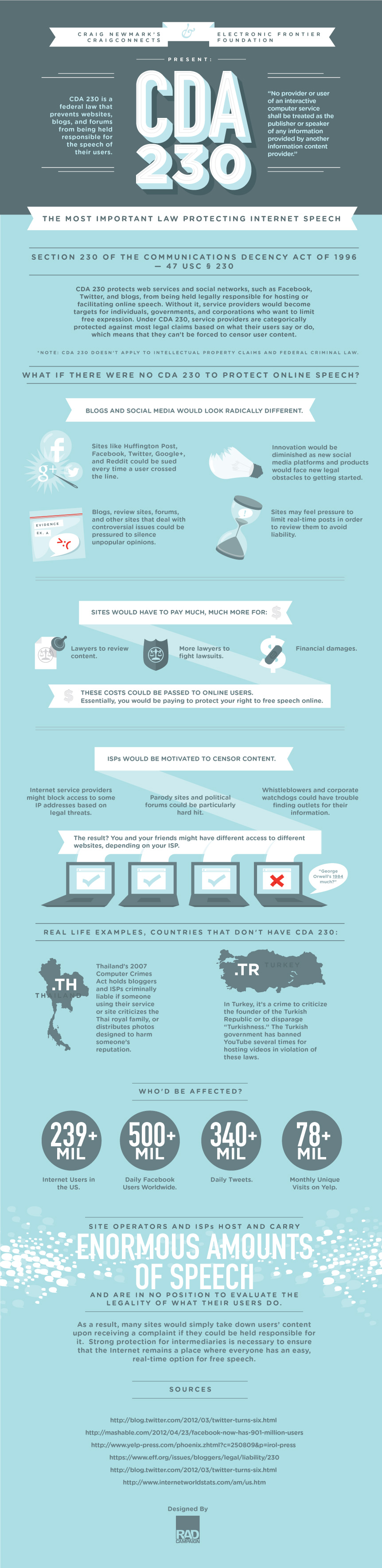
One legal pathway that has been proposed (ironically, on Twitter) by Republican Senators Marco Rubio and Josh Hawley is some sort of review of Twitter's protections under section 230 of the Communications Decency Act. Subsection (c) of this section states:
(c) Protection for ''Good Samaritan'' blocking and screening of
offensive material
- (1) Treatment of publisher or speaker - No provider
or user of an interactive computer service shall be treated as the
publisher or speaker of any information provided by another
information content provider.
- (2) Civil liability - No provider or
user of an interactive computer service shall be held liable on
account of -
- (A) any action voluntarily taken in good faith to
restrict access to or availability of material that the provider or
user considers to be obscene, lewd, lascivious, filthy, excessively
violent, harassing, or otherwise objectionable, whether or not such
material is constitutionally protected; or
- (B) any action taken to
enable or make available to information content providers or others
the technical means to restrict access to material described in
paragraph (1).
This section means that Twitter's actions are protected by law. Rubio, however, makes the argument that Twitter's actions confirm their role as a publisher, which he argues means they should no longer receive the protections conferred by this Act:
The law still protects social media companies like @Twitter because
they are considered forums not publishers.
But if they have now decided to exercise an editorial role like a
publisher then they should no longer be shielded from liability &
treated as publishers under the law.
Hawley makes a similar argument, referring to the Act's provisions as a "sweetheart deal".
And @Twitter is getting subsidized by the federal government for
that interference in the form of special immunity worth billions. Time
to end #BigTech sweetheart deal w/ government
It should be noted that Hawley has made similar arguments before, for example in April, when he called for a third-party audit of the platform's suspension policy.
The initial pathway open to Trump, then, at least as proposed by certain Republican Senators, seems to surround either the repeal of this part of the Act, or some sort of argument that due to Twitter's adoption of an 'editorial role' in attaching the warnings to Trump's tweets, that the legal protections detailed above should no longer apply to the website.
If Twitter no longer benefitted from the protections it currently enjoys under the provisions of Section 230, the website could itself become legally responsible for any illegal content posted on the site by its users. The EFF has published an infographic with more information on Section 230, including the statement that sites could be sued every time a user posted objectionable material.