55

I know there's a lot of discussion at the moment of the EU introducing new "right to repair" regulations to try to reduce waste.

I was recently told that this is effectively a reversal of existing policies and that EU regulations have actively prevented such activity on electrical devices, meaning small traders etc could only recondition, not repair (e.g. replace whole circuit boards, not fix individual components).

I've searched for such a rule without success. Does anyone know if this definitely exists and, if so, where I might find the details?

David Fulton
  • 699
  • 1
  • 5
  • 8
  • 112
    Most EU rules are misreported, especially in the English-speaking press. – pjc50 Feb 07 '19 at 13:01
  • I suspect this is an example of such misreporting, but I'd like to know the facts. – David Fulton Feb 07 '19 at 13:08
  • 17
    There are some rules, typically set up by the individual states, which tie commercial repairs to some kind of ability verification. For example, in Germany, you need a "Meistertitel" to be able to open a shop that repairs cars or high-voltage electrical equipment. Historically this has been the case for many crafts; it has been dropped for most by now, but stays in place for those that have safety concerns. Other states have similar laws. But they typically don't forbid repair in general, they do forbid commercial repair by people who can't provide proof of qualification. – Guntram Blohm Feb 07 '19 at 16:45
  • 4
    Another factor is electrical safety testing, i.e. UK PAT. Somebody commercially repairing and even selling used electrical goods needs to have a qualified person test and certify the device. – user71659 Feb 07 '19 at 17:39
  • 1
    H&S was cited as the reason (details were vague), but it was a qualified electrician who was telling me this. Is there any reason why a qualified person could repair an appliance and be blocked from PAT testing? – David Fulton Feb 07 '19 at 17:42
  • 1
    Why is this on Politics SE instead of Law SE? (Edit: I've flagged the question for moderator attention to migrate.) – Wildcard Feb 07 '19 at 22:54
  • 1
    @pjc50 I'm not disputing that some are misreported but have you got any evidence to prove that most are? Or that this is more prevalent in the English-speaking press? (for example it is, perhaps, important to note that a wider spread of critics will be English speaking so perhaps the same level of misreporting in all press but more English speaking ones are picked up on) – Lio Elbammalf Feb 08 '19 at 11:02
  • 1
    The usual source is Euromyths: https://blogs.ec.europa.eu/ECintheUK/euromyths-a-z-index/ ; I've not been able to find corresponding ones for non-English Euromyths, although some must exist. The Daily Express' unique disregard for facts is not something that's found in most continental media. – pjc50 Feb 08 '19 at 13:31
  • 3
    This myth could be misreporting of ROHS. It was aimed at eliminating lead in waste, but making the devices immediately less reliable and harder to repair was a side-effect. Both the metallurgy and hobbyist equipment have caught up since, and the ROHS-gap is mostly closed now. – Agent_L Feb 08 '19 at 14:36
  • @Agent_L could you elaborate on the ROHS impact? – David Fulton Feb 08 '19 at 17:13
  • If anything, the difficulty of getting anything repaired smacks like a marketing thing originating from the US, where huge corporations rule and recyclers weep. For example, it's been progressively more difficult to get spare parts for a computer in need of a few. I know, I know, Lenovo is not really an American company. It's just that I first encountered this drive to make people buy new things instead of fixing old ones when living in the US. Sorry, if I offended someone. It just sounded silly to pick on EU here. – Jyrki Lahtonen Feb 08 '19 at 20:41
  • 4
    @DavidFulton ROHS banned lead in solder (although not in other products such as lead flashing and car batteries, making the whole thing pointless IMO). The lead-free solder requires higher temperatures and tends to suffer from early failure with "tin whiskers". – pjc50 Feb 08 '19 at 22:25
  • @LioElbammalf speaking as an American, I can tell you anecdotally that deliberately misleading descriptions of EU regulations in our media are extremely common, and I would say that the average person will be exposed to more completely invented nonsense than factual descriptions. – barbecue Feb 10 '19 at 01:31
  • @barbecue Sure, I'm not disputing the fact they are misrepresented - I've seen that myself - only the two claims that "most" rules are and that this is more prevalent in English speaking press. – Lio Elbammalf Feb 10 '19 at 07:09
  • @pjc50, I'm not sure how justifiable it is to call the Daily Express' disregard for facts "unique". Wasn't the origin of euromyths Boris Johnson's column in the Daily Telegraph? – Peter Taylor Feb 11 '19 at 11:13
  • I think what you were told was incorrect. The "right to repair" rules are in response to manufacturers making it virtually impossible (through how its designed and engineered) for anyone to do maintenance, if so inclined, on their own property themselves or though a non-official-manufacturer repair professional, from what I've read. – PoloHoleSet Feb 11 '19 at 23:04
  • While acknowledging that anti-EU sentiment exists, and that some of those people have propagated false claims about the EU, I wouldn’t expect the people behind a consumer right movement to be particularly biased against the EU. – Golden Cuy May 11 '20 at 04:07

6 Answers6

89

No. There is no regulation that prevents a citizen from repairing themselves any kind of electronic device. The problem is that there is also no regulation that requires electronics companies to provide documentation or standardization of parts for the repair of these devices.

This means that your company (let's say a company making TVs) can obfuscate access to their device by using unique proprietary parts (that only they produce). This has been in discussions for years particularly due to some manufacturers doing planned obsolescence (which is worth its own analysis).

The EU proposal "right to repair" is following a world trend (the movement in US is even stronger) and it requires manufacturers to provide adequate conditions for third parties to repair the devices.

Currently this has been enshrined in EU law (which is positive) but somewhat watered down (see this article):

Everyday products including lighting, displays, washing machines, dishwashers and fridges will need to be made to be more easily repairable and longer-lasting from April 2021.

...

However, campaigners have criticised the new laws for limiting access to most spare parts and repair manuals to professional repairers only. This may restrict the access of independent repairers, repair cafés and consumers to some key replacement parts and information, limiting the availability and affordability of repair services, they said.

Campaigners blame strong pressure from industry lobby groups for prompting the European Commission to water down proposals on repairability in favour of recyclability.

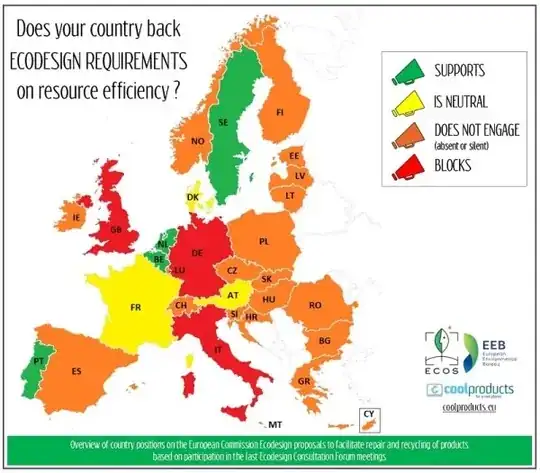
This was not totally unexpected since the EU members with large industries were against the proposal (see this article):
enter image description here

The European Commission has put on the table proposals to make it easier for consumers to have certain products repaired instead of having to buy new ones. They would trigger substantial environmental benefits by reducing waste and unleashing the potential of job creation in the sector, according to Chloé Fayole from ECOS, co-leader of the Coolproducts campaign, who attended the discussions. “At the moment, consumers are forced to discard products, as repair is made impossible or unaffordable.”

According to their statements during the meetings, Germany, Italy and the UK are currently blocking the proposals, while France, Poland and Spain are either completely disengaged or have adopted a neutral stance. Because of the high weight their votes carry, the proposals are likely to be dropped from the agenda if their positions are not challenged.

armatita
  • 5,467
  • 15
  • 31
26

I don't think there's any one law or regulation that does this. Instead, we have old laws being used in new ways. While the Electronic Frontier Foundation is in the US, they describe the problem as this

[U]ntil it breaks and you want to fix it yourself (or take it to a local repair shop you trust). Or you think of a way to make it work better that requires tinkering with the software (or some third party does). Or you want to give it to a friend or re-sell it. Then, you have a problem. Why? Copyright.

Further complication: the software may come with digital locks (aka Digital Rights Management [DRM] or Technical Protection Measures [TPMs]) supposedly designed to prevent unauthorized copying. And breaking those locks, even to do something simple and otherwise legal like tinkering with or fixing your own devices, means breaking the law, thanks to Section 1201 of the Digital Millennium Copyright Act.

And then there’s manual lockdown, which happens when manufacturers refuse to publish crucial repair information (including the manuals themselves, but also things like diagnostic codes for cars)—and then threaten to sue anyone else who tries to do so with a lawsuit for copyright infringement.

Most of these laws exist in Europe and manufacturers have learned that copyright laws are an effective tool in ensuring that only the original manufacturer (and their hand-picked repair shops) can repair a device. And some companies are getting even more aggressive with restricting repairs

Users who have had a screen repair performed by a third party, rather than with Apple, on their iPhone 8 smartphones found that the iOS 11.3 update stopped the touchscreen from working, reports Motherboard.

The screens continue to display the homescreen once updated to iOS 11.3 but cannot be interacted with, effectively rendering the affected iPhone 8 device unusable without warning from Apple.

The real problem is software is being used in more and more products, which means that copyright laws meant to protect software and its manufacturers are now being used to create monopolies around entire ecosystems. So you need a law to specifically address this usage, as opposed to repealing one single law.

Machavity
  • 48,310
  • 11
  • 131
  • 209
  • 1
    This is interesting and provides a useful background, but I don't think it covers the specific scenario I was asking about. The above would also block component replacement (such as screens), whereas the example I was given allowed such replacement, but not replacing a resistor on a PCB (for example). – David Fulton Feb 07 '19 at 13:40
  • 3
    @DavidFulton The copyright restrictions means you can't reproduce a manual that would describe how to do that. Copyright takedowns are permitted in Europe. Furthermore, EU law makes it a legal minefield to reverse engineer how to do that. – Machavity Feb 07 '19 at 13:44
  • 1
    Right, but hypothetically, if I took my multimeter and discovered that capacitor X was faulty, wouldn't I be able to fix that? I've not reverse engineered the device, or written any documentation. – David Fulton Feb 07 '19 at 13:48
  • 4
    I think in that case it's more a warranty problem than a copyright problem. Most warranties vanish as soon as you alter the device (so people don't screw around with them). But this also leads to the fact that as soon as you repair your product all warranty claims vanish. If the device is build to be defective when you try to repair it, you don't have any legal claims against this. – miep Feb 07 '19 at 13:53
  • 3
    @DavidFulton The simple answer there is that the law is murky on that point. In theory, the answer should be a definitive "no", but there's enough legal play that you could still be sued and have to defend yourself in court. Even if you did prevail, you're out those legal fees. A clearer law would disallow the suit from proceeding in the first place. – Machavity Feb 07 '19 at 13:54
  • @Machavity "...once updated to iOS 11.3 but cannot be interacted with, effectively rendering the affected iPhone 8 device unusable without warning from Apple." So Apple was sued in a court of law, correct? – paulj Feb 08 '19 at 15:06
  • 1
    @paulj I don't know about lawsuits but Apple was fined in Australia for that – Machavity Feb 08 '19 at 15:09
  • +1 - I've heard about car manufacturer that used copyright law to prevent 3rd parties from providing car mirrors for their cars. Mirrors was easy to break away and a steady stream of income. Plus, 3rd party ones was half the price or so. – Mołot Feb 11 '19 at 11:37
  • @Machavity "Even if you did prevail, you're out those legal fees" - That is true in the US, but not the UK. In the UK, the loser (usually) pays both sides' legal costs. I don't know what the situation is in other parts of Europe. – Martin Bonner supports Monica Feb 11 '19 at 15:26
  • @MartinBonnersupportsMonica: also in Germany, the loosing side has to pay for both sides' legal costs - unless there wasn't a court decision because the mediation came out with a solution which typically has each side cover their costs. Of course, the time you had to put in is gone in any case. – cbeleites unhappy with SX May 10 '20 at 19:25
  • @miep: not only does the warranty vanish, but also some liability for the safety of the repaired device is on you (which is fine with me as long as I repair my own stuff - but there are decided limits to what I'll repair for other people). Or the local repair shop who may decide that the risk is not worth the money they can earn with such repairs. It may also be their liability insurance that tells them this... – cbeleites unhappy with SX May 10 '20 at 19:27
9

I think you missinterpreted the term in this context

right to repair

It is not the case that the EU forbids repairs, it is meant the other way round: As Machavity in his answer said, the companies making it really hard for consumers to repair their products. The "right to repair" should give the consumers the right to fix and repair broken products, without companies (looking at you, Apple) prohibiting/hindering them.

Sadly I can't provide you with the sources you ask for, but I'm certain this issue is either in the EU-law to copyright or in the EU-law to warranty.

miep
  • 980
  • 5
  • 20
2

There are certainly regulations that can be misused by a hostile OEM in such a manner against independent, commercial repair services:

  • safety regulations - one could argue that someone repairing an undocumented device cannot ensure it to be safe. Or that a device that has been modified by a repair that uses alternative or custom made spare parts forfeits safety approvals that are documented for/on the device

  • trademark regulations - one could argue that a modified (as above) device still bearing the original manufacturers trademark misrepresents that manufacturer's brand

  • environmental, patent, liability etc laws that would equate to a barrier to market entry if you were to build such a device from scratch - these might be applied to a modified device too....

rackandboneman
  • 389
  • 1
  • 9
0

AFAIK there is no such law. But in addition to other points covered in other answers there are also safety and liability regulations that have side effects such as making repairs more difficult (or expensive) than they'd need to be because the producers fear liability.

Source of this is a workshop on CE certification I took at our chamber of commerce where we were told:

  • that a producer of a tool is liable for its safety both wrt. to intended use and also to misuse that suggests itself (even if the instructions explicitly warn against that misuse).

  • that we should avoid to reveal the internal safety documentation or detailed plans of the tool/machine/instrument/...: In case a work accident happens the work accident insurance or the company where the accident happened will of course try to get the liability to the producer of any tool involved with the accident.
    If the plans and/or safety documentation is available to the other side in such a court case, they have all the time to pick whatever they think are weak points in the producer's safety analysis - while the producer doesn't even know yet they should prepare for litigation, and have no previous insight into the accident.

    In other words, the exact plans and documents that would help to make safe repairs create a legal risk for the producer.

  • that giving detailed plans of the internal workings of the product e.g. in the manual may make (potentially unsafe) attempts to repair by "laypeople" a misuse that suggests itself.

  • OTOH, weird "safety" screws or glueing the case so that it cannot be opened without obviously destroying are seen by some producers' legal departments are means to discourage repair attempts and thus make sure repair is a type of misuse that does not suggest itself and that thus has a much lower liability risk.

  • Another related side effect is: assume a company replaces their, say, power drill because they think it more economical to not squeeze out the last 10 working hours and have it break down at a construction side. Now while that power drill is certainly not new any more, it may be a perfectly sensible and safe tool for someone to get for their home workshop. But: the company is legally responsible that the tool is in a safe condition if they hand it on, unless it is given away as broken. But just saying "broken, use at your own risk" is legally not sufficient. What is recognized as sufficient is if the tool is obviously broken. So, instead of putting in the money to get it safety stamped again, they cut off the cable, and then hand it on hopefully without legal risks.

  • The work put into the internal safety documentation is basically the same whether you sell a million or 3 pieces of that product. Meaning that small series are very expensive. Repairs, particularly repairs that don't replace parts with replacement parts from the manufacturer can also make the repairer legally producer of the repaired product. Meaning that they have more liability (and would need to put in paperwork to prove safety) - which makes such repairs uneconomic for e.g. the electrician around the corner.

  • The same applies to repair documentation: if a producer puts repair instructions into their manual, they must be safe to follow. I.e. they must put in the work to make repairs safe even in an environment they cannot control (as opposed e.g. to their own production/repair facilities where they can better enforce procedure to make the work safe).
    This is certainly possible, but the question is: will sufficiently many consumers honor that by paying the correspondingly higher price?

0

In Sweden at least one reason for far less repair of small appliances and stoves/etc is the requirement that repair should be done promptly.

The understanding is that it is the seller which is responsible against the customer so what should a supermarket do with a broken shaver for example (the customer is encouraged/expected to take his broken shaver to the seller.)

Have their own people to repair it or use a 3rd part work shop ? Can they (the own workshop or the 3rd part's) have the parts ready ?

Back to the first point: repair/returns should be done promptly (the understanding now is three days) which is an liability for the seller who has the obligation against the customer) so is the seller able at all to send things away to another supermarket there they have a repairman or a 3rd part workshop, all this while, remember the requirement that repair should be done promptly.

Hint: Philips had/has a supply center in the Netherlands which usually could supply the work shop with parts at midday next day if the order was received before 12 day before. This worked while UPS did their thing smoothly.

One big problem : costs. The work shop really wants payment for at least half an hour so every guarantee repair now costs AT least 24 euro minimum.

Says the repairman (repaired/sold shavers,coffe makers, stoves and heating pumps over 30 years.)

Stefan Skoglund
  • 342
  • 1
  • 10