Using Open Project (or MS Project, i suppose), in the following example:
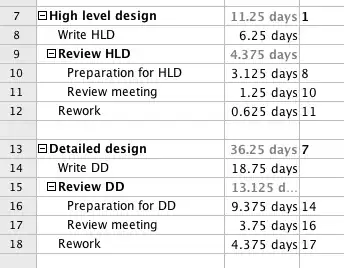
- does #13 depend on #7?
- does #14 depend on #7?
- does #13 depend on #12?
- does #14 depend on #12?
Or does it matter at all? Please assume waterfall
7,9,13, & 15 are "Summary Tasks", or "Roll-Up" views. They're combinations of other tasks (9 is the sum of 10,11,12, and 7 is the sum of 8,10,11,12), not tasks in and of themselves. So no, they would not have predecessors.
12 is a task, and can have a predecessor.
So for your questions -
No. 14 would follow (depend) 8. Both 13 and 7 are summary tasks.
No. 14 would follow 8. No 13 is a summary task.
No. 14 would follow 12. 13 is a summary task.
Yes. See above.

And to add to Trevor's explanation, you have both hard predecessors and soft predecessors. A task can have a finish start relationship because the first task MUST finish before the second begins. That is hard logic. But you can also have the same logic based on a resource constraint or other scheduling logic. That would be considered soft logic.
Every leaf level task or package should have a predecessor-successor relationship somewhere in the schedule. No task should be orphaned. That way, your ability to manage a critical path or two will not be compromised.

