1

Students commonly wonder about the near-analogies between electricity & magnetism. One in particular:

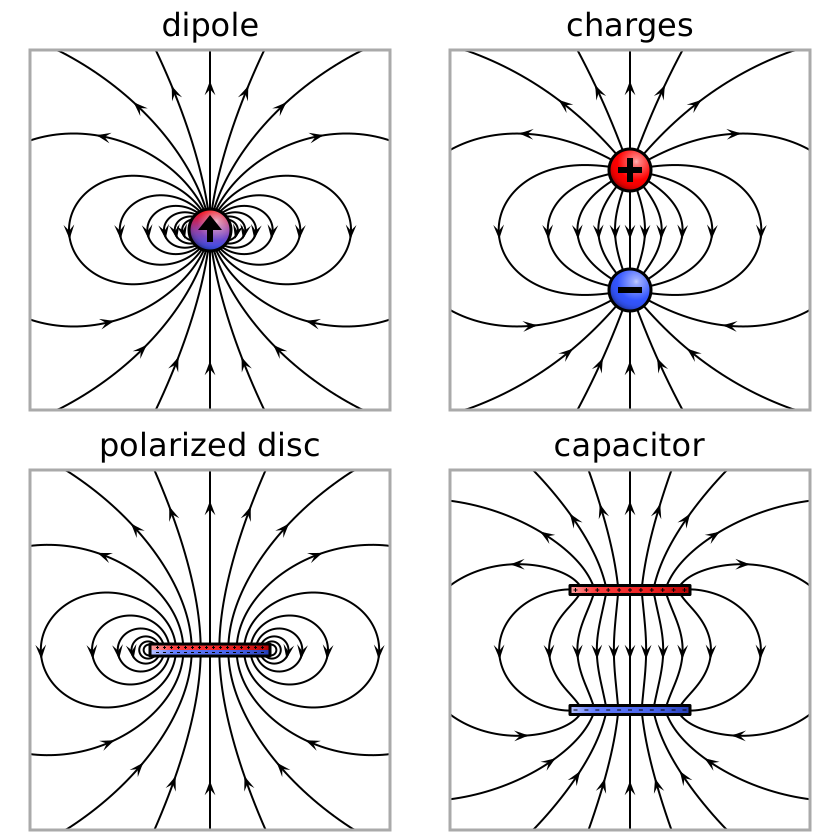
Polarization $\mathbf{P}$ and magnetization $\mathbf{M}$ are the infinitesimal densities of electric and magnetic dipole moments ($\mathbf P = {\mathrm d\mathbf p \over \mathrm d V}$ and $\mathbf M = {\mathrm d\mathbf m \over \mathrm d V}$). Flux lines exit the positive end of electric and magnetic dipole vectors the same. Yet $\mathbf{P}$ and $\mathbf{M}$ have the opposite effect on the total (= fundamental = free + bound charge) fields $\mathbf{E}$ and $\mathbf{B}$. Why is the $E$-field lessened by parallel electric dipoles, while the $B$-field is greater when it induces parallel magnetic dipoles?

Qmechanic
  • 201,751

1 Answers1

2

Because you chose the pair $\mathbf E,\mathbf B$ instead of the pair $\mathbf E,\mathbf H$ and because you assume magnetically paramagnetic or ferromagnetic medium.

If the medium is diamagnetic (copper, bismuth), then its magnetization due to external field decreases $\mathbf B$ inside.

If you want to talk about iron or steel, those are ferromagnetic, external field induced magnetization increases field $\mathbf B$ inside. But it decreases field $\mathbf H$ inside.

So there is no general relation/analogy, the relation between external magnetic field $\mathbf B_{ext}$ and medium-induced field $\mathbf B_{ind}$ depends on the kind of material medium.

  • 2
    Note the parallel between a "diamagnetic" material and a "dielectric," in terms of the relation between the vacuum field and the polarization of the material. – rob Mar 27 '21 at 22:36
  • This is just a restatement of the question, not an answer. I explicitly chose $\mathbf{M}$ parallel to $\mathbf{B}$ (i.e. paramagnetic) because it’s analogous to $\mathbf{P}$ parallel to $\mathbf{E}$. Both represent dipoles parallel to the external fields E & B. I chose E & B because these fundamental quantities include the effects of free and bound charges/currents. – alexchandel Mar 28 '21 at 02:13
  • My question is why dipoles have opposite effects on the respective total (free + bound) fields. – alexchandel Mar 28 '21 at 02:15
  • @alexchandel So really you just want to understand what the electric field of a dipole is? – BioPhysicist Mar 28 '21 at 08:37
  • @alexchandel Field $\mathbf H$ isn't any less fundamental than field $\mathbf B$. They differ by density of magnetic moment, which is an objective physical quantity. – Ján Lalinský Mar 28 '21 at 16:56
  • @alexchandel In paramagnetics, $\mathbf H$ behaves like $\mathbf E$ does in dielectrics. In diamagnetics, $\mathbf B$ behaves like $\mathbf E$ does in dielectrics. – Ján Lalinský Mar 28 '21 at 16:59
  • But other accepted & highly voted answers say $\mathbf{E}$ and $\mathbf{B}$ are a pair, and more fundamental at the microscopic level. I know $\mathbf{B}$ is reduced in diamagnetics, but the question (I've heard) is why $\mathbf{m}$ parallel to the external $\mathbf{B}$-field results in an increased field internally, while $\mathbf{p}$ parallel to the external $\mathbf{E}$-field results in a decreased field internally. – alexchandel Mar 28 '21 at 18:59
  • 2
    @alexchandel that is a common sentiment with very little justification for it. In electrostatics both $\mathbf D$ and $\mathbf E$ depend on all charges, the simple equation $\nabla \cdot \mathbf D = \rho_{free}$ does not mean $\mathbf D$ does not depend on bound charges. In microscopic theory, there is no point introducing 4 quantities, 2 are enough, and by today convention these are chosen as $\mathbf e,\mathbf b$. If you read older books like Lorentz' Theory of electrons, he uses $\mathbf d,\mathbf h$ in microscopic theory. His results are correct; these are just conventions, preferences. – Ján Lalinský Mar 28 '21 at 20:34