Is the weight of the aircraft flying in the sky transferred to the ground? Is the weight of people swimming in the pool also transferred to the ground? How can we prove it?
Asked
Active
Viewed 8,917 times
59


-
25“How to prove it?” Put a beaker partly full of water on a beam balance. Balance the system. Float a cork. Observe how the balance behaves. Try it again but this time lower a dense object in on a string, not letting it touch the bottom. – dmckee --- ex-moderator kitten Dec 13 '19 at 23:49
-
21@dmckee The plane is not in the sky with buoyancy. – enbin Dec 14 '19 at 05:30
-
4@enbinzheng I was always wondering whether the overall volume of affected air around the airplane plus the airplane itself is not, in fact, as dense as the air surrounding that volume (there is a volume of lower-density air above the wings); since pressure differentials are the only thing which can lift anything, in the end. – Peter - Reinstate Monica Dec 14 '19 at 11:33
-
@Peter-ReinstateMonica When the lamp is hung on the ceiling, its rope is also pulling force. – enbin Dec 14 '19 at 16:00
-
3@enbinzheng Well, anything suspended in a fluid. – Peter - Reinstate Monica Dec 14 '19 at 16:26
-
@Peter-ReinstateMonica "since pressure differentials are the only thing which can lift anything, in the end." Planes get their lift from air leaving the wings with a downward component. – Acccumulation Dec 14 '19 at 17:00
-
3The increase in pressure on the ground due to a plane of mass $M$ flying at an altitude of $h$ is approximately $$P = \frac{2 M g h^4}{\pi (h^2 + d^2)^3}$$ where $d$ is the distance on the ground from the point directly below the plane. – Count Iblis Dec 15 '19 at 04:05
-
2@CountIblis I've never seen that formula before. From where did you find this? Also, I'd like a lot to see your comment transformed into an answer, if it is not much trouble for you. – Physicist137 Dec 15 '19 at 14:28
-
@enbinzheng - "The plane is not in the sky with buoyancy." Actually in most regards, it is. Air is just as much a fluid as water is, and this question could just as easily have asked about an airship. – MikeB Dec 16 '19 at 11:45
-
1This article describes the actual measurement of the weight of an airplane flying over: [https://www.knmi.nl/kennis-en-datacentrum/achtergrond/het-wegen-van-een-vliegtuig-met-een-microbarometer] Unfortunately in dutch, but there is google translate. In short: the formula as mentioned in other comments was proven valid, measured by an infrasound array with barimeters at Greenland, below a landing aircraft, type Dash 7. The article refers to the bird analogy as mentioned in an answer below. – Roland Dec 16 '19 at 12:52
7 Answers
52
Is the weight of the aircraft flying in the sky transferred to the ground?
Yes, at approximately the speed of sound.
Is the weight of people swimming in the pool also transferred to the ground?
Yes
How to prove it?
The swimming one can be quantitatively proven with a kitchen scale. Weigh an object that will float. Fill a bowl partway with water. Weigh it without and then with the object.
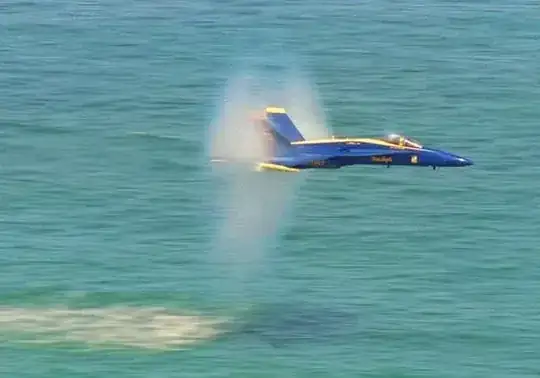
The airplane one can be qualitatively seen in pictures of aircraft flying low over water.

Dale
- 99,825
-
11The illustration isn't quite convincing to me. A closer analogy to the object floating in water is an object floating in the air, a balloon, and there will not be visible waves from the balloon floating over the ocean. – SE - stop firing the good guys Dec 15 '19 at 23:11
-
Hmm, I never claimed that the two situations were analogous. I am not sure why you think that they should be. – Dale Dec 15 '19 at 23:29
-
-
13Sound is a pressure wave, so pressure waves travel at the speed of sound. The pressure increase on the ground cannot increase instantaneously, but rather must propagate as a wave from the aircraft and that wave moves at the speed of sound. – Dale Dec 16 '19 at 00:48
-
10If you have a small drone, you can also hover it over a kitchen scale and see that it shows the same weight as if the drone was sitting directly on the scale. – functionpointer Dec 16 '19 at 08:31
-
-
So if I have to transport 1 ton of budgies and only have a 0.5 ton truck, I can't safely transport them by having at least half of them constantly flying around the truck's load box? – Dec 16 '19 at 16:31
-
4@Jeeped see https://www.youtube.com/watch?v=lVeP6oqH-Qo for a quick version of the MythBusters episode where they tested this – Dale Dec 16 '19 at 16:40
-
1@Jeeped I immediately thought of that old joke too! In reality, though, assuming that the back of the truck is more or less closed (not airtight, or the budgies are in trouble!) then the budgies' weight would be transferred to the floor of the truck. If it was an open cage then the pressure wave could pass through, and some of that weight would thus transfer to the road outside the truck. So, with a tall enough truck and big enough gaps in the cage, it might actually work. – anaximander Dec 16 '19 at 16:43
-
1While I agree that the weight must in fact be transferred to the ground, the problem with the picture is that it only shows that there is a disturbance (it's impossible from the picture to really measure how much displacement is occurring) and furthermore only for the case where the aircraft is close to the ground. – Michael Dec 16 '19 at 17:16
-
@ Dale, actually, the pressure that builds up underneath the wing is not transferred to the ground at the speed of sound. It's the reaction force to the pressure under the wing is only the momentum increase of the downwash behind the wing – Apfelsaft Dec 16 '19 at 20:35
-
1While the image is really cool, it's not as conclusive as it's supposed to be: The plane in the image is obviously flying at supersonic speed, the low-pressure zone behind the shock wave is highlighted by the typical fog cone. So, what's seen on the water surface is actually the disturbance of the water after it has been hit by a really close-by sonic boom. And while it's undoubtable from the picture that the plane's energy is transferred to the water surface, it's not obvious that there is actually an additional downwards net force that's acting on the water surface. – cmaster - reinstate monica Dec 16 '19 at 23:00
-
@Jeeped It's no problem. It's like you let the pigeon fly back to its nest. You don't need a truck. The problem is that you close the budgies in a big box and let them fly. You transport the big box. – enbin Dec 17 '19 at 00:58
-
@Michael and several others, hence my “qualitative” characterization. It is not intended to show quantitatively that the force is equal to the weight, only that there is a force, which is clear from the photo – Dale Dec 17 '19 at 02:33
34
If the planes flew higher, to avoid air friction and at much greater speeds, they would orbit, and no weight would be transferred to the ground.
But at 900 km/h, the centripetal acceleration (V$^2$/R) is about 0,1% of g. So its weight is 99,9% transferred.
The weight of floating objects on water is obviously transferred. Just put lots of ice on a water jar to verify.

Claudio Saspinski
- 16,319
-
28Note that while the weight of the plane is transferred, it is spread over a very large area beneath, so the pressure difference at ground level is negligible. – WorldSEnder Dec 14 '19 at 20:11
-
1In the orbital case there absolutely is a force between the vehicle and the ground, but what is fun is that while in low speed, level, atmospheric flight the aerodynamic forces balance the gravitational ones, in orbit we wind up with only the gravity in play, so the vehicles mass pulls the earth towards it, as it is pulled towards the earth, but there is no counteracting aero force, it is just going fast enough to keep missing the planet. Thus the orbital case is actually the one with the net forces between the bodies, the atmospheric flight has everything cancel. – Dan Mills Dec 15 '19 at 11:38
-
@Dan Mills You are right. The gravitational force between earth and a orbit object can be measured through its effect on the acceleration of both bodies. But it is not transferred to the ground in the usual meaning of the expression. If the plane could really accelerate closer to an orbit velocity, the atmospheric pressure would decrease in the process. – Claudio Saspinski Dec 15 '19 at 16:26
-
3@WorldSEnder is it possible to approximate how large of an area? based on airplane height? (and speed??) – Aequitas Dec 16 '19 at 00:35
-
2Am I making a math mistake? 900km/h = 250m/s. Earth radius = 6,371,000m. I get the accel at 0.1% of g – Mars Dec 17 '19 at 03:04
-
12
Yes the supporting force is ultimately transferred to the ground, for a theoretical "proof" (=calculation) one would likely employ the concept of control volume in fluid dynamics, and calculate the momentum balance and pressure balance around the surface of the control volume.
Airplane in stable horizontal flight:
In simple terms, the pressure distribution around the airplane (mainly the wings) generates the lift, while at the same time pushing air downwards, to satisfy the momentum balance. This in itself is enough to provide lift.
The downwards directed airstream will gently flow towards the earths surface and excert a pressure increase there, because there it will get redirected, hence applying the same lift force on the ground.
For an airplane flying at high altitude, this airstream will be dragging surrounding air with it due to friction inside the airspace, and hence widen up. Since the momentum is conserved, the larger the moving mass, the slower the velocity will be. By the time this air flow gets redirected on the ground, it's a large mass at low velocity, so the pressure increase for redirection will be very low, and wide spread out.
For a low-flying airplane, the airstream directed downwards is significantly more concentrated, leading to a higher pressure increase on the ground. (key word "ground effect", and the things visibly in the picture of the F18 seen above.)
Buoyancy of a swimmer in a pool:
This is somewhat simpler - no need to check momentum balances. The ground will have to support everything that's inside the pool, otherwise the pool would accelerate towards earth center. As analogy, you could put a pot with water ("model of a pool") on a scale, and then add an apple ("model of a swimmer"), and check what the scale shows in the two cases.

Apfelsaft
- 298
-
3
-
7
-
@Peter-ReinstateMonica Suppose there is an airplane that does not use buoyancy, but uses lift to fly in the water. – enbin Dec 14 '19 at 17:36
-
4@enbinzheng The "plane" pushes down on the fluid (water, air, metallic hydrogen) under the wing. That's what lift is. – Draco18s no longer trusts SE Dec 14 '19 at 18:03
-
4@enbin zheng, buoyancy also provides lift. The difference to heavier-than-air vessels is that the lift is "dynamic". And that airplane would be a "water plane" then.. (seriously - that exists and is called hydrofoil) – Apfelsaft Dec 14 '19 at 21:40
-
@enbinzheng : See also hovercraft, which more obviously produce lift by accelerating air downward, and ground-effect vehicle which less obviously produces lift by the interaction of downwardly directed air with a nearby surface. – Eric Towers Dec 14 '19 at 22:55
-
-
Since we're taking about the fluid dynamics, doesn't the air that is pushed downwards also push outwards? Meaning some of the weight would be transferred not to the earth, but to the sides instead. – Mars Dec 16 '19 at 05:31
-
@enbinzheng there is very little difference between an entity "flying" in air and an entity "flying" in water, the reason we tend to use lift to fly in air and buoyancy to float in water is because water is orders of magnitudes more dense than air, so displacing an amount of water to create the required up force is significantly easier than displacing a required amount of air (see airships and hot air balloons for the in-air submarine equivalent). You could quite easily create a submarine out of lead, stick wings on it and "fly" it through the water with similar mechanics... but why would you. – James T Dec 16 '19 at 10:44
-
@Trotski94 Only flying in water can be compared with flying in the air. A ship is different from an airplane. Ships use buoyancy. Airplanes do not use buoyancy. – enbin Dec 16 '19 at 11:53
-
4@enbinzheng Indeed, and the only reason ships use buoyancy and planes use lift is because buoyancy is a function of the displaced mass, and with the density of water being significantly higher than the density of air it is far easier to displace a required volume of water for a given lift requirement than it is to displace a required volume of air for a similar lift requirement. This is a key reason we mostly use buoyancy for water and lift for air. Blimps/hot air balloons rise through the air using buoyant forces, hydrofoils rise in water using lift. The fluid doesn't care. – James T Dec 16 '19 at 11:57
-
@Trotski94 Will a plane flying in water transfer more force than its weight to the ground? – enbin Dec 16 '19 at 12:23
-
@enbinzheng No, it is the same as if flying in the air. Air and water are both fluids, and similar mechanics apply. – James T Dec 16 '19 at 12:52
-
@mars Yes, air is actually being "pushed out sidewards" from underneath the wing, but since the momentum is not directed downwards, it doesn't add to the lift. As a side note, (#1) this air - at the wing tip - will evolve into what's called wing tip vortex, and (#2) is the reason for induced drag. – Apfelsaft Dec 16 '19 at 20:25
-
@Trotski94 You seem to be right. But if an underwater plane flies close to the ground, does it exert more force (or impact) on the ground? – enbin Dec 16 '19 at 23:05
-
@CarlBerger The air you push downwards doesn't move straight down like a laser. It was part of the lift, – Mars Dec 17 '19 at 00:09
-
1@enbinzheng no, think of the air deflecting off the wings as a spotlight or torch pointing downwards. If you point a torch at the ground from your knee height, the beam of light is very concentrated and easy to see, if you shined the same light from the top of the empire state building you probably wouldn't even be able to see the light pattern on the ground the cone of light has spread that far, but the same number photons are still hitting the ground, its a similar principle with the deflection of air from the wings (or water, if you were under water) – James T Dec 17 '19 at 08:20
-
@Mars - only the overall resulting airstream downwards will provide lift upwards, regardless of all the quirks this air has been through beforehand. That's the point of a control volume analysis. – Apfelsaft Dec 21 '19 at 00:07
8
This seems like an application of Newton's Third Law: For each action there is an equal and opposite reaction.
The airplane flies because the air beneath it exerts an upward force on the wings. There's also a downward force from the air above, but the wing shape takes advantage of Bernouli's principle so that the upward force will be greater. The net force is upward, and must be equal to the aircraft's weight when cruising or rising at a constant upward velocity (it will be greater when it's accelerating upward).
Therefore, the wings are exerting a net downward force on the air below it of an equal magnitude. And each volume of air similarly exerts force on the volume below it, going all the way down to the ground.
In effect, the column of air below the plane acts like enormous stilts connecting the plane to the ground.

Barmar
- 1,037
-
1The lift force and the the weight force (m*g) are also equal during constant climb or descent. Otherwise the airplane would undergo an acceleration in the direction of the lift (could be e.g a turn) – Apfelsaft Dec 14 '19 at 21:46
-
-
2Stick to Newton and leave superstition out of it. The wings push the air down so the air pushes the wings up. To push the wings up the air must push the ground down. – Paul Smith Dec 16 '19 at 00:04
4
Flying Aircraft
Logically: the aircraft is supported by reactions with the surrounding air; the air is supported by the ground, so yes, the weight of a flying aircraft is transferred to the ground. Although winged aircraft fly due to aerodynamics, interactions between air molecules ultimately represent the weight of the aircraft in their interactions with the ground. The closer an aircraft is to the ground, the more localized the effect (there is a noticable downwash as an aircraft passes over); the higher its altitude, the more it diffuses out. This is a twist on the "birds in a truck" riddle.
Swimmer
Does the weight of the water in a pool transfer to the ground? Obviously yes.
If you added an amount of water to a pool equal to the weight of a swimmer, would that added weight transfer to the ground? Obviously yes.
If you add a swimmer to a pool, why would you treat the addition of their weight differently? You don't.
So, yes, the weight of a swimmer transfers to the ground. However, as water is a fluid, the weight isn't applied directly under the swimmer; it is evenly distributed over the entire bottom surface.

Anthony X
- 4,084
-
If the pool is of a type that has a constant water level, the swimmer displaces some water from the pool and the water equivalent to their weight is transferred to the overflow tank. – Jasen Dec 15 '19 at 04:51
-
1@Jasen Okay, so some water moves to an overflow tank, but this distracts from the key point: the swimmer's mass becomes part of the mass of the pool's contents thus contributes to the water's overall weight, thus is represented in the forces applied by the water to the bottom surface of the pool. – Anthony X Dec 15 '19 at 15:59
2
Airplane Shell
Let's do a thought experiment: what if we increase the number of planes in the air until they blot out the sky1? If pressure transmitted to the ground is not holding them up, then what is? Does the air itself have some kind of magical inertia that allows it to suspend planes without themselves transmitting the force? Does the density of this magical air matter? Could we thin out the atmosphere and still maintain this "airplane shell"?
Let's do just that. Let's put all the planes on the ground, and cover the surface with runway, so the planes are rolling around on their wheels. Do we agree that the ground is holding them up? Now, let's gradually add air until they lift off. Note that as their speed increases and they generate lift, the suspension will hold up less and less of the aircraft weight. Where does this lift come from, and what is it pushing against? The wheels are pushing against the ground, so if the air isn't also pushing against the ground, you need to invoke some magic to tell us what the air is doing differently than the wheels to counteract gravity.
Ground Effect
Now, it turns out that the lift near the surface does something special, called ground effect. This increase in lift is so pronounced that entire vehicles have been built to take advantage of it. One of the largest such "planes" was the Russian-built ekranoplan. @Dale's dramatic picture of an F-18 skimming the ocean looks awesome, but doesn't directly imply ground effect, because we know these jets can fly at tens of thousands of feet. Whereas, the ekranoplan couldn't even get 100' into the air, because it is completely dependent on ground effect, which is the increased lift from air pushing against a nearby surface (like the ground, usually).
Escape
Now, if you got a big metal plate and tried to float it in a swimming pool, if the plate exactly fit the surface of the pool, then the water should be able to hold it up. But what if the plate didn't exactly fit the shape of the pool? Or what if it had a hole in it? Well, obviously, it would sink, and water would spurt up every opening it could find. Huh.
So let's think about this for a minute. Gravity is pulling the plate down, along with the water. And the water molecules are kind bouncing around near each other mostly not going too far2. But when the plate-with-a-hole begins to sink, we don't just have metal pushing on water pushing on ground. We also have metal pushing on water, pushing on a water jet that shoots upwards, opposite of the plate's direction of travel!
Now technically, the falling metal plate is not directly accelerating any water molecules upwards. Rather, the plate is increasing pressure on the water beyond the gravitational weight, and the water molecules simply escape through whatever free path they can find. The fact that liquids don't hold their shape allows them to convert the downward force of the plate into an upward force on some of the water molecules. So, even though most of the weight of the plate is being transmitted by the water to the bottom of the pool, some of it is actually causing water to escape from the pool.
In the same way, if our "airplane shell" were "floating" on our atmosphere, but were not air-tight, then some of the lift would actually go towards forcing the air between the cracks, and accelerating it away from earth. So even though most of the force must eventually get to the ground to support the weight of the airplanes, the slippery nature of gases ensures that we cannot direct all of the lift exactly downwards.
Note: all of the weight of the airplanes must be ultimately transferred to the ground, or they will not be able to maintain level flight. However, the "weight" of the airplane also causes forces to be transmitted in all other directions as well, including upwards.
Notes
1 Let's ignore the fact that there isn't a feasible flight path for all those planes, assuming straight and level flight, or that they don't perfectly tile the surface of a sphere, or that aerodynamic effects would prevent them from flying so close together, etc. Just pretend they are spherical cows.
2 If they were going far, you would notice them as currents, although, diffusion of dye in the pool should show you that a single molecule could make it all the way across the pool eventually, just from Brownian motion.

Lawnmower Man
- 2,434
1
Short version: the weight of the atmosphere, the oceans, and everything in them presses on the earth. This includes the plane, whether flying or not.

WGroleau
- 369
-
If the swimmer is swimming, will he have more pressure on the bottom? So the bottom is put on more weight? – enbin Dec 14 '19 at 22:21
-
If I go into the ocean, there is immediately ninety kilograms transferred from the land to the ocean. – WGroleau Dec 15 '19 at 02:25