Try weaning her onto more solid foods.
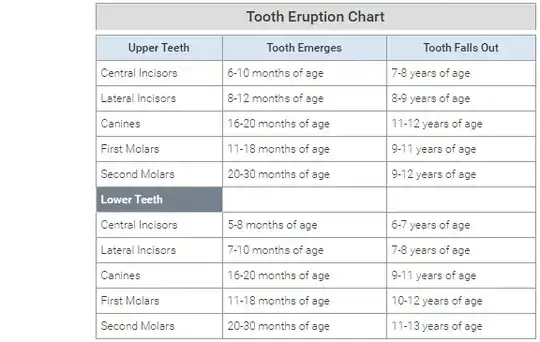
Her teeth are just coming in, and depending on how she was fed before, chewing my be an acquired skill. I'm no pediatrician, but if your daughter uses teething methods ("chewing" or gumming the food) on the pureed foods and you haven't introduced many "solids" into her diet, she may not be comfortable with chewing quite yet.
My suggestion would be to try and introduce larger pieces of food into her diet at a gradual pace to try and develop her chewing skills. Weaning her off of gumming may be the result as more of her teeth comes in, as she may not quite be used to grinding her food just yet.
Some three and four year olds can be still learning to chew and grind effectively.
This seems to be a common occurrence for children up to 4 years old, and
as long as the textures are not too difficult. Certain foods should either be carefully monitored or avoided completely to remove any choking hazards.
Textures are very important for introducing foods. Most babies prefer to start with softer, smoother textures and gradually move toward thicker foods. Firm foods, especially round foods, slippery foods and sticky foods are choking hazards. To avoid choking, don’t offer the following foods to children under 4 years of age:
- Popcorn
- Peanuts
- Nuts and seeds
- Whole grapes, cherry tomatoes
- Whole kernel corn
- Olives
- Hot dogs
- Hard, raw fruits or vegetables such as apples, celery and carrots
- Chunks of meat or poultry
- Sticky foods, such as peanut butter, which can get stuck in the back of the mouth
- Hard candy, gum drops and jelly beans
It's possible the food is too large for her, and she is having trouble chewing it. Try cutting the foods she's given into smaller pieces, and be aware when she's avoiding certain foods, as she may be relating them to a food she doesn't like.
For toddlers and preschoolers, chop grapes, meat, poultry, hot dogs, and raw vegetables and fruits into small pieces (about ½ inch or smaller).
In general, just try to get her to eat on her own with a bit of dietary help from you. Try making sure she always has options to eat healthy things that she likes to eat and give her plenty of freedom to explore new foods she'd like to try. An idea is to take her shopping, and let her pick something (healthy is preferred) that she wants to try. Make it a bonding experience, and show her that her hunger is up to her. She'll learn eventually that not eating is bad for her, and that it really doesn't feel good to be hungry.
I hope this helps, and if she doesn't begin eating more solid foods after quite a time, it may be something for therapy or a second opinion could help.



Speech-language pathologists typically do the following:
Evaluate patients’ levels of speech, language, or swallowing difficulty Identify treatment options Create and carry out an individualized treatment plan that addresses patients’ specific functional needs Teach patients how to make sounds and improve their voices Work with patients to develop and strengthen the muscles used to swallow Counsel patients and families on how to cope with communication and swallowing disorders"
– WRX Jan 04 '17 at 22:03