16

I went camping last trip and my nice inflated pad... deflated. I always carry a patch kit but I discovered another issue: I couldn't find the leak. The leak was small. It took quite a while of me lying on it for the pad to deflate. I as not able to locate the leak in order to patch it.

How do you locate a small leak in an inflatable sleeping pad?

Mr.Wizard
  • 9,506
  • 1
  • 38
  • 76
Russell Steen
  • 32,121
  • 23
  • 131
  • 274
  • This in no way answers your question, but also check the manufacturer, some patch holes for free. – MaskedPlant Oct 05 '12 at 20:02
  • 1
    If you don't already practice this (many don't), never use your inflatable pad directly on the ground if you want it to remain leak-free. Use it only inside of a tent or in a hammock. Trust me. – montane Jan 17 '13 at 04:28
  • A note on this -- I have, as a result, completely abandoned the use of inflatable pads. If a leak springs it's nigh impossible to find in the back country. This leaves me with a flat pad and at risk for hypothermia. – Russell Steen Oct 29 '13 at 19:45
  • 1
    @RussellSteen - Yeah, I don't blame you at all. I don't personally use an inflatable pad, even though they do have many advantages. However, they're biggest disadvantage is much greater than any negative of a foam pad. If memory serves, I had a friend once get his pad punctured from a splinter even inside of a shelter on the A.T. – montane Feb 28 '14 at 10:34

3 Answers3

13

Sometimes you don't have a place to submerge your pad to find leaks, or it's just too cumbersome to do so. Here is a method for leak-finding that can be done at home or in the field:
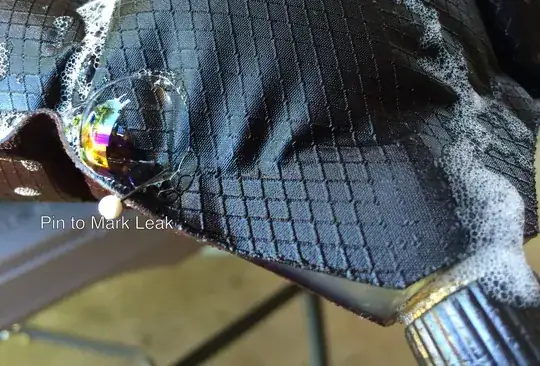
Photo of soapy pad with pin in leak (Note the location: in a crease that is repeatedly stressed, being by the valve. Also note the difference between bubbles from suds and the bubble from the leak.)

  1. Fill a squirt bottle, spray bottle, hydration bladder (something with a nozzle to control the flow) with water near to the top.
  2. Add several drops of liquid soap (dish detergent works best).
  3. Wet your fully inflated sleeping pad with the mixture.
  4. Look for bubbles forming to isolate the leak(s).
  5. Carefully mark the location of the leak with a needle/pin (you've got to fix the leak anyway) as you will lose it as soon as you rinse the soapy water away. You may try a grease pencil or china marker but not much else will write on a soapy wet surface. (Note that a grease pencil or china marker can leave residue which can impede adhesion of the patch. If you use one of those, make your reference marks outside of the range of where the patch will go. A pin or needle is best.)
  6. Rinse the area to be patched of the soapy water.
  7. Let the pad dry and follow your procedure for repairing the leak!

I've had to use this method several times and it always works. Be systematic about it so you can keep track of what you've checked. Usually leaks occur on the bottom of your pad, or they could be at a failing seam, so target those areas first. Also you might have to refill the bottle once or twice before you find the leak, depending on the size of the pad and just how lucky you get. If you're mix isn't sudsy enough, add more soap.

montane
  • 5,575
  • 7
  • 43
  • 68
  • 1
    I actually like this answer a lot better. I'm tall and have a long pad which is quite difficult to submerge in a our household bath. – Russell Steen Jan 18 '13 at 14:16
  • 1
    Glad it helps! I work at an outdoor camp and we have a lot of inflatable pads for the backpacking program, and this is the method I usually use. The dunk method is great, but it's sometimes hard to differentiate between bubbles that just happen because they cling to the pad, or bubbles from the actual leak. – montane Jan 18 '13 at 20:11
  • I have a recommendation for an edit, you suggest china markers or grease pencils, i cannot agree. If you fix a inflatable toy, that may be ok, but if you have a inflatable raft or something which essentially carries your life. NEVER use greasepencils/chinamarkes, because these leave grease on the surface which can cause failure of your repair. otherwise nice answer – Jeredepp Jul 30 '13 at 13:53
  • @Jeredepp That's a great point that I failed to mention. I never meant to actually mark with one of those under where the actual patch would go, but rather to make reference marks pointing to the hole if a pin or needle is unavailable. Thanks for bringing this up cause it's important to make a proper patch on anything! – montane Oct 29 '13 at 10:02
12

Take a bath.

Fill the bath tub with water and the pad with air, and put the pad underwater (if it's too big to all go under at once, check section by section). You should see bubbles coming out of the leak.

Kevin
  • 5,338
  • 4
  • 33
  • 50
  • 1
    Smart idea! ingenious! – studiohack Oct 05 '12 at 21:26
  • 1
    Awesome answer! Now I just have to ask the right question. – Russell Steen Oct 05 '12 at 22:05
  • Takes me back to my childhood, when a similar technique (using a bucket, not a bath) would be used to find the puncture in my bike inner-tube – Andrew Oct 22 '12 at 05:55
  • 1
    A similar solution exists if you have no place to dunk your pad. Fill a squirt bottle or spray bottle with several drops of liquid soap (dish detergent is great), fill the rest with water and spray it on your inflated pad until you can isolate the leak by the bubbles forming. You can usually rule out the top as the location but not always, and you may have to refill your bottle a few times until you find the leak. I've had to use this method before, and while not ideal, it works. – montane Jan 17 '13 at 04:23
  • @manoftheson I think that's different enough you should post it as an answer. – Kevin Jan 17 '13 at 14:22
  • Cool deal. I added it. – montane Jan 18 '13 at 02:29
  • 2
    If you are camping when you realize there is a leak, a lake makes a good bath substitute. – Kate Gregory Nov 03 '13 at 15:38
  • @manoftheson this is a good option for a toy, but depending on the material, this can destroy your equipment. – Jeredepp Jan 24 '14 at 07:05
  • 2
    @ Jeredepp - Can you elaborate? I'm not sure how a little liquid soap and water will destroy any inflatable sleeping pad that I've encountered. They do require periodic cleaning after all. – montane Feb 20 '14 at 05:20
2

In the past I have filled the sleeping pad with water to find leaks.

  1. Fill pad with water
  2. Leave it outside so that the outside of the pad dries off (you may need to flip it over at some point, to dry both sides) There will be a persistent wet spot near the leak, where the pad won't ever dry off. (You can slightly pressurize the pad as normal if necessary, but usually filling it with water is enough.)
  3. Once the leak is found I mark it with a sharpie
  4. Empty the water out
  5. Dry the outside of the pad
  6. Repair the leak (Seamgrip works very well in my experience)
  7. Wait for the repair to cure, reinflate the pad, hang it so that the remaining water collects near the deflate hole, then drain that water,
  8. Repeat that step a few times until there isn't any water left.

This works very well to find the leaks, but it is a lot of work, and the pad can get mildew inside if you're not fastidious about drying the inside. To be honest the soapy water method sounds better to me, because of how much work this method is, but I'm posting this anyways because of how reliable I've found it. It has worked for me every time, and I've fixed a bunch of holes in our pads with this method. It can also be done while camping, if you have access to enough water.

nmr
  • 121
  • 2