An extract taken from Exploring Piano Classics - Technique by Nancy Bachus
May I ask why must it be shorten?
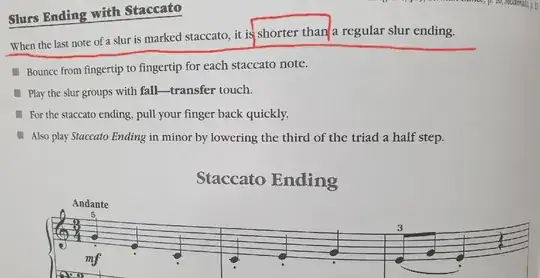
Why wouldn't it be shorter? A slur means to connect ending of one note and beginning of the next note under it seemlessly, so it states nothing about the ending of the last note it connects to. A staccato dot talks exclusively about the ending of a note, shortening it. The difficulty of this exercise lies in not changing the character of the beginning of the last note while still making it end early.
A dot meaning staccato says the note it refers to is played about half as long as is normally would be played for.
Where that note is in the music is inconsequential. It's the note itself that is affected. The fact that it happens to be the last note of a phrase - then play that note as written. The slur itself is played exactly as it would except the last note is shortened.
True, the length of a staccato crotchet is around a quaver in sounding length, so a quaver and a quaver rest could have been written, so it's somewhat up to the player's discretion, but obviosly it's a shorter note than it would normally be. I can't see the point in pointing it out...

The important thing to realize here is that none of the examples in Nancy Bachus's books are what the composer wrote, or what was in the first published edition (except by pure coincidence).
They are what Nancy Bachus thinks the composer ought to have written, and how Nancy Bachus thinks the music should be played (and reading the book may leave you will the wrong impression that there is only "one right way" to play any piece of music).
The OP didn't ask "what did slurs and staccato dots mean" (which is trivial to answer) but the more intelligent question "why do that, in the particular example." And the only answer to the second question is "because Nancy Bachus says so".

