8

I'm trying to read an old handwritten German document from 1835 which describes the range of the newly invented tuba.

enter image description here

It says:

die Bass-Tuba hingegen 4 reine Octaven durch die chromatische Scala, und zwar vom eingestrichenem, bis zum Contra C, zurückrechnet.

When I run this through a translator, I get:

the bass-Tuba, on the other hand, calculates 4 pure octaves through the chromatic scale, from the bow down to Contra C

My troubles here is with "eingestrichenem" which could translate to "bow", but if I play with it a little, I also get "cross" or "paint". What octave is this referring to?

A similar phrase appears a little later in the same document.

enter image description here

This says:

Alle Bass-Blaseinstrumente als: 1) das englische Basshorn 2) der Serpente, (beide in einem Umfange von höchstens 2 1/2 Octaven brauchbar, und zwar vom kleinen G bis zum großen C, zurrück) und 3) die Baß-Posaune (in einem Umfange in 3 Octaven und zwar vom eingestrichenem C bis zum großen zurrück, konnten den fehlenden Contra-Bass nicht ersetzen, welchen die Harmonie-Musik nöthig bedurfte.

or in English:

All bass wind instruments as: 1. the English bass horn 2. the serpent, (both usable in a range of a maximum of 2 1/2 octaves, from small G to large C, back) and 3. the bass trombone ( in a range of 3 octaves, namely from the bowed C back to the big one), could not replace the missing contra bass, which harmony music needed.

In this sentence, they describe "small G to large C" which I think (thanks to this answer) describes G4 (middle of treble clef) to C3 (middle of bass clef), but I'm still not sure about "eingestrichenem C" or "bowed C".

Divizna
  • 2,454
  • 1
  • 5
  • 17
Stewart
  • 851
  • 4
  • 10
  • 1
    If you're curious about the English bass horn, I found one at The Met museum – Stewart Jan 10 '24 at 09:22
  • I’m voting to close this question because it's not about music, it's about translation (and might even belong on German SE). The offered translation is wrong. Correct would be "... namely from c' back to C ...", and then the question becomes one about identifying Helmholtz notation, and that's already been answered on numerous other questions here. – PiedPiper Jan 10 '24 at 12:24
  • 1
    And by "Helmholz notation" I mean "what is now known as Helmholtz notation". – PiedPiper Jan 10 '24 at 12:33
  • 5
    @PiedPiper i disagree. Although in the strictest terms it's a translation issue, the question bears direct relevance to (the history of) music theory, so is of specific interest to music theorists as opposed to linguists. – Aaron Jan 10 '24 at 16:06
  • 2
    @Aaron Even if it's of music-theoretical interest, any question that is answered with an explanation of Helmholtz pitch notation is also a duplicate. – PiedPiper Jan 10 '24 at 16:27
  • 2
    I didn't bother weighing in earlier, but I also feel it's on-topic, since it's so important but inobvious (at least, maybe, to those not experienced in German literature of the period). We have explanations of Helmholtz on here, but no other instances of the word eingestrichenem. – Andy Bonner Jan 10 '24 at 16:59
  • 1
    @PiedPiper It's a terminology question, no different from any other we get in which the answer involves a translation and/or the history of the term. The explanation of Helmholtz is secondary a secondary matter and could be replaced with a link without changing the fundamental answer to "what does this musical term mean?" – Aaron Jan 10 '24 at 18:44
  • 1
    @AndyBonner Unless you're learning German you don't need to know the word "eingestrichen". – PiedPiper Jan 10 '24 at 19:48
  • 1
    @PiedPiper What I mean is, seems like if you're going to read this document or material like it you do. I would understand a reference to c1, but without this question I would not have understood a written-out reference like this one, and while its use is probably a bit delimited, it seems important to music history. Akin to any other question linking a convention that's commonplace today to some less-known way of indicating or referencing it. – Andy Bonner Jan 10 '24 at 19:51
  • 1
    @AndyBonner Of course it's an important piece of musical history so it deserves to be translated well, there's probably one somewhere on the internet. If the document had been properly translated then this question would never have existed. Normally I would have corrected the translation, but the mistranslation was the whole point of the question. With a good translation the question becomes a duplicate. – PiedPiper Jan 10 '24 at 20:16
  • 3
    I think the mistranslation came about this way: on string instruments "gestrichener Ton" means a note played with the bow (arco, as opposed to plucked pizzicato). The literal meaning is stroke with the bow. This is a similar word to "eingestrichen" meaning a stroke on the paper next to the note name, which has actually a completely different meaning. It is just the sort of misassociation a large language model would make, though it's utter nonsense for somebody actually playing an instrument. – leftaroundabout Jan 11 '24 at 10:15
  • It seems with many notable German composers that this question should be on-topic as related to music. Many words have jargon specific meanings. For example, "work" means something very specific to a physics student that is quite different than (or at minimum, extends) its ordinary meaning. In theory, walking horizontally does no work in the physics sense (neglecting air resistance and friction) whereas a partial vertical walk (such as going up stairs) does work against gravity. – JosephDoggie Jan 11 '24 at 22:59

3 Answers3

9

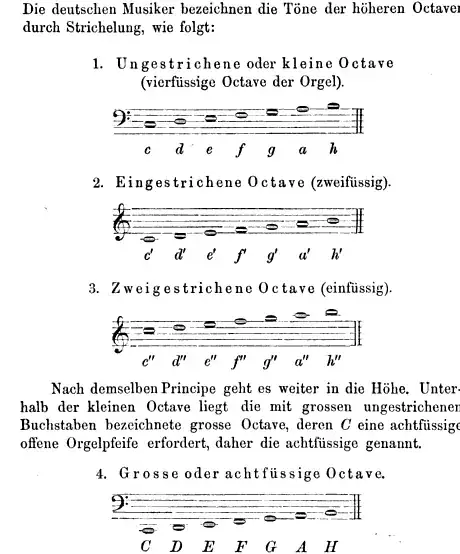
This is Helmholtz pitch notation, which uses primes and sub-primes in addition to upper and lowercase note names for octave indication. For example: c' is eingestrichen (i.e. has a single quote/prime, as opposed to none, or to a double quote which would be phrased zweigestrichen).

So translating gestrichen by bowed is a mistranslation in this context.


While Helmholtz had his publication later, Wikipedia states that he "fully described and normalized" the scheme, from which I deduce that it was already in use earlier.

This is confirmed by Helmholtz in Die Lehre von den Tonempfindungen als Physiologische Grundlage für die Theorie der Musik, see page 28 where he describes the terms ungestrichen, eingestrichen, etc. as already in use by German musicians:

1. Ungestrichene oder kleine Octave (vierfüssige Octave der Orgel): An octave from C in the second space of a staff in bass clef to H in the first space above the staff.  2. Eingestrichene Octave (zweifüssig): An octave from C on the first ledger line below a staff in treble clef to H on the third line in the staff.  3. Zweigestrichene Octave (einfüssig): An octave from C in third space in a staff in treble clef to H in the second space above the staff.  4. Grosse oder achtfüssige Octave: An octave from the C on the second ledger line below a staff in bass clef to the H on the second line in the staff.

Elements In Space
  • 13,682
  • 4
  • 29
  • 78
guidot
  • 11,034
  • 1
  • 25
  • 56
  • 1
    How can it be Helmholtz, which wasn't proposed until 30 years after the OP document? – Aaron Jan 10 '24 at 09:38
  • Oh nice! I recognize c' from lilypond as C4 (middle-C). Could "small G" refer to g', "large C" as c and contra C as c, in this case? – Stewart Jan 10 '24 at 09:39
  • 2
    Good terminology used here. That helped me find a reference. kontra=[,C=,H]/[C1-B1], gross=[C-H]/[C2-B2], klein=[c-h][C3-B3], eingestr.=[c'-h'][C4-B4] zweigestr.=[c''-h''][C5-B5] – Stewart Jan 10 '24 at 09:48
  • 2
    @Aaron it is the forerunner of Helmholtz notation, which dates back at least to Guido of Arezzo in the 11th century, though I don't know when the switch from double letters to strokes occurred. – phoog Jan 10 '24 at 09:49
  • 1
    @phoog That should be made clear in the post, which says that it is Helmholtz notation, not that it's an early version of what would become Helmholtz notation. – Aaron Jan 10 '24 at 09:53
  • @Aaron: I disagree; in the question the names are given (and I understand this to be the core of the question), and the notation seems to be already the one used by Helmholtz and not the horizontal overstroke/underscore. – guidot Jan 10 '24 at 10:00
  • @guidot but as Aaron says it cannot be Helmholtz notation because it was written before Helmholtz notation was developed. – phoog Jan 10 '24 at 10:14
  • Eingestrichenem means bow according to Google Translate. – Vighnesh Jan 11 '24 at 14:36
  • 5
    @Vighnesh Google gets it wrong; “Bow” doesn’t make any sense in this context. That’s why this question was asked in the first place. – Elements In Space Jan 11 '24 at 15:09
  • One more question: This document describes "2 1/2 octaves from kleinen G to grossen C". According to this reference, that would be G3 to C2, but that's only 1 1/2 octaves. It also describes the bass-trombone as "3 octaves from eingestrichenem C to grosse C". That would be C4 to C2 which is only two octaves. IIRC, there was a point when octaves went from A-Ab instead of C-B. Could that explain why these ranges don't match up? – Stewart Jan 13 '24 at 11:32
7

It means "C with a stroke," referring to the octave of the C in the system that prevailed from sometime in the early modern period (I guess) until Helmholtz.

In the 1000s, the gamut was defined starting from Γ, majuscule Greek gamma, which corresponded to G2 in scientific pitch notation, then upper-case (Latin) A through G (A2 through G3), then lower-case a through g (A3 through G4), then doubled lower-case aa through ee (A4 through E5). At some point (which I believe was in the early modern period, but I don't have time to confirm), the doubled letters were replaced with strokes, ā through ē, later a' through e', which gave Helmholtz the basis for his innovation.

At the low end, it was not practical to stick with the Greek alphabet, because Γ is the third letter of the alphabet, and one would quickly run out of letters. Instead, Γ became GG and the extension used Latin letters. (At some point, I don't have any idea when, the octaves were redefined as running from C to C rather than from A to A.)

"Bow" is certainly a bad translation. In English, it seems, it would be called "one-stroke C" or "one-line C," a perhaps surprisingly direct translation.

phoog
  • 22,771
  • 3
  • 39
  • 86
4

The correct translation is one-line, refering to the one-line octave.

In terms of what you're probably more used to:
One-line octave (eingestrichene Oktave) corresponds to C4 to B4 (starts at middle C).
Small octave (kleine Oktave) is below that: C3 to B3.
Great octave (große Oktave) comes next: C2 to B2.
Contra octave is C1 to B1.
Subcontra octave ends at B0.

Above one-line, you get two-line (from C5), three-line (from C6), and so on.

Here's an overview in the German Wikipedia, and here's a handy conversion table in the English Wikipedia.

One-lined C (eingestrichenes C), or simply c', is the middle C (C4).
"Small g to great C" is G3 to C2.

(And I see the translator likes to give "big" or "large" for "groß". While it's pretty comprehensible, I'd like to note that as far as I know, the term in English is "great".)

Divizna
  • 2,454
  • 1
  • 5
  • 17
  • 3
    @Mazura Don't take Google translate as a word of God, there's a lot it gets wrong. And what you did above isn't even how you take the word apart. It's eingestrichen; the ending -em comes from declension. It's a compound of ein (one) and gestrichen - the participle of streichen: a verb with a fairly wide meaning, cognate with the English strike. (It's also a homonym of the participle of einstreichen, which does mean to cover a surface in a coat of some substance - that's where the mistranslation "painted" comes from; note that it doesn't mean a painted picture but a painted wall.) – Divizna Jan 11 '24 at 16:10
  • 2
    Quoting from what I linked above: Eingestrichene Oktave: von c′ (261,6 Hz) bis h' - that is, One-line octave: from c' (261,6 Hz) to h' (H is the note that English speakers denote as B). This is, in no uncertain terms, what we're dealing with here. Nothing to do with "colourful" or "deleted" or anything so colourful. Just the standard term for a pitch. – Divizna Jan 11 '24 at 16:17