27

I have read in many sources that it's generally better for an employee to be paid bi-weekly than monthly. I have been performing some calculations and can't see the benefit to this.

Say I was on a $100,000 salary. Let's assume a tax rate of 0% for the purposes of this calculation (I wish!).

Monthly payments are calculated like this:

100000 / 12
= 8333.33 per calendar month

Bi-weekly payments are calculated like this (assuming non leap year):

(100000 / 365) * 14
= 3835.61 per fortnight

Here's my analysis:

  • Let's assume that bi-weekly payments always fall on a Monday.
  • Since the maximum number of days per month is 31, the first Monday of a month has to fall on either 1st, 2nd or 3rd of the month for there to be 3 payments in that calendar month (that's assuming of course that the first Monday of the month was a payday).
  • This means there will (usually) be 2 months in the year with 3 payments, while the remaining 10 months will only have 2 payments.
  • In the months with 2 payments (the majority), the sum of the 2 payments will be less than the payment I would receive if I was being paid monthly (using the figures above).

As far as I can see, unless I was someone who was living from paycheque to paycheque, there's no real benefit to getting paid bi-weekly instead of monthly.

I thought that maybe if I was being paid into an offset account which was reducing interest on my mortgage, I'd be better off. But my calculations (assuming interest is calculated daily) indicate that being paid monthly is still better off, because on a month by month basis my cumulative income is still higher when being paid monthly.

The only time I can see a benefit is if 1st January is a payday, then for the non leap-year case (365 days) the last paycheque will appear on 31st December. This is one extra paycheque a year. But this is not a common case.

Are my calculations correct? Or are there benefits I'm not aware of here?

  • 5
    You get your money sooner - can earn slightly more with it, but mainly, reduced credit risk – Bradley Thomas Dec 05 '16 at 18:51
  • 14
    Personally speaking, getting paid monthly was the wooooorst. There's something about getting paid twice a month that seems to enable the thought, "Oh yeah, all of my bills come out of this paycheck, and then I can do what I will with the other paycheck." – Wayne Werner Dec 05 '16 at 19:37
  • 4
    As @BradThomas and others note, getting paid bi-weekly means you get 2 extra weeks of interest. It turns out that paying your mortgage bi-weekly pays it off a lot faster for pretty much the same reason. However, if you're borrowing money at a low rate and can invest it at a higher rate, it's not always good to pay it off faster. –  Dec 05 '16 at 19:48
  • 4
    @barrycarter the reason paying a mortgage is faster with biweekly has almost literally nothing to do with interest. It's actually a similar concept as the "two months with an extra paycheck" others have mentioned: you make 26 half payments, which works out to one extra payment every year. – stannius Dec 05 '16 at 20:39
  • @stannius So you're saying that if someone paid their mortgage twice a month (1st and 15th for example), instead of once every two weeks, they would not see significantly lower total payments? –  Dec 05 '16 at 21:12
  • 2
    @barrycarter No I am saying that if someone paid 13/12ths of their mortgage payment once a month, or doubled their payment once a year, they would end up with about the same total payments as if they paid every two weeks. – stannius Dec 05 '16 at 22:24
  • @WayneWerner: exact opposite experience for me. More than half my monthly expense comes from a single credit card. Moving to being paid twice a month forced me to borrow from my credit line to pay the card each month; and the interest, although low, eroded my cc benefits. – Martin Argerami Dec 06 '16 at 11:33
  • 1
    @MartinArgerami If you're disciplined enough to budget what we've found to be helpful in paying down our CC debt is (aside from some input to savings and our mortgage) dumping our entire income into our CC card. Then whatever we don't spend is already paid towards the balance. – Wayne Werner Dec 06 '16 at 12:07
  • @WayneWerner: I don't have cc debt. I spend less than my monthly income, and pay the full amount every month. But with my salary paid in two halves, the cc still bills monthly, with the net result that I don't have enough money to pay when the balance is due. Thus biweekly salary payments actually cause me to lose money, which is definitely worse. – Martin Argerami Dec 06 '16 at 12:19
  • 3
    @MartinArgerami I'm pretty sure being unable to pay your entire CC bill in one fell swoop is the definition of CC debt. You may not have much of it, but it sounds like you have a small amount every month. If you can, I highly recommend cutting any extraneous expenses you can, i.e. no eating out, cheap (beans & rice) meals, etc. temporarily. Even shut off cable/Internet/phone or downgrade your plans if there's no cost to restoring it. If you can't cut expenses, see if you can pick up some side jobs to get on top of your CC bill. – Wayne Werner Dec 06 '16 at 12:23
  • 1
    "This is one extra paycheque a year. But this is not a common case." - incorrect logic. If you got 27 paychecks a year, the company would decrease the amount paid per paycheck to equal $100k per year total. So your second formula wouldn't be (100000 / 365) * 14, it would be (100000 / # of paychecks per year). – glassy Dec 06 '16 at 16:13
  • @WayneWerner: this whole discussion comes from you not reading my comments. I can borrow at 2.5% percent to pay my cc, so I don't have cc debt, and I never paid less than full amount (at least over the last 20 years). In any case, you are recommending me to cut expenses and look for a side job because my salary went from monthly to biweekly? And still you claim that being paid twice a month is better than being paid once a month? – Martin Argerami Dec 06 '16 at 16:29
  • 2
    @MartinArgerami: If you're paid biweekly, it fits well to pay your credit card twice a month. Your problem is that of the two payments you make, the first is on the due date and the second would-be-late (if not for the other line of credit you borrow against). What people are suggesting is that you cut expenses short-term until the same two payment are made, but it is the second one paid on the due date, and the "other half" payment is sent two weeks early instead of two weeks late. (You should also try to set aside some for an emergency fund, but that's an entirely different topic) – Ben Voigt Dec 06 '16 at 19:22
  • @BenVoigt: fair enough. The point of the conversation was that Wayne Werner said that being paid monthly was way worse than biweekly. I mentioned my example because being paid biweekly makes my life harder (as per your suggestions), so it is definitely worse than being paid monthly. – Martin Argerami Dec 06 '16 at 23:32
  • @MartinArgerami: You'd be in exactly the same situation if you were paid monthly, but the credit card bill came due two weeks before payday. Except that then you'd be borrowing the entire credit card amount against your LoC instead of half. – Ben Voigt Dec 06 '16 at 23:42
  • In my country, it's typical for monthly payroll to be paid 2 weeks in advance (and simultaneously 2 weeks in arrears) so there's very little disadvantageous versus fortnightly payroll. – Coxy Dec 07 '16 at 03:48
  • I don't understand your concern of paying your CC bill with bi-weekly paychecks, perhaps you can clarify. Assume previously you were paid on the 1st of each month (Nov 1, Dec1), for the period of the previous month and at that time, you are able to manage your cc bill as you normally have. Then, on Dec 15 you receive your first bi-weekly paycheck for the period Dec 1 through Dec 14, and on Dec 29 you receive your next bi-weekly paycheck for the period Dec 15 through Dec 28. --->> – Kevin Fegan Dec 07 '16 at 17:54
  • <<--- Then, on Jan 1, you will already have the money from both of your December bi-weekly paychecks to handle your cc bill. The only difference is that the 3 days pay for Dec 29,30,31 will be shifted to the next paycheck, so you will have to manage that difference. But, the first time you get 3 paychecks in a month, it will make up for this and you'll likely be ahead of the game from then on. – Kevin Fegan Dec 07 '16 at 18:01
  • To provide an alternative viewpoint: If you put aside this month's pay for next month's budget, it doesn't matter how often you get paid, as long as it's at least once a month. Daily, weekly, biweekly, once a month - doesn't matter, since this month's budget has already been allocated from last month's pay. This works especially well for cases like @MartinArgerami's, because a change in payment frequency doesn't affect bills at all. – Agop Dec 07 '16 at 23:00
  • Doesn't the credit card have an interest grace period of 50 days or move? I don't understand why bi-weekly is causing a problem but either way you could probably time charges to maximize use of the no-interest period. – shawnt00 Dec 07 '16 at 23:40
  • @KevinFegan: If it works like you say, then of course it is no issue. My understanding is that after getting a full month on Dec 1st, next payment is half a month on Jan 1st. That's where the problem lies. – Martin Argerami Dec 08 '16 at 00:21
  • @MartinArgerami - Oh, I see your concern. Why do you think they would hold back the pay for a full month? Typically, companies hold back a few days, up to a week of pay (generally not more). In the case of being paid monthly, it might be for the period of Oct 26 through Nov 25, and paid on Dec 1. If it then switched to bi-weekly at that point they wouldn't hold back payroll for over a month, from Nov 26 through Jan 1. Of course some companies might try to do that, or want to do that, but it would be rare. In the US, they are probably not allowed to do that (by federal or state laws). – Kevin Fegan Dec 08 '16 at 12:49
  • @Kevin: it's just a guess so far. They have announced we are switching from monthly to biweekly, but they have not given specifics yet. If it is as you say, all will be good. – Martin Argerami Dec 08 '16 at 16:48

11 Answers11

42

Especially for people just starting out, without much reserve, the biggest concern is the rhythm of their expenses and income. If you're paid every two weeks, but your rent, car loan, and other "big rocks" are due once a month, then there are two paycheques a year that no-one has a claim on. Depending on your spending style, these can go into savings (yay!) or be spent on the spot and "wasted" (boo!).

Of course, you can get your mortgage set to every two weeks, and typically the bank will do that at the "half your monthly payment" level. If you're paid every two weeks, you won't feel any pain from this, but are making extra payments every year and getting out of the mortgage faster.

The time-value-of-money part has a small impact. The emotional part and fooling yourself into saving, or paying things off faster, has a bigger one.

Kate Gregory
  • 13,193
  • 1
  • 33
  • 52
  • 3
    I think this is really the biggest difference. Those people who are living pay check to pay check, close to it or are just bad at budgeting. Having more frequent pay checks makes it more likely they will have the money when they need it. First check of the month is rent/mortgage. It also tents to help them limit their monthly expenses to the two checks a month amount. Unfortunately, they seem to blow their extra check on something rather than paying of debt or building up savings. – Evan Steinbrenner Dec 05 '16 at 19:17
  • 1
    Your last sentence doesn't apply to any of the paid biweekly folks I know. Loans are up to date or paid off, retirement savings are accumulating, etc. Those are big rocks and they get taken care of. Often doesn't leave much for discretionary spending but they rarely complain. – Kate Gregory Dec 05 '16 at 19:19
  • I was thinking primarily of the people I referenced at the start, people living paycheck to paycheck or just bad at budgeting. Their reaction to that extra check, or tax refund for that matter, seems to more commonly be buy that new TV or game system or what ever ignoring their CC or other debt etc. Yeah I can get something I want rather than I've got a chance to get myself out of this situation. I'm not saying everyone getting paid bi-weekly is like this but in my experience it certainly isn't uncommon. – Evan Steinbrenner Dec 05 '16 at 19:32
  • We've had some discussions about programs that switch mortgages over to biweekly payments. While perhaps your bank might just switch it for you, more commonly this is an upsell by a third party which charges a fee and/or gains from holding the payments without applying them to your mortgage immediately. – Joe Dec 05 '16 at 19:47
  • @Joe must be an American thing; Canadian banks do biweekly on request. – Kate Gregory Dec 05 '16 at 19:53
  • @KateGregory that is one of the less significant differences between US and Canadian mortgages. http://www.fool.com/investing/general/2014/02/23/3-huge-differences-between-us-and-canadian-mortgag.aspx – stannius Dec 05 '16 at 22:25
  • I most-prefer monthly. Followed by semi-monthly. Then bi-weekly. We can budget on 24/26th of my salary - and did when we were bi-weekly. But it's substantially simpler to budget on 1/12 or 2/24 of your salary instead – warren Dec 08 '16 at 18:45
  • +1 I do exactly that - pay 50% owed, on all my bills, bi-weekly, regardless of due date. If anything goes south, I'm ahead on all, and have a reasonable buffer, to gets my ducks in a row. – tahwos Dec 18 '16 at 16:10
15

I feel that getting money sooner than later is always advantageous.

If I offered you the choice between getting:

  • $100 ninety days from now or
  • $100 a week from today or
  • $50 today and $50 a week from today or
  • $100 today

Which option would you take?

I would take the last option. And for the same reason, from a purely-numbers point of view, I would argue that getting paid biweekly is preferable (assuming the the annual salary is pro-rated fairly, and barring any compulsive spending habits).


Your calculations suggest to me that they are trying to answer the question, "Looking at a single year or month (or some other fixed amount of time) in a vacuum, is there any financial benefit to being paid bi-weekly over monthly?".

The analysis seems to be focusing on comparing the two pay schedules on a month-by-month basis, noting when one is paid bi-weekly, some months you get paid more times than the other.

However, one could also compare the two pay schedules on a fortnight-by-fortnight basis, and note that when one is paid monthly, many fortnights you don't get paid at all, and some you get paid a lot.

Or one could compare the two pay schedules on an hour-by-hour basis, too.

But in the long run, the money adds up to be the same amount. I prefer getting it as soon as I can.

mattliu
  • 280
  • 1
  • 7
  • 1
    $100 today is an unfair, unrealistic option, that is also not applicable to deciding when to get paychecks. Your point is otherwise valid, but in regards to paychecks, Monthly is going to get you more money until you get 3 paychecks in the month. Its choosing between $100 in a month, or 46 in 2 and 4 weeks, and the remainder of the 100 later. For at least a few months most years, you are going to get more money sooner by choosing monthly. – Ryan Dec 05 '16 at 17:41
  • 5
    Different employers have different lags between when a day is worked and when you're paid for it. Pay frequency is just one part of that. – stannius Dec 05 '16 at 20:41
7

Many people, especially with lower income/skill/education, have poor money management skills to the point where they will not be able to ration their money for a full month. If the payment schedule is reduced to weekly or bi-weekly it becomes easier for such people to make non-discretionary payments.

6

Bi-weekly salaries often assume a 364-day year, and pay you 1/26 of your annual salary every two weeks. So you actually gain an extra week's salary every five or six years.

Mike Scott
  • 23,450
  • 2
  • 65
  • 77
  • 2
    By an extra week's salary, you mean that the extra week's gain will be amortized over the 5-6 year period? If this is correct, wouldn't I expect to get approximately an extra day's salary after 1 year? But then you mentioned salaries assume a 364 day year, so aren't I losing a day? This seems counter-intuitive to me. – LeopardSkinPillBoxHat Dec 05 '16 at 11:46
  • 1
    @LeopardSkinPillBoxHat 52 x 7 = 364 plug 364 instead of 365 in your formula at the question, and see if the values go up or down. The number of days go in the denominator of a division, of course using a smaller denominator result in a bigger pay. In other words, the 365th day of the year is already the beginning of the next forthnight pay period. And this window keeps moving backwards every year. – Mindwin Remember Monica Dec 05 '16 at 12:25
  • 1
    "often assume" that's to be verified in the case of the OP. See if you are being paid 1/26th of your annual salary every fortnight, or 14/365 (in which case you still win .25 day per year) – njzk2 Dec 05 '16 at 18:19
  • 8
    Only at companies with really bad accounting departments – Kevin Dec 05 '16 at 18:26
  • The company I work at was kind enough to not do any amortization or something and we received a full additional paycheck in 2015. http://lifehacker.com/watch-for-pay-period-leap-year-in-2015-if-you-get-paid-1663113166 – MikeS Dec 05 '16 at 19:27
  • 1
    @Kevin I'd argue the opposite. The only companies that wouldn't give you 27 pays @1/26 of the nominal annual rate are those ruled by stupid bean counters. Doing that year as 27@1/27 is going to be seen as a 3.7% paycut by the majority of staff and generate serious morale problems; trying to argue otherwise will only worsen it. Paying 14/365ths of annual pay isn't as obvious, but probably will trigger a similar blowup when someone does do the math and the rumor mill explodes with the 'fact' that everyone is being cheated out of 0.27% of their pay. The once every 14y 'bonus pay' won't matter. – Dan Is Fiddling By Firelight Dec 06 '16 at 00:44
  • 1
    @DanNeely if the majority of the staff is too dumb to understand how that works, then your company has bigger issues. Also, not doing the right thing because a few people will complain is a good way to ruin a company. There will always be people who complain regardless. Had a complaint at work the other day from an employee who wanted to be paid weekly instead of bi-weekly because "it's better for budgeting and taxes" – Kevin Dec 06 '16 at 03:51
  • I've worked at multiple companies and all of them have used a more simple formula for bi-weekly paychecks: (total salary / pay dates in a year). So if there were 27 paydays in a year, you would get 1/27th of the total salary per paycheck, and if there were 26, you would get 1/26th of the total salary per paycheck. – glassy Dec 06 '16 at 16:18
  • @glassy you have worked at multiple companies in the rare year that they issued 27 paychecks? How long have you been working? – stannius Dec 06 '16 at 18:50
  • @DanNeely I doubt anyone would notice a 0.27% difference in pay never mind blow up over it. I have some evidence - I worked at an employer who started passing a state-imposed tax on to us employees, which worked out to perhaps 0.08% of pay. Not only did nobody blow up, but of my unscientific survey of perhaps 30 of my fellow employees, only one (besides myself) even noticed the change. On the other hand, I would bet 3.7% of my pay that there would be an uproar if everyone's paycheck was 3.7% smaller one year. – stannius Dec 06 '16 at 19:03
  • @stannius - it happens about once a decade – glassy Dec 06 '16 at 19:17
  • you don't gain an extra week every couplefew years: it's a simple division of annual salary by 26 pay periods each year - ie, every year the math "resets" (not that it needs to but it does) – warren Dec 08 '16 at 18:42
5

Two comments on your calculations:

I worked for many years at a community college (Ontario, Canada) where I received an annual salary for the contract period Sept 1, Year N, to August 31, Year (N + 1). For most of that time, the system was 26 pay-cheques a year, one every 14 days.

Payroll made most mandatory deductions (union dues, pension, etc.) on a monthly basis, assigning them to one or the other of the two cheques each month. So there was a fairly large variation in the net amount received in the two cheques. Plus there were those two "extra" cheques each year with very few deductions. (as in the answer of @Kate Gregory)

Additionally, Payroll was smart enough to make the last cheque of the contract year for a slightly odd amount, just the correct amount to bring the total gross amount paid to the actual contractual salary, evening out any extra days or rounding error. They would restart the payment schedule anew on the second Thursday in September.

DJohnM
  • 4,294
  • 2
  • 15
  • 19
  • When I was bi-weekly, they made deductions in 1/26 amounts per check. Sounds like you had a bit of a wacky experience – warren Dec 08 '16 at 18:43
5

The big difference is that you get your money earlier at the start.

Suppose you start on a random day with payday on the last day of the month (monthly), or on every 2nd wednesday (biweekly), and it takes 3 days for payroll to "ramp up" (ie, if payday is within 3 days on your start date, your next paycheck is not on the next payday, but on the one after).

If we assume every month has 30 days (to keep things simple), it is an average of 4+5+...+33 days until you get your first paycheck with monthly pay, an average of 18.5 days.

For weekly it is a bit trickier

Assuming you get hired at a random date here, with * being a paydate:

M  T  *  R  F
M  T  W  R  F

time until you get paid:

16 15 14 13 12
9  8  7  6  5
      *

an average of 10.5 days.

So you get your first pay an average of 8 days earlier.

Later on, that 3 day thing no longer occurs, and now the company holds an average of 6.5 days of your pay "due to you" with biweekly paychecks, and about 14.5 days with weekly paychecks if you have monthly pay.

So with monthly pay, on average your bank account has 8 fewer days of your pay in it at all times. This happens when you are first hired, and persists over the length of your employment.

Now suppose you save that extra money (on average): Suppose you have an investment at 4% (after inflation). Over 40 years those 8 days of pay invested at 4% grow to 38 days of pay, a free month.

What more, if the company has problems making payroll, you'll get a warning (to, say, look for another job) an average of 8 days sooner, and/or have the money in your account. Having someone owe you money is usually worse than having the money in your bank account.

Yakk
  • 3,233
  • 14
  • 15
  • In the grand scheme of things, getting your first paycheck 8 days earlier isn't going to make that much of a difference. It's not like you're going to work for the same employer for 40 years. – stannius Dec 06 '16 at 23:44
  • @stan you get every paycheck an average of 8 days sooner. Not just the first; the second, the 20th, the 1027th. – Yakk Dec 07 '16 at 00:34
  • @stan which means if you go from one biweekly to the next, the same logic holds. Same for monthly. Now, having the money and interest is a nice feature; but the real benefit is the handul of times per career when the company goes under on you. The money in your bank you keep; the money they owe you you sometimes lose. – Yakk Dec 07 '16 at 01:55
5

Say one makes $60k/yr. The net gain is that half these funds are received about 2 weeks prior. To keep the math simple, let's assume a 12% return per year on the funds during this time. $30K * 12% is $3600. But 2 weeks is about 4% of a year, so $144. That's at a 12% return. In an offset mortgage the return will be closer to 4%, a $48/yr benefit.

With short term rates at or below 1%, we're really looking at a gain of $12 or so for the extra time with the funds.

JTP - Apologise to Monica
  • 172,273
  • 34
  • 296
  • 560
2

If you're getting the same total amount of money every year, then the main issue is psychological. I mean, you may find it easier to manage your money if you get it on one schedule rather than another.

It's generally better to get money sooner rather than later. If you can deposit it into an account that pays interest or invest it between now and when you need it, then you'll come out ahead. But realistically, if we're talking about getting money a few days or a week or two sooner, that's not going to make much difference.

If you get a paycheck just before the end of the year versus just after the end of the year, there will be tax implications. If the paycheck is delayed until January, then you don't have to pay taxes on it this year. Of course you'll have to pay the taxes next year, so that could be another case of sooner vs later. But it can also change your total taxes, because, in the US and I think many other countries, taxes are not a flat percentage, but the more you make, the higher the tax rate. So if you can move income to a year when you have less total income, that can lower your total taxes.

But really, the main issue would be how it affects your budgeting. Others have discussed this so I won't repeat.

Jay
  • 22,675
  • 1
  • 32
  • 72
2

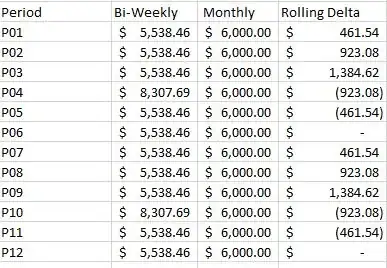
Here is my analysis. You will see that taking the monthly option give you more money upfront for the 1st 3 months. Then you will see that the person who gets paid bi weekly will surpass me in total income acquired for the next 2 months.On the 6 month we will have made the same amount. Months are based on a 5 week 4 week 4 week schedule. The cycle will repeat again until the end of the year where the delta is 0. I currently get paid monthly and have mixed feelings about it. I do like getting paid more frequently, but I also like that 6 times out the year I get paid more than I would have if was being paid bi-weekly. Bi-weekly only pays you more 4 times a year in comparison to the monthly paycheck.

Ultimately it is up to you and how you budget. But if you want your money upfront over the course of the year then go with monthly.

Monthly Vs Bi-weekly Chart

Chris W. Rea
  • 31,671
  • 16
  • 102
  • 190
-2

Financial benefit? No. No matter whether you are paid based on a salary or by the hour, the frequency of your pay check has no effect since at the end of the year you will have received the exact same amount of money.

Psychological benefit? Well, from the many answers and comments on this page that seem to think there is a difference, then apparently there is a large psychological difference. Whether that is a benefit or not, I guess, depends on your personality.

Octopus
  • 523
  • 3
  • 10
  • 3
    The question is asking about frequency of pay periods, not about salary vs. hourly. – stannius Dec 06 '16 at 23:36
  • 1
    @stannius, yes, and the amount still doesn't change. what's your point? I'm just pointing out that it still doesn't change even if each paycheck changes because you're hourly. at the end of the year its the same! – Octopus Dec 07 '16 at 19:36
-2

Yes, there is a financial benefit, if and only if you can live on 24/26th of your salary.

Semi-monthly = $100,000 / (12*2) = $4,166.67/period * 2 periods/month = $8,333.34/month.

Bi-weekly = $100,000 / 26 = $3846.15/period * 2 periods/month = $7692.31.

Thus, bi-weekly is 12/13 lower than a bi-monthly income. However, you now get a so-called "extra" paycheck twice a year. (We typically get them in March and October.)

You can either spend those extra paychecks on "hookers and blow" or spend them wisely on things like accelerated debt repayment, home/car down payment, property taxes, etc, etc.

HOWEVER... none of this really matters, since you don't control whether or not you're paid bi-weekly or semi-monthly.

RonJohn
  • 50,666
  • 10
  • 106
  • 170