1

What are some simple techniques used for Timing the Stock Market over the long term to beat average market returns?

By long term I mean 5 years and longer.

It may include investing directly into individual stocks or investing in ETFs representing the market as a whole.

Victor
  • 20,991
  • 6
  • 47
  • 85
  • 6
    There is no proven techniques in timing the market for 5 years or any number of years. – Abbas Jan 13 '15 at 08:12
  • 1
    @Abbas - what is your definition of proof in this case? – Victor Jan 13 '15 at 08:43
  • 2
    The proof is there is no proof of anyone ever timing the market in 100% consistency and accuracy. – Abbas Jan 13 '15 at 09:11
  • 2
    @Abbas - I never said I was after a crystal ball with 100% accuracy. – Victor Jan 13 '15 at 09:36
  • http://www.eagledailyinvestor.com/17537/elite-beat-market/ – DumbCoder Jan 13 '15 at 09:37
  • OK, even in the worst case probability one would stand to lose the investment, hence I would not time the market. It is not about timing the market, rather doing a fundamental study of a stock, then timing becomes irrelevant. – Abbas Jan 13 '15 at 09:42
  • 1
    @Abbas - what are you on about? Lose what investment? – Victor Jan 13 '15 at 09:48
  • 7
    If there were simple techniques, wouldn't just about everyone be using them? There are certainly many professional investors who consistently can "beat" the market (Warren Buffet - http://www.berkshirehathaway.com/letters/2013ltr.pdf), but they aren't doing it by simply by timing trades of ETFs. – EkoostikMartin Jan 13 '15 at 14:50
  • 1
    Victor - I don't have a complete answer, just a thought. In the US, PE/10 appears to be a valid predictor of longterm market expectations. – JTP - Apologise to Monica Jan 13 '15 at 18:27
  • 1
    @EkoostikMartin - "If there were simple techniques, wouldn't just about everyone be using them?" No, people are told smoking is bad for them but a lot of people still smoke. If you have a bias for value investing you may not understand why people buy growth stocks, similarly if you have a bias for fundamental analysis, you think you must know as much as you can about a company before you invest in it, then you may have a bias against technical analysis and all its claims - thus you look for information to substantiate your biases and ignore information against them. – Victor Jan 13 '15 at 20:50
  • 1
    @JoeTaxpayer - yes PE can be an early warning signal of when the market may start to become overheated or oversold. – Victor Jan 13 '15 at 20:53
  • I'm talking specifically about PE/10, introduced by Nobel Prize winning Robert Shiller, and advocated by fellow blogger Rob Bennett, http://arichlife.passionsaving.com/2012/03/26/why-buy-and-hold-investing-can-never-work/ – JTP - Apologise to Monica Jan 14 '15 at 00:40
  • @JoeTaxpayer Can you give more details on PE/10? That blog post you linked to doesn't use the term at all, and the article seems pretty conspiratorial (bans on honest posting, everyone keeps deleting my comments, etc.) and it meets a lot of the common criteria for cranks. – Michael A Jan 14 '15 at 15:34
  • @JoeTaxpayer The post keeps saying that the data show that Rob's strategy "always works" but I don't actually see any data analysis there, and it's too thin on the details to see how it bears more than a passing similarity to Shiller's work (which I'm familiar with, including Irrational Exuberance). – Michael A Jan 14 '15 at 15:38
  • 1
    @MichaelA, what it says about buy and hold is true, buy and hold is the worst advise you can give anyone. –  Jan 14 '15 at 20:31
  • 1
    @EkoostikMartin - I have included some simple techniques below in my answer. I am using them very successfully, why aren't you using them? – Victor Jan 15 '15 at 09:45
  • 1
    @MarkDoony Sorry but the point of my comment was "where's the evidence?" The article just says "XYZ advice is bad" without providing any hard data. People saying "yes, it is the worst thing to do" isn't helpful. Data is not the plural of anecdotes, and all that? – Michael A Jan 15 '15 at 22:01
  • 1
    @MichaelA, the evidence is in all the people including retirees who lost the majority of their life savings having buy and hold investments during the GFC. I know quite a few personally. Why would anyone keep holding an investment that is free-falling in price, when you have simple techniques, as victor has shown, which can get you out at an appropriate time. –  Jan 16 '15 at 02:11
  • 2
    @MarkDoony I know about people losing money in the crisis. thats why asset allocation with negatively correlated assets is important (which is different from just buy and hold). maybe its not clear though, but "evidence that ABC strategy is bad" isnt the same as "evidence that XYZ strategy is good". do you see the difference? some people claim to have made fantastic returns a) randomly picking stocks, b) using sufficient asset allocation/rebalancing, c) technical analysis, d) something else. thats why we need data/evidence because otherwise, its just hearsay on the internet. see what I mean? – Michael A Jan 16 '15 at 13:44
  • 1
    @Victor dont get me wrong, Im really interested in this stuff and I want to learn more, but Im also someone that needs evidence that isnt just someone (someone I dont know and have no way of validating what their saying if they dont provide evidence) saying "it worked for me." I wouldnt trust the word of someone on the internet I dont know, without evidence, in anything whether its finance, health, or anything else important. – Michael A Jan 16 '15 at 13:47
  • 1
    @MichaelA - I have provided some simple techniques, if you are interested you can go and learn about them and do your own backtest or use a virtual account to test them into the future. Why would you stay in the market during a period like 2008 where your investments would have been halved. Why would you not use a simple technique to warn you when you should be looking to get out of the market and then indicate when is a good time to get back into it. Is it 100% full proof? No it's not, but I would rather pay some tax and commissions on a false signal rather than lose 50% of my capital. – Victor Jan 16 '15 at 22:25

2 Answers2

6

"Buy low, sell high" - the problem, of course, finding a crystal ball that will tell you when the highs and lows are going to happen :-)

You could, for instance, save your money in cash and wait for the occasional sharp drop, but then you've lost profits & dividends from having that cash under the mattress all those years you were waiting.

About the closest I've ever gotten to market timing, and I think the closest anyone can get in real life, is that I cut personal spending to the bone from 2008 to 2011, and invested every spare cent. But such opportunities only come along a few times in a lifetime.

The other thing is to avoid what a lot of people do, which you might call anti-timing. When the market is high, they jump on the bandwagon, then when it drops they panic-sell, and lose money.

jamesqf
  • 11,142
  • 1
  • 29
  • 40
  • 1
    I see no problem buying into the market when it is moving up, but there are warning signals you can look out for to warn that a market high may not be far away. And the aim is to have an exit plan so you know when to get out of the market so you don't end up panic-selling. – Victor Jan 13 '15 at 21:03
  • 1
    -1, This is not an answer to the question, it should be a comment not an answer. –  Jan 14 '15 at 20:21
  • 2
    jamesqf -I am not after a crystal ball, as I mentioned in a comment above, and you cannot know where the highs and lows are going to happen, but Technical Analysis can give pre-warning when to be cautious and can indicate when a trend is reversing. Maybe you should learn about it before being so negative. Regarding market crashes the S&P500 has had 2 in recent times, 2000 and 2008, and I think it won't be too long before another one. Opportunities come around more often than you think. Great opportunities to short the market. – Victor Jan 15 '15 at 06:52
1

I can think of a few simple and quick techniques for timing the market over the long term, and they can be used individually or in combination with each other. There are also some additional techniques to give early warning of possible turns in the market.

The first is using a Moving Average (MA) as an indication of when to sell. Simply if the price closes below the MA it is time to sell. Obviously if the period you are looking at is long term you would probably use a weekly or even monthly chart and use a relatively large period MA such as a 50 week or 100 week moving average. The longer the period the more the MA will lag behind the price but the less false signals and whipsawing there will be. As we are looking long term (5 years +) I would use a weekly chart with a 100 week Exponential MA.

The second technique is using a Rate Of Change (ROC) Indicator, which is a momentum indicator. The idea for timing the markets in the long term is to buy when the indicator crosses above the zero line and sell when it crosses below the zero line. For long term investing I would use a 13 week EMA of the 52 week ROC (the EMA smooths out the ROC indicator to reduce the chance of false signals).

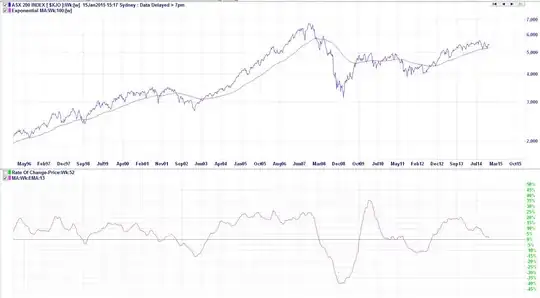
The beauty of these two indicators is they can be used effectively together. Below are examples of using these two indicators in combination on the S&P500 and the Australian S&P ASX200 over the past 20 years.
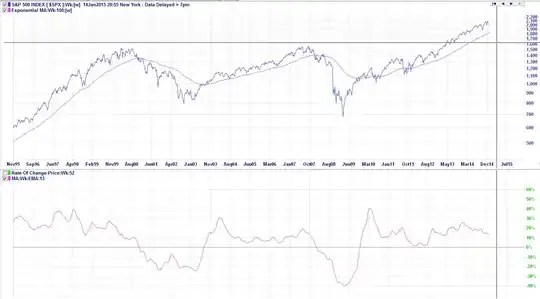
S&P 500 Past 20 Years S&P500 1995 to 2015

ASX200 Past 20 Years ASX200 1995 to 2015

If I was investing in an ETF tracking one of these indexes I would use these two indicators together by using the MA as an early warning system and maybe tighten any stop losses I have so that if the market takes a sudden turn downward the majority of my profits would be protected. I would then use the ROC Indicator to sell out completely out of the ETF when it crosses below zero or to buy back in when the ROC moves back above zero.

As you can see in both charts the two indicators would have kept you out of the market during the worst of the downfalls in 2000 and 2008 for the S&P500 and 2008 for the ASX200. If there is a false signal that gets you out of the market you can quite easily get back in if the indicator goes back above zero.

Using these indicators you would have gotten into the market 3 times and out of it twice for the S&P500 over a 20 year period. For the ASX200 you would have gone in 6 times and out 5 times, also over a 20 year period.

For individual shares I would use the ROC indicator over the main index the shares belong to, to give an indication of when to be buying individual stocks and when to tighten stop losses and stay on the sidelines. My philosophy is to buy rising stocks in a rising market and sell falling stocks in a falling market.

So if the ROC indicator is above zero I would be looking to buy fundamentally healthy stocks that are up-trending and place a 20% trailing stop loss on them. If I get stopped out of one stock then I would look to replace it with another as long as the ROC is still above zero. If the ROC indicator crosses below zero I would tighten my trailing stop losses to 5% and not buy any new stocks once I get stopped out.

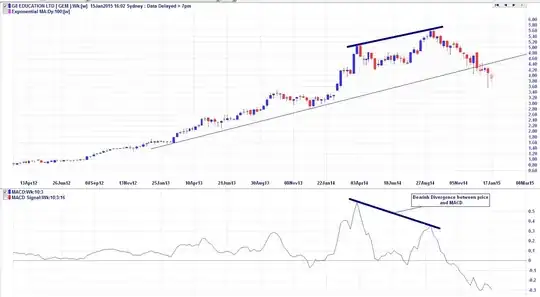
Some additional indicators I would use for individual stock would be trend lines and using the MACD as a momentum indicator. These two indicators can give you further early warning that the stock may be about to reverse from its current trend, so you can tighten your stop loss even if the ROC is still above zero.

Here is an example chart to explain:
GEM 3 Year Weekly Chart GEM.AX 3 Year Weekly Chart

Basically if the price closes below the trend line it may be time to close out the position or at the very least tighten up your trailing stop loss to 5%. If the price breaks below an established uptrend line it may well be the end of the uptrend. The definition of an uptrend is higher highs and higher lows. As GEM has broken below the uptrend line and has maid a lower low, all that is needed to confirm the uptrend is over is a lower high.

But months before the price broke below the uptrend line, the MACD momentum indicator was showing bearish divergence between it and the price. In early September 2014 the price made a higher high but the MACD made a lower high. This is called a bearish divergence and is an early warning signal that the momentum in the uptrend is weakening and the trend could be reversing soon. Notice I said could and not would. In this situation I would reduce my trailing stop to 10% and keep a watchful eye on this stock over the coming months.

There are many other indicators that could be used as signals or as early warnings, but I thought I would talk about some of my favourites and ones I use on a daily and weekly basis. If you were to employ any of these techniques into your investing or trading it may take a little while to learn about them properly and to implement them into your trading plan, but once you have done that you would only need to spend 1 to 2 hours per week managing your portfolio if trading long-term or about 1 hour per nigh (after market close) if trading more medium term.

Victor
  • 20,991
  • 6
  • 47
  • 85
  • 1
    what do you get if you backtest this with the S&P vs a simple DCA or rebalancing with something negatively correlated? what does it look like with transaction costs if you run it forward into different market conditions (like a choppier market for example)? – Michael A Jan 16 '15 at 13:43
  • 1
    @MichaelA - yes I have back-tested the ROC techniques and compared it to DCA since the start of 2007 in my answer to this question. There were actually less trades with the "Timing the Markets" option with almost double the returns of the DCA option. I have also back-tested various strategies of investing in individual stocks over the long term with Compounded Annualised Returns of over 25%. – Victor Jan 16 '15 at 22:01
  • 1
    @MichaelA - by rebalancing, if you mean selling off investments that have done well and are in profit to buy investments that are considered undervalued and have decreased in price just to rebalance your asset allocation, then I would stay away from such a strategy - where is your data that this produces good returns? Why would you sell an investment that is and keeps increasing in price - it may continue going up another 20%, 40% or 100% - and you would sell it and replace it with one that may not go up for months if not years. Why not place a stop loss and let the market take you out. – Victor Jan 16 '15 at 22:13
  • 2
    @Victor - Even though I was an original critic of the question, I upvoted this answer, it is a valuable contribution, more detailed and specific than most advice on this site about the stock market. As far as using EMA and ROC for timing index investing, I tested against some of the indexes I am in, it seemed to get me out quite well, but was delayed by months on when to get me back in, is there anything you have used in addition to EMA/ROC to better time reentry back into the market after a fall? – EkoostikMartin Jan 20 '15 at 15:34
  • 1
    @EkoostikMartin - that is probaly because the downtuns can be so steep. I've heard it described as an uptrend is like walking up stairs to the top of a cliff and a downtrend as falling off the cliff. Thinks you can look out for to maybe get you in earlier can be to look for bearish divergence between the price and momentum (opposite to example above), a break above a downward trendline, and looking directly at price action on a weekly chart. As a definition of a downtrend is lower lows and lower highs, you would look for a higher low and then a higher high... – Victor Jan 20 '15 at 22:06
  • 1
    ...this should be the end of the downtrend, but it would be wise to still be a bit cautious. You may want to buy back in slowly by buying a portion on the earliest signal the downtrend is over followed by another portion when you get a second signal and so on until you can confirm that the ROC has crossed above the zero line. – Victor Jan 20 '15 at 22:10
  • @EkoostikMartin - in my earlier comment above it should have been to look for bullish divergence (not bearish divergence) which is opposite to the bearish divergence example shown in my answer. – Victor Jan 21 '15 at 10:59
  • @Victor - thanks for the informative post! Could you also disclose which software/website you use to generate these charts? – MrMage Jan 30 '15 at 14:37
  • @MrMage - the software is incredible charts, they have a free version with limited indicators and different levels of paid versions. – Victor Feb 08 '15 at 08:42
  • To verify, am I right that this answer involves technical analysis? –  Mar 17 '15 at 01:42
  • @LawArea51Proposal-Commit - yes that is right, it involves technical analysis. – Victor Mar 17 '15 at 11:14
  • @Victor - soooo, .DJI has crossed 100 week EMA. Sell sell sell? – EkoostikMartin Aug 24 '15 at 18:23
  • @EkoostikMartin - I would be tightening my stop losses at this point in time to protect your existing capital. If you get stopped out and things turn around you can always buy back in (make a small loss and some additional commissions). But if things continue to go south you will still be able to sleep at night. – Victor Aug 25 '15 at 06:13
  • @Victor - thanks, I did exactly that. Set new stop loss limits last night. Didn't hit obviously since today the market it up. I did sleep better too! I am actually commission free (got 100 free trades from customer service awhile back) on my main account so I don't mind making extra trades. Do you just set your stop losses "good till cancelled" or do you set new ones up each day? – EkoostikMartin Aug 25 '15 at 15:26
  • @EkoostikMartin - I set them up good til cancelled but if the stock moves to a new high I adjust the stop upwards. The other alternative is to set a trailing stop loss. – Victor Aug 26 '15 at 12:30