0

I have purchased shares of a bond ETF, ticker symbol: SPTL (SPDR Portfolio Long-Term Treasury ETF). The prospectus states: "the fund's goal is to track the total return of an index that measures the performance of the long-term U.S. Treasury bond market (the Bloomberg US Treasury Long-term TR index)". I have wondered what exactly "the performance" means. I understand the Total return index also counts the coupon returns; but, basically, does "performance" here mean the average price of the long-term Treasury bonds included in the index?

As far as I know, the S&P 500 tracks the total market cap of 500 companies included in the index. However, I downloaded the Bloomberg Barclays Bond Indices Methodology booklet, and have read it. But, because they are total return indices, the formulas are too complicated for me to understand.
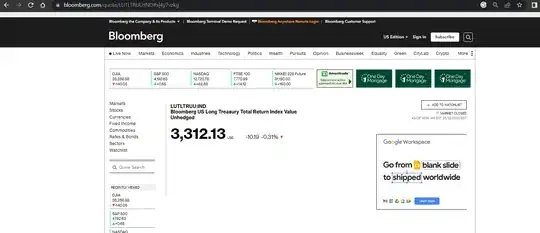
enter image description here

D Stanley
  • 133,791
  • 19
  • 313
  • 372
domino
  • 595
  • 1
  • 5
  • 13
  • 1
    You really should ask thus sort of question before you buy... Past answers have discussed what an index funds, whether mutual fund or etf, means by "attempts to track the performance" and how they go about doing som – keshlam May 23 '23 at 01:33
  • @keshlam I thought the price was pretty low, and tends to go up. So, I bought some although I don't understand the index calculations much. And, I believe that interest rates would stop rising, or at least rise at a slower pace. – domino May 23 '23 at 06:27
  • 1
    The reason it went up in between November 22 and December 22 is that yield dropped significantly in that time (from above 4.2 below 3.5). Price and yield is always in an inverse relationship. If high demand would push up prices, yield will decline. You might find this answer useful. – AKdemy May 23 '23 at 06:55

1 Answers1

4

Index are a way to measure the return of a basket of instruments. For an equity index it's naturally a basket of stocks. For a bond index it's a basket of various bonds. A total return bond index's performance will include the coupon return (which is fairly stable for the basket) and the price return, which means as interest rates go up, the price of the bonds in the index go down and the index goes down. If you look at the history of this index, you see that it's value has gone down in recent years as interest rates have gone up.

If you are buying into this type of ETF, you are essentially wanting interest rates to go down, or stay the same if you're comfortable with the current yield.

mhoran_psprep
  • 139,546
  • 15
  • 193
  • 389
D Stanley
  • 133,791
  • 19
  • 313
  • 372
  • stocks, not sticks -- Tupoghyrpc errrror. – keshlam May 23 '23 at 03:53
  • 1
    Note that since the index fund can not purchase enough of every stock in the referenced index to fill its investors' demands, it purchases a mix which its managers believe will roughly parallel the ups and downs of the index in question. Hence "attempts". Different index funds tracking the same index may have somewhat different results, depending on exactly how they achieve that mix, but their goal is to deliver something close to the index's aggregate returns. Rather than betting that some fund manager has a secret, you're betting on the entire category. DIversification for the win. – keshlam May 23 '23 at 03:58
  • 1
    Note that this fund should be only one of several index funds in your portfolio, with the ratio between them set to reflect your risk tolerance and time horizon. – keshlam May 23 '23 at 03:59
  • @D Stanley There is something I'm unsure of. Interest rates go up, the prices of the existing bonds go down, but how about the new-issued bonds? Because the index should also include new issued bonds as long as they meet the eligibility rules of the index (remaining maturity of 10 years or more, $300 million or more of outstanding face value,...). I assume the new-issued bond prices should equal their face values. – domino May 23 '23 at 05:42
  • @D Stanley I also notice that interest rate has kept rising, but the ETF price fluctuates. Recently, the price went up quite a bit (Nov 2022 to Dec 2022, it went up 15%). Is that because of high demand when bond yields are high? – domino May 23 '23 at 06:02
  • @keshlam Thanks. Yeah, I also buy other securities, like the Blackrock S&P 500 ETF- IVV, SPDR Gold ETF - GLD, ... – domino May 23 '23 at 06:08
  • 1
    Yes there is turnover but it's usually very low, so the buying of new bonds with higher coupons does not drastically affect the price of the fund. It's weighted heavily towards existing bonds. Also replacing a bond does not add value - you're selling a bond at a low price and replacing it with a new bond closer to par. – D Stanley May 23 '23 at 13:05
  • For the interest rate part, while the rate set by the Fed has gone up, expectation of future interest rates has fluctuated, which has more of an impact on bonds. Look at yield curves to see that fluctuation. – D Stanley May 23 '23 at 13:07
  • 1
    @domino New-issued bonds are also cheap if interest rates are high. I'm not sure how this affects bond ETFs though. I think bond ETFs basically go up all the time at the current interest rate, but also jump up or down if the interest rate goes down or up. – user253751 May 23 '23 at 18:12