66

I hope this is appropriate for mathoverflow. Understanding $\mathbb{C}_p$ has always been something of a stumbling block for me. A standard thing to do in number theory is to take the completion $\mathbb{Q}_p$ of the rationals with respect to a $p$-adic absolute value. The resulting field is then complete, but has no good reason to be algebraically closed. You can take its algebraic closure, but that is not complete, so then you take the completion of that, and get a field which is both complete, and algebraically closed, denoted by $\mathbb{C}_p$.

I understand that it is a reasonable desire to have a field extension of $\mathbb{Q}_p$ that is both complete and algebraically closed; my trouble, however, is getting some sort of grasp on how to picture this object, and to develop any intuition about how it is used. Here are my questions; I'd imagine the answers are related:

  1. Am I even supposed to be able to picture it?
  2. Is there some way I ought to think of a typical element?
  3. Is it worth it, in terms of these goals, to look at the proofs of the assertions in my first paragraph?
  4. How is $\mathbb{C}_p$ typically used? (this question may be too vague, feel free to ignore it!)

Please feel free to answer any or all of these questions.

  • 3
    I think the function field analogue over C is the field of Hahn series, so that might be a good starting place: http://en.wikipedia.org/wiki/Hahn_series – Qiaochu Yuan Jan 13 '11 at 03:55
  • 3
    Have you looked at Formemko's picture on p.3 of Koblitz's book? http://www.plouffe.fr/simon/math/p-adic%20numbers,%20p-adic%20analysis,%20and%20zeta-functions%202nd%20ed.%20-%20N.%20Koblitz.pdf – temp Jun 07 '12 at 16:33

7 Answers7

88

I'll suggest a way to get a hold on $\mathbb{C}_p$ in a "pictorial" way. It is supposed to be similar to viewing $\mathbb{C}$ as a plane acting on itself via rotations, scalings, and translations.

There's a usual picture of $\mathbb{Z}_p$, which looks like the thing below for $p=3$ (taken from the website of Heiko Knospe):
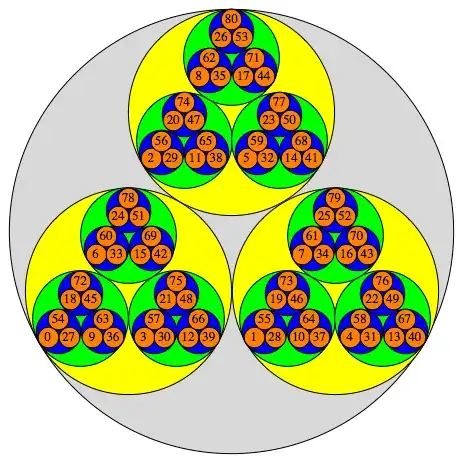
3-adics

Here the outermost circle is all of $\mathbb{Z}_3$; the three large colored circles are the residue classes mod $3$, the smaller circles are the residue classes mod $9$, and so on. If you want to think about $\mathbb{Q}_p$, imagine this picture continued infinitely "upward," (e.g. this circle is accompanied by two others, inside some larger circle, accompanied by two others, etc.).

Now the operations of multiplication and addition do something very geometric. Namely, addition cyclically permutes the residue classes (of each size!) by some amount, depending on the coefficient of $p^n$ in the $p$-adic expansion of whatever $p$-adic integer you have in mind. Multiplication by a unit switches the residue classes around as you'd expect, and multiplication by a multiple of $p^n$ shrinks the whole circle down and sends it to some (possibly rotated) copy of itself inside the small circle corresponding to the ideal $(p^n)$.

Now zero has the $p$-adic expansion $0+0\cdot p+0\cdot p^2+\cdots$ and so it is the unique element in the intersection of the circles corresponding to the residue class $0$ mod $p^n$ for every $n$. So we have a way to think of zeroes of polynomials over $\mathbb{Q}_p$---namely, a Galois extension of $\mathbb{Q}_p$ is some high dimensional vector space $\mathbb{Q}_p^N$ (which you probably have a picture of from linear algebra) acted on by $\mathbb{Q}_p$, in a way that twists each factor of $\mathbb{Q}_p^N$ and permutes the factors of the direct sum, according to the Galois action. That the extension is algebraic means that there's some way to twist it about (using the previously described actions) to put any element at the $0$ point.

Totally ramified extensions add intermediate levels of circles between those that already exist, whereas unramified extensions add new circles. I think this point of view is a particularly appealing visualization.

Now, the algebraic closure of $\mathbb{Q}_p$ is some maximal element of the poset of these algebraic extensions---which is hard to visualize as it is not really "unique," but for the sake of a picture one might think of choosing embeddings $K\to K'$ for each $K'/K$, and then taking the union. Finally, think of the completion in the usual way, e.g. by formally adding limits of Cauchy sequences.

Trying to draw pictures of some finite algebraic extensions of $\mathbb{Q}_p$ might help, and figuring out what the actions by addition and multiplication are is a fun exercise. I hope this "word picture" is as useful for you as it is for me.


ADDED: Though this answer is becoming rather long, I wanted to add another picture to expand on the points I made about unramified and totally ramified extensions above.

Here is a picture of $\mathbb{Z}_3$, which I made with the free software Blender; imagine it continuing indefinitely upward:
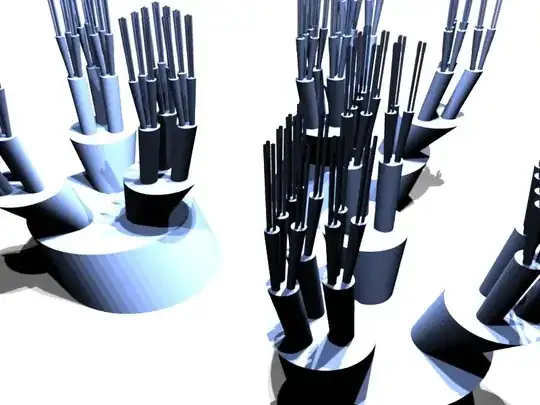
p-adics

A top view of this object should be the previous picture; the actual elements of $\mathbb{Z}_3$ should be viewed as sitting "infinitely high up" on the branches of this tree. As you can see, this object splits into levels, indexed by $\mathbb{N}$, and on the $n$-th level there are $p^n$ "platforms" corresponding to the residues mod $p^n$. For $\mathbb{Q}_p$, the levels should be indexed by $\mathbb{Z}$.

Now what happens when one looks at an unramfied extension of degree $k$? The levels, which correspond to powers of the maximal ideal, should not change, so the levels are still indexed by $\mathbb{Z}$; but the amount of branching on each "platform" is now indexed by $\mathcal{O}_K/m=\mathbb{F}_{p^k}$. So instead of having $p$ branches coming out of each level, one has $p^k$.

On the other hand, what if we have a totally ramified extension of degree $k$? Now $\mathcal{O}_k/m=\mathbb{F}_p$, so there are still $p$ branches on each level. But because the uniformizer now has valuation $1/k$, we can view the levels as being indexed by $\mathbb{Z}[1/k]$ (if you like, the height of each platform is now $1/k$ rather than $1$).

So what is the upshot for $\mathbb{C}_p$? We can view it as a similar diagram, except the levels are indexed by $\mathbb{Q}$, and the branches coming off of an individual platform correspond to elements of $\overline{\mathbb{F}_p}$.

One nice thing about this picture is that one can actually build spaces like the one I've included in the picture---replacing the tubes in my picture with line segments---such that the elements of $\mathbb{Q}_p$ or some extension thereof are a subset of the space (living "infinitely far" from the part I've drawn), with the subspace topology being the usual topology on the local field. Furthermore, the construction is functorial, in that an embedding $K\hookrightarrow K'$ induces a continuous map of spaces. The distance between two points in the local field is then given by their "highest common ancestor" in this garden of forking paths.

(This picture is essentially a description the Berkovich spaces mentioned by Joe Silverman, though I am essentially a novice in that regard, so it's quite possible I've made some mistake; you should take this as a description of my intuition, not Berkovich's definition.)

Daniel Litt
  • 22,187
  • "Now zero has the $p$-adic expansion $0 + 0 \cdot p + 0 \cdot p^2 + \ldots$ and so lies deep in the middle of the circles..." I'm not sure what you mean by this. If the blue disks stands for the residue class zero, then the element zero is the unique element lying in all of the blue disks. But terms like "deep" and "in the middle of" strike me as potentially misleading, because every element of $\mathbb{Z}_p$ has a similar description: no point is any deeper or more in the middle than any other point (and indeed the isometry group acts transitively). – Pete L. Clark Jan 13 '11 at 05:13
  • 1
    @Pete L. Clark: I've edited in agreement with your remark. The notion of "depth" I had in mind was given by the valuation, and I think was influenced by the picture I have in mind of $\operatorname{Spec} \mathbb{Z}_p$ as having a tower of closed subschemes corresponding to the powers of the maximal ideal. But I agree that this view is not particularly helpful. – Daniel Litt Jan 13 '11 at 05:34
  • 3
    @Daniel: if you'll permit me to say so -- along the lines of the answer I've since added, I think the issue is at least partly that when we try to describe our hard-earned intuition to others, it often comes out in distorted and less than helpful ways. – Pete L. Clark Jan 13 '11 at 05:42
  • And, in a totally different direction: when I draw the picture of $p$-adic disks for students, I actually put the "blue disk" (i.e., the one corresponding to the maximal ideal) in the middle and draw the others around it. I point to the blue one and say "this is the open unit disk", then I point to the union of the others and say "this is the corona". Then I explain that when the field is locally compact, a positive proportion (tending to infinity with $p$) of the measure lies on the corona. And then I make sure to make fun of the picture a bit so that no one takes it too seriously. – Pete L. Clark Jan 13 '11 at 05:46
  • That's absolutely true, and unfortunate--I think Bill Thurston laments this in one of his essays. That said, I at least found the picture of $\mathbb{Z}_p$ useful, and I particularly like the descriptions of ramified and unramified extensions (which I've surprisingly never seen described or drawn anywhere). So hopefully someone else will find this useful, and if not, no harm done I hope. – Daniel Litt Jan 13 '11 at 05:48
  • (Just in case that wasn't clear, that last comment was in response to the first of your last two.) And of course it's good to view these pictures with some skepticism--I like the term "corona" though. – Daniel Litt Jan 13 '11 at 05:50
  • 21
    Dear Daniel, thank you for the wonderful explanations and picture: I had never seen anything like that. American students, yours and Pete's for example, are very lucky to have teachers who explain mathematics in such a vividly visual way. – Georges Elencwajg Jan 13 '11 at 08:52
  • I like this picture; thanks! I'll have to think about it more... – Phillip Williams Jan 13 '11 at 16:14
  • 1
    @Georges: I really appreciate your remark, though I do not yet have students :). – Daniel Litt Jan 13 '11 at 21:03
  • 2
    Wow I like your new picture even more...I appreciate the effort in making it too, and the explanation. – Phillip Williams Jan 14 '11 at 05:10
  • 2
    Wow. I actually gave this answer a +1 for the first time after seeing the second picture. As I wrote in my answer, I am in general not a very visual or pictorial thinker (total number of pictures in all of my papers so far: $0$), but...gadzooks, that's a cool graphic. And the tree structure is made especially vivid here, so (even!) I see actual mathematical content. – Pete L. Clark Jan 14 '11 at 06:02
  • 3
    While the picture really is pretty funky, I am totally amazed by the thought that it might help somebody do arithmetic in $\mathbb{C}_p$ or even in $\mathbb{Z}_p$. Still +1 for the effort. – Alex B. Jan 14 '11 at 06:04
  • 1
    Hello, while i like a lot you pictures, and say that they match more or less to the idea i always had about p-adic number and their extensions, i'm not sure about one thing. In particular the branches at points of height $a/bp^k$ for $k>0$ and $(ab,p)=1$ should correspond to totally ramified extensions, and usually there is a lot of them, not just one possibility obtained taking a root of the uniformizer. On the other hand for what concern the tamely ramified extensions, they are unique after taking the compositum with the maximal unramified extension, and the representation works perfectly. – Maurizio Monge Jan 14 '11 at 13:05
  • You're right--I don't quite now how to represent this though. – Daniel Litt Jan 14 '11 at 16:49
  • 1
    In particular, keep in mind, the branches are not extensions but are instead representatives of elements of the quotient by powers of the maximal ideal; I'm not sure one can see the difference between tame and wild ramification in this picture. – Daniel Litt Jan 14 '11 at 16:56
  • I'm really curious, where does this visualization first come from? – temp Jun 07 '12 at 06:45
  • I can see the picture for Z_p and Q_p, but for unramified extensions, I feel like the reason the picture get messy for me is that I don't have a good picture for extension of finite fields! Do you have a way to visualize F_q? – temp Jun 07 '12 at 07:08
  • @temp: Well, the Galois theory of F_p is very simple...as for visualizing F_q, I'm not really sure I know how to do that, since there's no topology. But I can promise that extensions of F_p do not feel so mysterious after a while (compared to e.g. extensions of Q or Q_p). If I were to venture a guess as to the psychological reason for this, it would be that understanding Abelian extensions is much easier than understanding general extensions, and all extensions of F_p are Abelian. – Daniel Litt Jun 07 '12 at 18:56
  • Having looked at your other questions, however, I would guess you already know this :). – Daniel Litt Jun 07 '12 at 18:58
  • "this picture continued infinitely "upward,"

    Said like this, it looks very symmetric, as if we should allow an infinite numbers of decimals in the p-adic extension of a number in $\mathbb{Q}_p$.

    – Weier Jan 09 '24 at 12:30
26

Among the reasons that $\mathbf{C}_p$ is hard to "visualize" are the it is totally disconnected (as is $\mathbf{Q}_p$) and it is not locally compact. The lack of local compactness means, for example, that you can't put a nice measure on $\mathbf{C}_p$. Many people these days instead work on the Berkovich affine line $\mathbf{A}_p^{Berk}$ or the associated Berkovich projective line $\mathbf{P}_p^{Berk}$. The Berkovich line is a topological space that

  1. contains a copy of $\mathbf{C}_p$ as a topological space
  2. is (simply) connected;
  3. is locally compact.

So people do measure theory, and even harmonic analysis, on Berkovich spaces. You can find a brief introduction, with some pictures, in my book The Arithmetic of Dynamical Systems, Springer, Section 5.10. For a more complete introduction, there's a great new book by Baker and Rumely, Potential Theory and Dynamics on the Berkovich Projective Line, American Mathematical Society, 2010.

Final comment: The fact that $\mathbf{C}_p$ is not spherically complete, which was mentioned by Pete L. Clark, plays a role in Berkovich space. More precisely, it leads to some extra points that are needed to make Berkovich space complete.

Joe Silverman
  • 45,660
19
  1. You do whatever works for you. Some people think more algebraically, others more geometrically. I certainly don't know what "to picture" means in this context, but then, I am a more algebraic person, so maybe others will be able to say more. Can you picture $\mathbb{Q}^{ab}$, say? I can't.

  2. A typical element is, by definition, represented by a Cauchy sequence of elements of $\overline{\mathbb{Q}}_p$. Each of the elements in the Cauchy sequence lives in a finite extension of $\mathbb{Q}_p$, so you can view it in the usual way, as a power series in a uniformiser of that finite extension with coefficients in a finite field. But the field $\overline{\mathbb{Q}}_p$ itself is not discretely valued, so you cannot pick a common uniformiser for all the numbers in your Cauchy sequence.

  3. Yes! In my opinion, that's the only way to get a feel for all the fields involved.

  4. That one really is too broad. As you may guess, these fields always come in when you need something $p$-adic that is complete and algebraically closed at the same time. Sometimes, you only need something that is complete and has an algebraically closed residue field. Then, people work with the completion of $\mathbb{Q}_p^{nr}$. For example, these fields are used all the time in $p$-adic Hodge theory (you will find many introductions if you google) and, consequently, in the theory of Galois representations. To expand on that would require a whole essay, which I'm afraid I am not qualified to write.

Alex B.
  • 12,817
  • I have a question to point 2. You seem to choose a finite extension of Q_p in which the whole sequence lies, right? But why does it exist? For me it's only obvious that we have a countable-generated algebraic extension. – Martin Brandenburg Jan 13 '11 at 08:19
  • Dear Martin, sorry if I was ambiguous. I was merely saying that each element of your Cauchy sequence lies in a finite extension. Of course, if all the elements lie in the same extension, then the limit of the sequence already exists in that extension (since it's complete) and you don't get anything new. The new elements of $\mathbb{C}_p$ can only be represented by Cauchy sequences in which the elements lie in infinitely many different extensions. – Alex B. Jan 13 '11 at 08:34
  • That was the point of my last sentence in 2.: you can only view each term of the Cauchy sequence as a power series in its own uniformiser, but you cannot choose the same uniformiser for all the terms (so I personally don't regard that as a particularly helpful way of thinking about the elements of $\mathbb{C}_p$, I was just trying to offer something to the OP, since he was asking how he can think of them). – Alex B. Jan 13 '11 at 08:35
  • 1
    about visualizing Q^{ab}... I think this page can help you a little bit : https://seesar.lbl.gov/anag/staff/ligocki/MathMusing/PolyRoots/index.html – Bo Peng Feb 24 '11 at 16:05
  • 1
    @Bo Peng: thanks, the pictures are certainly pretty. As I have indicated above, such pictures don't actually help me work with these objects, but they can definitely be fun. – Alex B. Feb 24 '11 at 16:41
13

Since there are already several very good answers, I just discuss question 4 (how is ${\mathbb C}_p$ typically used?) with one example of use which made a great impression on me when I learnt it, and made me think that ${\mathbb C}_p$ was something deep and serious, and not only a very amusing curiosity. This example is a theorem of Tate and Sen, which states that if $V$ is a finite-dimensional over $\mathbb{ Q_p}$ vector space with a continuous linear action of $G=$Gal$(\overline{\mathbb Q_p}/{\mathbb Q_p})$ (that is, $V$ is a $p$-adic representation of $G$), then the following are equivalent:

(1) $\dim_{\mathbb Q_p} (V \otimes {\mathbb C_p})^{G} = \dim_{\mathbb Q_p} V.$ (Here, G acts on $\mathbb{C_p}$ by extending by continuity its action on $\overline{\mathbb Q_p}$ and it acts on $V \otimes {\mathbb C_p}$ by acting on both factors.)

(2) The inertia subgroup of $G$ acts on $V$ through a finite quotient (in more knowledeable words, $V$ is potentially unramified).

To appreciate this theorem, it may be useful to solve for oneself the following elementary exercise: if in (1), ${\mathbb C}_p$ is replaced by $\overline {\mathbb Q_p}$, then (2) should be replaced by "$G$ acts on $V$ through a finite quotient". Somehow, replacing $\overline {\mathbb Q_p}$ by its completion allows (1) to see inside the group $G$ and detect the behaviour of the inertia subgroup in it.

I believe that someone who understands the proof of this theorem has necessarily a good understanding of $\mathbb{C}_p$, and this will be my answer to question 3 as well: knowing the proof of the basic assertions on $\mathbb{C}_p$ given in the questions is a first step into a good understanding of that field and its elements, but won't take you very far. Learning the proof of the above theorem will let you get a much deeper look inside $\mathbb{C}_p$ -- and in addition you will learn a nice result, which is a first step in the fundamental $p$-adic Hodge Theory.

Joël
  • 25,755
11
  1. No, not necessarily. It is hard to get a faithful geometric picture of a non-Archimedean space. It may be helpful to have schematic approximate pictures in mind like in Daniel Litt's answer, but it is just as important to recognize the limitations of these pictures. Speaking only for myself, contemplating the picture in Daniel's answer did not help me understand $p$-adic numbers: I was exposed to the picture offhandedly in a course I took as a college freshman, but it didn't make much sense to me until I studied the algebraic and metric properties of non-Archimedean fields more carefully (at a later time). Pictures here are a form of intuition. Having intuition is always helpful and at times indispensable, but importing others' intuition often does not work: you need to develop your own.

  2. I would say no to this as well. Of course you should understand what $\mathbb{C}_p$ means and how it is constructed, but in general thinking of algebraic structures element by element is not so useful. By this I mean that rather than thinking of an element of $\mathbb{C}_p$ as a certain Cauchy sequence of elements in algebraic extensions of $\mathbb{Q}_p$ of varying degree, it is just as useful, and logically simpler, just to think of $\mathbb{C}_p$ as a complete, normed field containing a dense copy of the algebraic closure of $\mathbb{Q}_p$ with the (unique) extension of the $p$-adic metric.

  3. Oh, yes. You should definitely understand why the completion of the algebraic closure of the $p$-adic completion of $\mathbb{Q}$ is algebraically closed! Of course, it's best if you can embed this fact into a general understanding of non-Archimedean fields rather than learning and memorizing an argument which shows exactly this. For instance, in these notes I deduce (Corollary 22) the fact that the completion of a separably closed normed field is separably closed from Krasner's Lemma, which to me personally has become one of the most useful and meaningful parts of the entire theory. Later on I show that a complete, separably closed field is necessarily algebraically closed (Proposition 27). These are the right explanations for me, and I think they are good ones, but I'm not saying they need to be the right explanations for you. Maybe something else speaks to you more than Krasner's Lemma.

  4. Why are you lamenting your lack of understanding of $\mathbb{C}_p$ if you don't know how it is used? (This is not meant to be rhetorical or combative: it's a sincere question.) There are a lot of different answers in different areas of mathematics. Moreover, for many people (and even some number theorists), the honest answer is that it is not used for anything in particular. For instance, above I referred to some of my notes for a course I taught last spring on local fields and adeles. From the perspective of those notes, the Henselian field $\overline{\mathbb{Q}_p}$ is just as good and perhaps more natural. On the other hand, for some people going to $\mathbb{C}_p$ is not far enough: it is not spherically complete, meaning that the key property of a locally compact field like $\mathbb{C}$ or $\mathbb{Q}_p$ that a nested sequence of closed balls necessarily has nonempty intersection does not hold in general. If you want to do serious $p$-adic functional analysis -- e.g. if you want things like the Hahn-Banach Theorem to hold -- then you want to work in $\Omega_p$, the spherical completion of $\mathbb{C}_p$. But my guess is that the average working number theorist doesn't even know what $\Omega_p$ is, so it depends a lot on what you want to do.

(Edit: the link to the notes is broken, but see here instead. Krasner's Lemma appears on page 78 of the pdf.)

Pete L. Clark
  • 64,763
  • 6
    Dear Pete, Related to the discussion of spherical completeness in (4), I think that people often retreat to a finite extension $E$ of $\mathbb Q_p$, rather than advance all the way to $\Omega_p$ (certainly this is what I do!) since one then stays on more familiar territory and one has a discretely valued field as well. (And in applications often one only needs finitely many irrationalities, which can be packaged in the complete field $E$, rather than all of them, where one then has to advance to $\mathbb C_p$ or $\Omega_p$ to get the desired completeness properties.) Regards, Matt – Emerton Jan 13 '11 at 06:00
  • 1
    @Matt: good points. I hope you will offer an answer as well: I would be interested to read it. – Pete L. Clark Jan 13 '11 at 06:04
  • 1
    Hi Pete, I'm not sure that many number theorists use the spherical completion of $\mathbf{C}_p$, maybe because it's too big to easily work with and too small to have really nice properties. However, lots of number theorists these days are using Berkovich spaces and proving, for example, equidistribution results for Galois orbits, which then have interesting arithmetic applications. – Joe Silverman Jan 13 '11 at 14:28
  • @Prof. Silverman: yes, I was right on the border of mentioning the connection to Berkovich spaces, both w.r.t. spherical completion and as an answer to the question as a whole: trying to picture about the Berkovich $p$-adic disk (or projective line, or...) seems like a more rewarding exercise than trying to picture $\mathbb{C}_p$ as a non-Archimedean metric space. – Pete L. Clark Jan 13 '11 at 15:35
  • Ah, but I see you have. (I suppose I guessed that someone more qualified would come along and do so.) – Pete L. Clark Jan 13 '11 at 15:36
  • @Pete: In regards to 4, there are many things in mathematics that give me the impression of being "important" though I could not tell you why anyone thinks so, as far as my own understanding of anything goes. I'm trying to repair gaps in my understanding of algebraic number theory; part of what I'm seeking is some idea as to why something I want to run from seems to be showing up all over the place. So it's helpful for me to know how the experts treat it; your comments, and those of others, do seem to be providing this for me, so thank you! – Phillip Williams Jan 13 '11 at 15:40
  • 1
    Pete, I believe you are using the wrong definition of "spherically complete". A nested sequence of closed balls whose radii go to zero always has intersection equal to a point in a complete metric space. In order for a metric space to be spherically complete, you need any nested sequence of closed balls whose radii do not necessarily go to zero to have nonempty intersection. For example, in $\mathbb{C}_p$, you can choose a sequence like $B(0,p^{1/2})$, $B(p^{-1/2},p^{1/3})$, $B(p^{-1/2}+p^{-1/3}, p^{1/5})$, $B(p^{-1/2}+p^{-1/3}+p^{-1/5},p^{1/7}),\ldots$, with empty intersection. – S. Carnahan Feb 24 '11 at 15:21
  • @Scott: yes, of course you're right. I've fixed the oversight. – Pete L. Clark Feb 24 '11 at 15:25
4

One point that I don't think anyone has mentioned yet is that $\mathbb{C}_p$ is isomorphic (as an untopologised field) to $\mathbb{C}$. More generally, any two uncountable algebraically closed fields of the same characteristic and cardinality are isomorphic, if I remember correctly. Of course the proof is horrendously non-constructive, but the very definition of $\mathbb{C}_p$ is already horrendously non-constructive. So instead of worrying about what $\mathbb{C}_p$ is, you can instead worry about why $\mathbb{C}$ admits a $p$-adic metric with respect to which it is complete. I don't have anything to offer about that.

[Corrected as per Johannes Hahn's comment]

  • 4
    Not all alg.closed fields of the same cardinality are isomophic. Example: $\overline{\mathbb{Q}}$ and $\overline{\mathbb{Q}(\pi)}$ are not isomorphic. Your result only holds for uncountable fields. – Johannes Hahn Jan 13 '11 at 11:05
  • 1
    Doesn't the same-cardinalty-isomorphism depend on AC? In which case, you can't get a picture of anything... – Ketil Tveiten Jan 13 '11 at 15:25
  • @Ketil: yes, but AC is already needed to construct algebraic closures, so we can't begin to talk about $\mathbb{C}_p$ without it. – Neil Strickland Jan 13 '11 at 16:13
  • 2
    @Neil: AC isn't needed to talk about algebraic closures: it's needed to be sure that every field has an algebraic closure. For instance, certainly AC is not needed (or used) to show that $\mathbb{R}$ has an algebraic closure. I would be interested to know whether it is actually required for $\mathbb{Q}_p$. – Pete L. Clark Jan 13 '11 at 16:24
  • Pete: Since all the irreducible polynomials in Q_p[x] of a fixed degree split in some finite extension of Q_p (that's how I will say Q_p has only finitely many extensions of each degree in an algebraic closure without mentioning the term "algebraic closure), one should be able to construct an algebraic closure of Q_p without using AC in its most general form. – KConrad Jan 14 '11 at 07:52
  • @KConrad: sure, it's clear that one can get away with only a weak form of choice. But my question is whether you need any choice at all. – Pete L. Clark Jan 14 '11 at 11:27
  • In fact, now that I think about it, I strongly suspect that no choice is needed whatsoever... – Pete L. Clark Jan 14 '11 at 11:28
  • @PeteL.Clark It seems that you are correct: https://math.stackexchange.com/questions/803524/fields-whose-algebraic-closure-cannot-be-constructed-without-the-axiom-of-choice#comment3808722_803524 – Z. M Feb 11 '22 at 23:44
2

You may, or may not, be able to derive some inspiration from "Artist's conception of the 3-adic unit disc" by A. T. Fomenko, included as frontispiece in Neal Koblitz' book, $p$-adic Numbers, $p$-adic Analysis, and Zeta-Functions.

Gerry Myerson
  • 39,024