5

Let $P\subset\Bbb R^d$ be a convex polytope (a convex hull of finitely many points). Lets call it flexible, if it can be continuously deformed while

  • keeping its combinatorial type, and
  • keeping its edge-lengths.

I know that the $d$-cube is flexible in this sense. More generally, most (all?) zonotopes are flexible (see the comments). Also all polygons are flexible. But are there any others?

$\quad\quad$
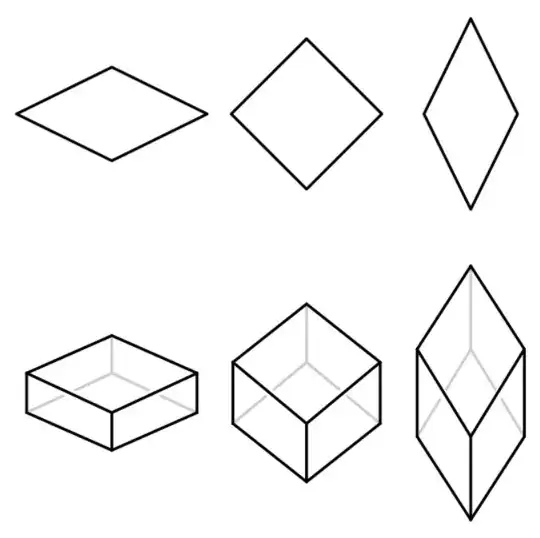
I also know that there are polytopes having several realizations with matching edge-lengths (e.g. see the image here), but these realizations cannot be continuously deformed into each other while preserving all edge-lengths.

M. Winter
  • 12,574
  • Possibly: All zonohedra? – Joseph O'Rourke Oct 10 '20 at 12:15
  • @JosephO'Rourke Oh I see. I suspect you mean to generate a polytope $$Z=\sum\mathrm{conv}{-r_i,r_i}$$ for some (generic) unit vectors $r_i$, and then you change these unit vectors continuously. So the question might be whether there are any that are not zonohedra/zonotopes (or polygons)? Is it still okay for me to edit the question? – M. Winter Oct 10 '20 at 12:18
  • Sure, please edit as you see fit. – Joseph O'Rourke Oct 10 '20 at 13:55
  • What about a pentagonal cylinder, i.e. ${(\cos 2\pi n/5, \sin 2\pi n/5, \pm 1)}$? Or a cylinder of any other polygon? –  Oct 10 '20 at 16:53
  • @MattF. Right. A prism over any flexible polytope is flexible. Probably the same holds for the cartesian product of a flexible polytope and an arbitrary polytope. What about Minkowsi sums? It might be useful to find the "elementary" flexible polytopes. – M. Winter Oct 10 '20 at 17:29
  • Perhaps, it is also better to search for “minimal” ones. E.g., you may glue anything to a facet of a cube, and it remains flexible (although with less freedom). Perhaps, you are not interested in such examples? – Ilya Bogdanov Oct 10 '20 at 20:50
  • What I take a away from this discussion in the comments is, that there are many more flexible polytopes than what I have naively assumed. So I suppose I have to rethink this question. I still think it would be interesting to ask whether there are any "unexpected" flexible polytopes, that are not polygons, zonotopes, or are created by products, Minkowski sums, gluing, or any other (not yet considered) "trivial" process. But this should certainly be made more precise. In any way, thanks to all of you for your input. – M. Winter Oct 11 '20 at 00:23
  • maybe looking structural rigidity is helpful. In the linked article it is stated that "In any dimension, the rigidity of rod-and-hinge linkages is described by a matroid" – Manfred Weis Oct 12 '20 at 03:15

0 Answers0