67

The Navier-Stokes equations are as follows,

$$\dot{u}+(u\cdot \nabla ) u +\nu \nabla^2 u =\nabla p$$

where $u$ is the velocity field, $\nu$ is the viscosity, and $p$ is the pressure.

Some elementary manipulations show that if you zoom in by a factor of $\lambda$, then you expect viscosity to scale as $\lambda^{\frac{3}{2}}$. So, for example, if you zoom in to the length scale of a cell, you expect viscosity to be around a million times larger than humans experience it.

This is not observed, however, which makes sense since we expect the components of a cell to move around extremely quickly. (EDIT: this is observed - see answer - my initial google searches were untrustworthy, damn google). Nonetheless, the calculation above suggests that they feel like they are moving through one of the most viscous fluids imaginable.

What then is the mechanism that prevents this? I have seen some explanations through the ideas of 'microviscosity' and 'macroviscosity' in the physics community, but I couldn't find much of a theoretic backing for them.

I'm wondering if there is a more mathematical explanation, perhaps directly from the Navier-Stokes equation itself (seems unlikely), or something from a kinetic theory point of view? For example some kind of statistical model of water molecules that reproduces the result?

vmist
  • 889
  • 2
    My comment is unrelated to your question, but maybe this can be interesting for you. I've asked few months ago the post with title Fluid dynamics for the sepiolite on Physics Stack Exchange, post with identitficator 552396. On the other hand Wikipedia has an article dedicated to Sepiolite (if you're interested in this material). Isn't required a response/reply for this comment and I hope that it doesn't disturb to you. – user142929 Aug 03 '20 at 17:01
  • 2
    @user142929's PSE question: https://physics.stackexchange.com/questions/552396/fluid-dynamics-for-the-sepiolite . – LSpice Aug 03 '20 at 23:13
  • 1
    Have you ever heard of the Reynolds number? It's the reason insects fly so differently from birds and aircraft and can manuever the way they do whereas birds and aircraft cannot. They are swimming through the air more than flying through it. But we don't know the physics down at that level very well. If we did, we wouldn't have so much trouble simulating and building micro-UAVs (which are still enormous compared to insects). – DKNguyen Aug 05 '20 at 21:55
  • "This is not observed, however": No? – Peter - Reinstate Monica Aug 06 '20 at 15:42

3 Answers3

103

There is a beautiful article (a write-up of a talk, actually), by E.M. Purcell, Life at low Reynolds number, that explains how bacteria swim.

Low Reynolds number is the technical way to phrase the statement in the OP that motion at that scale feels like moving in a tar pit. The governing equation is the linearized Navier-Stokes equation, a.k.a. the Stokes equation, which lacks the inertial $v\nabla v$ term. The linearity of the Stokes equation means that the swimming technique which we would use, moving arms or legs back and forth, will not work. Purcell calls this the "scallop theorem": opening and closing the shells of a scallop will just move the object back and forth, without net forward motion.
Inertia can still play a role on short time scales, as explained in Emergency cell swimming.

The way bacteria move in the absence of inertia is the way a corkscrew enters a material upon turning, the cork screw being the flagellum. In fact, any nonsymmetrical object, when turned will propagate in a tar pit. Typical velocities are $1$ mm/min, as Purcell says: "Motion at low Reynolds number is very majestic, slow, and regular."

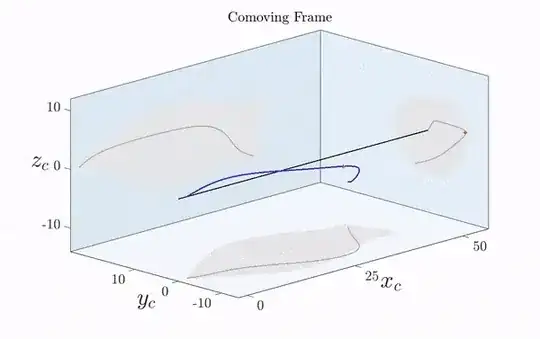
Here is a visualization of a sperm cell moving by rotating its flagellum (published just this week in Science Advances).

Note that the rotation is only clearly visible in three dimensions. Two-dimensional projections suggest a beating motion (first reported by Van Leeuwenhoek in the 17th century), which is not an effective means of propagation at low Reynolds number.

Carlo Beenakker
  • 177,695
  • 4
    So to be clear you’re saying the NS equations at that scale are still approximately valid? – Sam Hopkins Aug 03 '20 at 13:12
  • 5
    yes, and in fact they are valid in the fully linearized form (without the $v\nabla v$ term) – Carlo Beenakker Aug 03 '20 at 13:14
  • 3
    What about paramecia? – Nik Weaver Aug 03 '20 at 14:50
  • 7
    paramecia work around the scallop theorem by beating their cilia in an asymmetric stroke, see https://www.pnas.org/content/108/18/7290 – Carlo Beenakker Aug 03 '20 at 14:52
  • It's worth noting that the way humans swim is already very inefficient. Nearly all of the energy expended when swimming is wasted, and world class pace in the water is essentially a brisk walk for most people. – Gabe K Aug 04 '20 at 22:28
  • I think I understand the projections on the $x z$- and $x y$-planes, but what is the extra orange dot on the $y z$-plane tracing? – LSpice Aug 04 '20 at 23:08
  • 3
    @LSpice If you look on the 3d-animated portion you will also see an orange dot, which is at the midpoint of the string/flagellum from what I can see. – zibadawa timmy Aug 05 '20 at 04:39
  • 1
    I'm now wondering if it's actually faster/more efficient to move in a viscous fluid than a non viscous fluid. For example could you think of this as saying the cork screw motion is not efficient for humans, or boats (even though propellers still use it), and actually they might benefit from water being more viscous than it is? – vmist Aug 05 '20 at 23:11
  • 3
    @vmist For what it's worth, the paper this post starts out with mentions that the flagellum-propulsion is about 1% efficient. Which sounds awful, but the total amount of power they need to run the thing is still just a small fraction of their total energy intake, so the efficiency is pretty irrelevant. Good human swimmers are something like 3% efficient. Dolphins are more like 80%, I think. – zibadawa timmy Aug 06 '20 at 07:14
18

You may be interested in Shapere, A., and F. Wilczek. 1987. Self-propulsion at low Reynolds number. Phys. Rev. Lett. 58: 2051–2054 where they use gauge theory to describe micro-swimming. Because the Stokes equation - the infinite viscosity limit of Navier-Stokes - is linear, it allows us to define a connection for the principal G bundle: (located shapes) --> (unlocated shapes). Here G is the group of rigid motions of space, a located shape is (say) a volume-preserving embedding of the ball into usual 3-space, and the space of unlocated shapes is the quotient space of the space of located shapes by the action of G. Think of the ball as the cell (parmecium, E Coli, cyanobacterium, ..) which wants to move. A swimming stroke is then a loop in the space of unlocated shapes. The resulting holonomy for the Stokes connection is computed by solving the Stokes equation with zero boundary data at infinity. Shapere in his thesis estimates the curvature at the embedding which is a round ball, and thereby investigates ``infinitesimal swimming motions''. Some of this story can also be found in my book, A Tour of SubRiemannian Geometry.

Carlo Beenakker
  • 177,695
2

If I am not mistaken, the Navier Stokes equations do not include random motion due to thermal fluctuations. Because of typical physiological temperatures, molecules bounce around vividly through random kicks in an overdamped viscous fluid, giving rise to Brownian dynamics.

  • 3
    This seems to be a possible explanation of random motion, but not volitional motion of the sort that @‍vmist seems to consider and that @‍CarloBeenakker's answer addresses. – LSpice Aug 03 '20 at 22:32
  • 1
    @LSpice Perhaps it was meant as a response to the original question's comment that "we expect the components of a cell to move around extremely quickly". – Robin Saunders Aug 04 '20 at 19:00