61

If people think this is the wrong forum for this question, I'll cheerfully take it elsewhere.

But: How did Solomon Lefschetz do mathematics with no hands?

Presumably there was an amanuensis to whom he dictated his papers, and then dictated his revisions. Does history record that person's identity? Was it someone trained in mathematics? Someone we might have heard of independently? Or maybe a series of graduate students?

And what about the research phase, when most of us make a lot of idle notes, come back, revisit, cross things out, etc. Was Lefschetz also dictating all these idle thoughts to someone --- or did he learn to hold them in his mind until he was ready to write a paper? Or something else?

Or did he have some sort of prosthetics that allowed him to write?

I expect there are people alive --- and perhaps active on this site --- who were at Princeton during the time Lefschetz was active, or who have had direct contact with such people. Maybe one of them can answer?

Edited to add: If anybody is tempted to answer that "he used a Lefschetz Pencil, of course!", I've just pre-empted you.

  • 52
    Even more remarkable in my opinion is Bernard Morin, blind since the age of six, yet he was the first person to visualize how to smoothly evert a sphere (proved possible by Smale). See https://en.wikipedia.org/wiki/Sphere_eversion. I had the pleasure of visiting Morin in Strasbourg, where he explained to me his construction. – Richard Stanley Jun 25 '19 at 02:46
  • I don't have time to read and translate this now but Alberto Verjovsky, Lefschetz' last student, speaks about Lefschetz in this interview (in Spanish): http://universo.math.org.mx/2014-1/Recordando-a-Lefschetz/Recordando-a-Lefschetz.html – Taladris Jun 25 '19 at 15:38
  • 5
    You are asking us to second-guess his mental processes, among other things, which seems impossible. I also find the tone of the question disrespectful and somewhat condescending. – Geoff Robinson Jun 25 '19 at 19:03
  • 1
    Others have made good answers, but if I hadn’t read them, I would have assumed he wrote or typed with his feet, as myriad other handless people have done. – WGroleau Jun 25 '19 at 19:44
  • @Richard_Stanley just possibly, not being continually subject to real-world physically-restricted visual inputs was actually helpful for visualizing in the mathematical sense. One might compare Beethoven who composed his greatest (and most revolutionary) music after going deaf. – nigel222 Jun 26 '19 at 11:15
  • 2
    One should note that there are people with greater physical disability, who (pre-computers) learned to write with their feet, or with their mouths. Mathematics is much less prolix than ordinary language (and you can invent your own notations), so mathematical note-making may be less challenging than writing notes in natural language. – nigel222 Jun 26 '19 at 11:26
  • @nigel222 I agree. – Richard Stanley Jun 26 '19 at 14:14
  • 1
    Just wanted to mention Pontryagin and Vitushkin, to add to Richard Stanley comment. – TT_ stands with Russia Jun 26 '19 at 22:33
  • 2
    @GeoffRobinson: Trying to second-guess his techniques or thoughts would be both disrespectful and unhelpful, I agree. Asking if he or his colleagues left us any record of those techniques seems entirely reasonable, and may be both useful and inspirational to others who have practical obstacles to the standard expected ways of doing maths. – Peter LeFanu Lumsdaine May 12 '21 at 07:58

3 Answers3

49

I just found this in Halmos's autobiography: "The natural hands were replaced by a neat-looking pair of wooden hands, covered by gloves. As prosthetic devices they were awkward, but they were good enough to hold a pen or a piece of chalk."

I guess this question can be closed or deleted now

  • 3
    FWIW I think mention of these hands can be found in Rota's stories/anecdotes about Fine Hall, in e.g. Indiscrete Thoughts – Yemon Choi Jun 25 '19 at 03:39
  • 32
    Why not just accept your own answer after the required wait? Then others who google this question will be able to find this post. – David Roberts Jun 25 '19 at 05:50
  • 20
    Indeed, deleting it would be a bad idea. – Filippo Alberto Edoardo Jun 25 '19 at 06:00
  • @DavidRoberts: I suppose that's the usual procedure, but it feels a little icky to grant myself reputation points. (Unless maybe there are no points for accepting your own answer?) I'll try to get over it. – Steven Landsburg Jun 25 '19 at 06:11
  • 1
    If you're worried about the points, Steven, can't you make your answer Community Wiki? (not that I see any necessity to do that) – Gerry Myerson Jun 25 '19 at 06:19
  • @GerryMyerson : Thanks. I don't object to the points from other people's upvotes; it''s granting them to myself via an acceptance that made me a little squeamish --- but I've got a couple days to get over that. Or maybe a better answer will come along. – Steven Landsburg Jun 25 '19 at 06:42
  • 12
    I was told by a former Phd student of him that in Princeton every day there was a graduate student that had the duty to put a piece of chalk in Lefschetz' right hand in the morning when he arrived and to take it down when he left. – Xarles Jun 25 '19 at 08:21
  • 5
    You don't get reputation from accepting your own answer. Additionally, I think the answer is not put before higher scoring answers in that case. – Arnaud D. Jun 25 '19 at 08:36
  • @ArnaudD. : Thanks. That resolves my issue completely. – Steven Landsburg Jun 25 '19 at 17:57
  • I saw once a movie of a lecture by Lefschetz. (Back in those days, it came on film and we had to thread it into a projector.) There were, indeed, black gloves. He could write on a blackboard with no trouble. I did a cursory check in YouTube, but did not see such a thing there today. – Gerald Edgar Jun 26 '19 at 11:54
  • @Gerald Edgar: apparently the movie of Lefschetz lecturing is in the Princeton library: perhaps it could be uploaded to YouTube 'https://blogs.princeton.edu/mathclub/2019/05/09/thursday-lefschetz-film-screening-inb/ – roy smith Feb 09 '24 at 23:34
41

enter image description here

Photograph by Paul Halmos showing the artificial hands of Solomon Lefschetz [source]

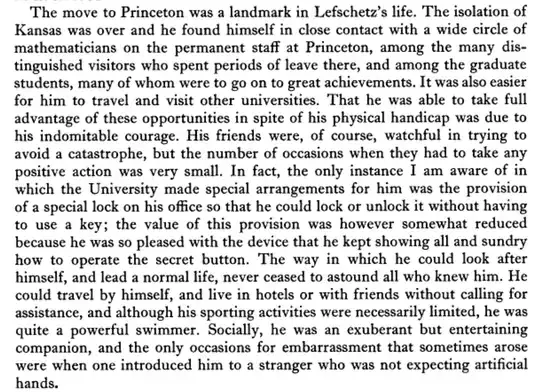
This quote [source] shows how Lefschetz overcame some limitations of his disability:

Carlo Beenakker
  • 177,695
  • 27
    This photo seems to resolve the question at the cost of raising a more difficult question: How did he tie that necktie? – Steven Landsburg Jun 25 '19 at 14:22
  • 3
    @StevenLandsburg --- good point: I added a quote that shows Lefschetz's resourcefulness in another domain (locking and unlocking doors), and I presume tying and untying a necklace was a comparably simpler problem (don't undo the knot). – Carlo Beenakker Jun 25 '19 at 14:49
  • 8
    @StevenLandsburg It appears to be a pencil tie so... oh, curse your pre-emption. – David Richerby Jun 25 '19 at 16:10
32

Surely his wife, nee Alice Berg Hayes, deserves much credit. She graduated with a master's degree in mathematics at Clark, with a thesis on "Reduction of Power Determinants". This was where she met Lefschetz, and she received her M.A. on the same day that he received his Ph.D.

Albert Tucker and Frederik Nebeker said in the Dictionary of Scientific Biography:

She helped him to overcome his handicap, encouraging him in his work and moderating his combative ebullience.

Lefschetz himself said:

of debts which I may never succeed in liquidating to the full...the first is my enormous debt to my wife Alice, my Clark companion. Without her constant and unfailing encouragement through 59 years, 56 as my wife, I would have long since ceased to operate.