52

The first ever black hole was "pictured" recently, per an announcement made on 10th April, 2019. See for example: https://www.bbc.com/news/science-environment-47873592 .

It has been claimed that state-of-the-art imaging algorithms were an enabler for this historic success. Does anybody care to describe the difficulties, and (quite certainly non-trivial) mathematics that went into this effort ?

  • 7
    For reference here is the paper where the collaboration described data processing: https://iopscience.iop.org/article/10.3847/2041-8213/ab0c57/meta – Neal Apr 11 '19 at 02:11
  • Katie Bouman's work might shed some light here! – Yousuf Soliman Apr 11 '19 at 02:39
  • 4
    But, @yousuf, will that light be able to escape from the black hole? – Gerry Myerson Apr 11 '19 at 06:34
  • 6
    The actual image reconstruction is described in paper IV: https://iopscience.iop.org/article/10.3847/2041-8213/ab0e85. In a nutshell, they formulated a baker's dozen of data misfit (for all the different acquired data as described in paper III) and regularization (including total variation and sparsity) functionals, and then minimized their weighted sum using L-BFGS. Not quite state-of-the-art from a mathematical point of view (especially using BFGS for a non-differentiable functional), but close enough. – Christian Clason Apr 11 '19 at 07:04
  • 5
    Great post and answer. For those also interested on the physics side of the discussions, here's a recent post: https://physics.stackexchange.com/questions/471972/putting-the-importance-of-the-blackhole-image-into-perspective – user929304 Apr 11 '19 at 13:49
  • 1
    Related post on twitter: https://mobile.twitter.com/sky0_1/status/1116759965329494017 – Alexander Chervov Apr 20 '19 at 15:06

1 Answers1

45

Essential elements$^*$ of the reconstruction algorithm were developed at MIT under the name CHIRP = Continuous High-resolution Image Reconstruction using Patch priors, as described in Computational Imaging for VLBI Image Reconstruction (2015).

The difficulty of VLBI (Very Long Baseline Interferometry Image) reconstruction is that the inversion problem is highly-ill posed, there are many images that explain the data. The challenge is to find an explanation that respects our prior assumptions about the “visual” universe while still satisfying the observed data. Bayesian approaches are generally employed for that purpose, in CHIRP machine learning is used to automatically identify visual patterns --- obviating the need for hand training of the algorithm.

A key technical innovation is a way to correct for the delays in the signal received from the various telescopes. The delays are difficult to predict, since they depend the local variations in the speed of the radio waves through the noisy atmosphere. CHIRP adopts an algebraic solution known as phase closure to this problem: If the measurements from three telescopes are multiplied, the extra delays caused by atmospheric noise cancel each other out.

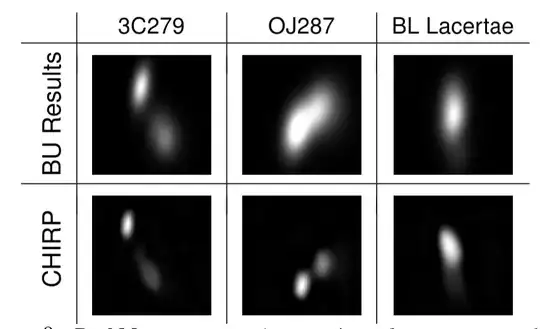
One test case that shows the resolving power of CHIRP, compared to a competing algorithm (BU) is shown below (taken from the MIT paper). Notice how CHIRP is able to resolve 2 separate, previously unresolved, bright emissions in the blazar OJ287.

$^*$ UPDATE: This statement must be qualified, as stated by the lead author, Katie Bouman: “No one person or algorithm made the image. It was actually made by combining the images produced by 3 separate imaging pipelines, leading to a more powerful result than we could ever achieve with any single method.”

Carlo Beenakker
  • 177,695