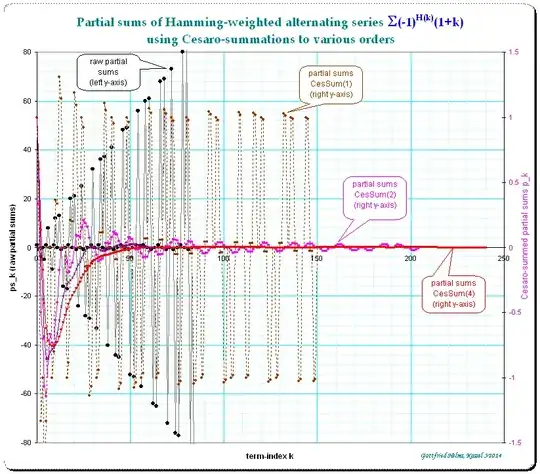
We give two arguments: one that shows rigorously that sufficiently large Cesaro means of $s(p)$ tend to zero for all $p=0$, $1$, $\ldots$, and the other that gives a quick indication of why this is so. Note: I think I got the standard version of Cesaro summation right below, but there are several equivalent forms (in a previous edit I had worked with Riesz means instead of Cesaro means) and in any case the argument would be substantially the same.
First Argument.
Put as in the problem
$$
S(z) = \prod_{k=0}^{\infty} (1-z^{2^k}) = \sum_{n=0}^{\infty} (-1)^{H(n)} z^n,
$$
which is an analytic function in $|z|<1$. Define also for each non-negative integer $k$,
$$
H_k(z) = \sum_{n=0}^{\infty} \binom{n+k}{k} z^n= \frac{1}{(1-z)^{k+1}}.
$$
We are interested in the Cesaro means
$$
C(N;p,k) = \binom{N+k}{k}^{-1} \sum_{n=0}^{N} (-1)^{H(n)} (n+1)^p \binom{N-n+k}{k},
$$
and we wish to show that if $k\ge p+2$ then $C(N;p,k) \to 0$ as $N\to \infty$.
Let $0<r<1$ be a real number to be chosen later. Note that
$$
\frac{d^p}{d\theta^p} (re^{i\theta} S(re^{i\theta}) ) = \frac{d^p}{d\theta^p} \sum_{n=0}^{\infty} (-1)^{H(n)} (re^{i\theta})^{n+1} = i^p \sum_{n=0}^{\infty} (-1)^{H(n)} (n+1)^p (re^{i\theta})^{n+1}.
$$
Therefore by Parseval
$$
\frac{1}{2\pi} \int_0^{2\pi} \Big(\frac{d^p}{d\theta^p} (re^{i\theta}S(re^{i\theta}))\Big) H_k(re^{i\theta}) (re^{i\theta})^{-N-1} d\theta = i^p \binom{N+k}{k} C(N;p,k).
$$
Integrating by parts several times, the LHS above equals
$$
\frac{(-1)^p}{2\pi } \int_0^{2\pi} (re^{i\theta} S(re^{i\theta}) ) \Big(\frac{d^p}{d\theta^p} (H_k(re^{i\theta}) (re^{i\theta})^{-N-1})\Big) d\theta. \tag{1}
$$
Now we use the following bounds for $|S(z)|$ and the derivatives of $H_k(z)$. Note that for any $z$ with $|z|<1$ and any natural number $K$ we have
$$
|S(z)| = \prod_{k=0}^{\infty} |1-z^{2^{k}}| \le \Big(\prod_{k=0}^{\infty} (1+|z|^{2^k})\Big) \Big(\prod_{k=0}^K (2^k |1-z|)) \Big) \le C_K \frac{|1-z|^{K+1}}{(1-|z|)},
$$
for some constant $C_K$. Next note that for any non-negative integer $j$
$$
\Big| \frac{d^j}{d\theta^j} H_k(re^{i\theta}) \Big| = \Big|\sum_{n=0}^{\infty} \binom{n+k}{k} n^j r^n e^{-in\theta}\Big| \le
D_{k+j} \Big( 1+ \frac{1}{|1-re^{i \theta}|^{k+j+1}}\Big)
$$
for some constant $D_{k+j}$. It follows that
$$
\Big|\frac{d^p}{d\theta^p} (H_k(re^{i\theta}) (re^{i\theta})^{-N-1}) \Big| \le r^{-N-1} A(k,p) \sum_{j=0}^{p} N^{p-j}
\Big( 1+\frac{1}{|1-re^{i\theta}|^{k+j+1}} \Big)
$$
for some constant $A(k,p)$.
We take $r= 1-1/N$, and use these bounds in (1). Thus we get that this quantity is
$$
\ll_{K,p,k} \int_0^{2\pi} N |1-re^{i\theta}|^{K+1} N^{p} \Big(1 + \frac{1}{|1-re^{i\theta}|^{k+1} }\Big) d\theta
\ll N^{p+1},
$$
upon choosing $K \ge k$. We conclude that
$$
|C(N;p,k)| \ll N^{p+1-k},
$$
so that this tends to zero for large $N$ if $k\ge p+2$.
Second Argument.
Consider the Dirichlet series
$$
F(s) = \sum_{n=0}^{\infty} (-1)^{H(n)}(n+1)^{-s},
$$
which converges absolutely for Re$(s)>1$. We will obtain a meromorphic continuation for this, which suggests the proper way of renormalizing the sums in the question.
Now consider, following Riemann,
$$
\int_0^{\infty} e^{-y}S(e^{-y}) y^{s} \frac{dy}{y}.
$$
In the region Re$(s)>1$ we may expand the above as
$$
\int_0^{\infty} \sum_{n=0}^{\infty} (-1)^{H(n)} e^{-(n+1)y} y^s \frac{dy}{y}
= \Gamma(s) \sum_{n=0}^{\infty} (-1)^{H(n)} (n+1)^{-s}= \Gamma(s)F(s). \tag{2}
$$
Now we examine the LHS above. Since $e^{-y}S(e^{-y})=O(e^{-y})$ as $y\to \infty$ clearly
$$
\int_{1}^{\infty} e^{-y}S(e^{-y}) y^{s} \frac{dy}{y}
$$
is an analytic function for all $s\in {\Bbb C}$. Next note that as $y\to 0$ we have $e^{-y}S(e^{-y}) = O(y^K)$ for any positive integer $K$. Therefore
$$
\int_0^1 e^{-y}S(e^{-y}) y^s \frac{dy}{y}
$$
is also an analytic function of $s$ for all $s\in {\Bbb C}$. We conclude that the LHS of (2) extends analytically to ${\Bbb C}$.
To recap, $\Gamma(s) F(s)$ is analytic in ${\Bbb C}$. Since $\Gamma$ is never zero, and $\Gamma$ has poles at $s=0$, $-1$, $-2$, $\ldots$, we find that $F(s)$ is analytic everywhere, and $F(0)=F(-1)=F(-2)=\ldots =0$.
Thus the regularized values for $s(0)$, $s(1)$, $s(2)$, etc should all be zero.