36

When I was a teenager, I was given the book Men of Mathematics by E. T. Bell, and I rather enjoyed it. I know that this book has been criticized for various reasons and I might even agree with some of the criticism, but let's not digress onto that. E. T. Bell made a reasonable list of 34 of the greatest mathematicians from the ancient Greek period to the end of the 19th century. His list isn't perfect — maybe he should have included Klein or skipped Poncelet — but no such list can be perfect anyway. I think that his selection was good. He also made the careers of these mathematicians exciting and he addressed why mathematicians care about them today. It helped me learn what achievements and topics in mathematics are important.

(Just to head off discussion, the standard complaints include that the title is sexist and so is the book, that Bell was loose with biographical facts, and that he "chewed the scenery".)

After the period covered by Bell, there is a 50-70 year gap, followed by the the Fields Medals. The list of Fields Medalists has its own limitations, but it is another interesting, comparably long list of great mathematicians. Somewhat accidentally, this list also orients and motivates advanced mathematics students today.

But who are the great mathematicians in the gap itself, that is, those born between 1850 and 1900, or say between 1860 and 1910? (Or 1920 at the latest; that is what I had before.) There is a good expanded list of mathematicians with biographies at the St. Andrews site. However, it is too long to work as a sequel to Bell's book. (Not that I plan to write one; I'm just asking.) If you were to make a list of 20 to 50 great mathematicians in this period, how would you do it or who would they be? Presumably it would include Hilbert, but who else? (Poincaré was born in 1854 and is the latest born in Bell's list.)

For example, I know that there was the IBM poster "Men of Modern Mathematics" that also earned some criticism. But I don't remember who was listed, and my recollection is that the 1850-1900 period was somewhat cramped.

I decided based on the earliest responses to convert this list to community wiki. But I am not just asking people to throw out names one by one and then vote them up. If a good reference for this question already exists, or if there is some kind of science to make a list, then that would be ideal. If you would like to post a full list, great. If you would like to list one person who surely should be included and hasn't yet been mentioned, then that's also reasonable. It may be better to add years of birth and death in parentheses, for instance "Hilbert (1862-1943)".

Note: To make lists, you should either add two spaces to the end of each line, or " - " (space dash space) to the beginning of each line.

  • I think you only missed Poincare's birthday by a century :) – Gjergji Zaimi Dec 30 '09 at 07:25
  • I was a proud owner of the IBM poster, and yes it was very dense towards the end. I don't know where I kept my copy, but there is one in my School, to which I will not be back for another two weeks or so. – José Figueroa-O'Farrill Dec 30 '09 at 07:50
  • There is a list here http://fabpedigree.com/james/grmatm6.htm (courtesy of google) It has some potential names. – Gjergji Zaimi Dec 30 '09 at 08:07
  • 1
    @Jose: You should post a photo of the poster here if you get the chance later. – Kevin H. Lin Dec 30 '09 at 12:27
  • I'll try to remember :) – José Figueroa-O'Farrill Dec 30 '09 at 16:29
  • 2
    I edited the title to include a specific time period, because "early modern" is rather ambiguous out of context.

    (My first assumption when seeing the title was that "early modern" was being used in the sense that it is used in the humanities, namely 1500-1800. I was happily surprised to find out that this was actually a question that interested me much more.)

    – Alison Miller Dec 30 '09 at 21:42
  • Seconding Alison's comment, the title is completely wrong. "Early modern period" has a well established meaning, and 1850-1920 (or later) isn't it. – HJRW Dec 30 '09 at 22:03
  • Feel free, both of you, to give it the best title that you can think of. – Greg Kuperberg Dec 30 '09 at 22:13
  • Much better! .. – HJRW Dec 30 '09 at 22:19
  • 1
    By the way, my list -- which ends at 1910 -- nevertheless contains the first two Fields Medallists. – Pete L. Clark Dec 30 '09 at 22:45
  • Yes. One issue is that there were two Fields Medals awarded in 1936, and then a 14-year gap. Likewise at the early end, Bell threw in Poincare, who might better belong in a sequel. – Greg Kuperberg Dec 30 '09 at 23:36
  • I'd just like to point out that the fairly arbitrary cutoff dates (particularly the first one) mean that a few people who are certainly deserving don't get a mention. This is probably unavoidable, but I'd like to give a shout-out to Klein and Frobenius, both born in 1849. (Lie is the other really big name from the '40s, discounting Cantor, who made it into Bell's book.) – Harrison Brown Dec 30 '09 at 23:41
  • I second the inclusion of Frobenius. – Emerton Dec 30 '09 at 23:54
  • 3
    I totally agree that you shouldn't entirely trust Bell's list of names. (There are various things about Bell and his book that you shouldn't trust.) He missed Klein and Lie for sure, and you could also argue for Frobenius and Christoffel. They could replace Poncelet and Sylvester, and maybe Monge. – Greg Kuperberg Dec 31 '09 at 00:00
  • 2
    In addition to nonBell-preFields mathematicians, I'd like to see 3 more lists: 1.Fields-caliber nonFields mathematicians of Fields medal era (R.Bott, F.Adams, V.Arnold, ...); 2. Clear-cut super attractive theorems (hm..., perhaps a separate sublist for each of the major mathematical domains); 3. Clear-cut theories. I'd like to see such lists but I don't dare to ask :-) – Włodzimierz Holsztyński Feb 27 '13 at 02:14
  • Somewhat related: http://mathoverflow.net/questions/27144/why-didnt-vladimir-arnold-get-the-fields-medal-in-1974/153617#153617 – TT_ stands with Russia Dec 12 '14 at 20:07

14 Answers14

45

Nothing very scientific, I'm afraid, but I do have my favourites from this period. Of course, Hilbert, but in addition: Élie Cartan, Emmy Noether, Hermann Weyl, Paul Dirac (if one is allowed to consider him a mathematician), Kurt Gödel, André Weil, Israel Gelfand, Laurent Schwartz. And I'm sure that I'm leaving many in the inkwell, so to speak.

A more scientific approach -- I'm fully aware of its pitfalls! -- is that given our propensity for naming things after people, one could draw a list by counting attributions using the Encyclopaedia of Mathematics or the Princeton Companion as corpus.


Edit

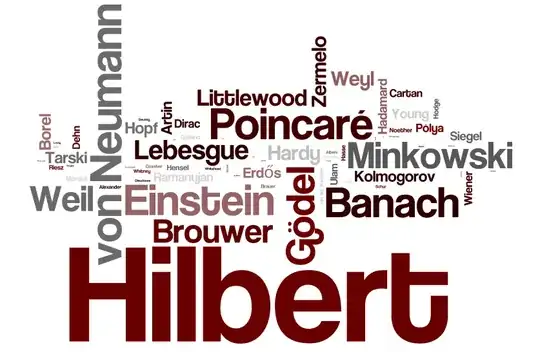
OK, this time $\epsilon$ more scientifically. I took The Princeton Companion to Mathematics (don't ask), converted the PDF to text, analysed the word frequency and isolated the names mentioned among the answers thus far. I then fed the results to Wordle and obtained the following amusing name cloud:

Mathematicians Name Cloud

I've also made available a larger PDF version of the image. Needless to say, one has to take this with a grain of salt. It's a first approximation. For example, no effort has been made to distinguish between Cartans, Artins, 'von Neumann' actually denotes the appearances of 'Neumann'. Not to mention the fact that as Greg points out in a comment below, it is heavily biased in favour of those mathematicians after whom we name things. But I take it we are aware that any such lists are bound to have an element of bias and subjectivity.

Glorfindel
  • 2,743
  • Any chance of making this image larger so the small names are more readable? – Sam Lichtenstein Dec 30 '09 at 16:26
  • 4
    If you click on the link that says "name cloud" you get the larger version of the image from the Wordle site. I could post a larger version here, though, if people think this is a good idea. If so, just upvote this comment and I'll do so. – José Figueroa-O'Farrill Dec 30 '09 at 16:28
  • 3
    I conjecture that PCM = Princeton Companion to Mathematics. This is a useful experiment for sure, but it is biased in favor of mathematicians with things named after them. – Greg Kuperberg Dec 30 '09 at 17:39
  • This is very cool. A larger version would be even cooler. – Sam Nead Dec 30 '09 at 22:19
  • Larger, but not too much larger, please. When I go to Wordle, somehow its Javascript does not cooperate with my browser. – Greg Kuperberg Dec 30 '09 at 22:39
  • 2
    The bias is even weirder than that. It biases towards people who have things named after them in a particular way. "Hilbert space" counts but "Noetherian ring" doesn't. – Noah Snyder Dec 31 '09 at 06:46
  • 3
    @Noah: That's a good point, but in your particular example, "noetherian" (with or without capitalisation) does not appear in the PCM! I repeat: take this with a grain of salt :) – José Figueroa-O'Farrill Dec 31 '09 at 08:01
33

The St. Andrews site is an invaluable resource. From that list, I picked (usually) at most one great mathematician born in each year from 1860 to 1910:

$\textbf{EDIT: By popular demand, the list now extends from 1849 to 1920.}$

1849: Felix Klein, Ferdinand Georg Frobenius
1850: Sofia Vasilyevna Kovalevskaya
1851: honorable mention: Schottky
1852: William Burnside
1853: honorable mentions: Maschke, Ricci-Curbastro, Schoenflies
1854: Henri Poincare
1856: Emile Picard (honorable mention: Stieltjes)
1857: honorable mention: Bolza
1858: Giuseppe Peano (honorable mention: Goursat)
1859: Adolf Hurwitz (honorable mention: Holder)
1860: Vito Volterra
1861: honorable mention: Hensel
1862: David Hilbert
1864: Hermann Minkowski
1865: Jacques Hadamard (honorable mention: Castelnuovo)
1868: Felix Hausdorff
1869: Elie Cartan
1871: Emile Borel (honorable mentions: Enriques, Steinitz, Zermelo)
1873: honorable mentions: Caratheodory, Levi-Civita, Young
1874: Leonard Dickson
1875: Henri Lebesgue (honorable mentions: Schur, Takagi)
1877: Godfrey Harold Hardy
1878: Max Dehn
1879: honorable mentions: Hahn, Severi
1880: Frigyes Riesz
1881: Luitzen Egbertus Jan Brouwer
1882: Emmy Amalie Noether (honorable mentions: Sierpinski, Wedderburn)
1884: George Birkhoff, Solomon Lefschetz
1885: Hermann Weyl (honorable mention: Littlewood)
1887: Erich Hecke (honorable mentions: Polya, Ramanujan, Skolem)
1888: Louis Joel Mordell (honorable mention: Alexander)
1891: Ivan Matveevich Vinogradov
1892: Stefan Banach
1894: Norbert Wiener
1895: honorable mention: Bergman
1896: Carl Ludwig Siegel (honorable mention: Kuratowski)
1897: honorable mention: Jesse Douglas
1898: Emil Artin, Helmut Hasse (honorable mentions: Kneser, Urysohn)
1899: Oscar Zariski (honorable mentions: Bochner, Krull, Ore)
1900: Antoni Zygmund
1901: Richard Brauer
1902: Alfred Tarski (honorable mention: Hopf)
1903: John von Neumann (hm's: Hodge, Kolmogorov, de Rham, Segre, Stone, van der Waerden)
1904: Henri Cartan (honorable mentions: Hurewicz, Whitehead)
1905: Abraham Adrian Albert
1906: Kurt Godel, Andre Weil (honorable mentions: Dieudonne, Feller, Leray, Zorn)
1907: Lars Ahlfors, Hassler Whitney (honorable mentions: Coxeter, Deuring)
1908: Lev Pontrjagin
1909: Claude Chevalley, Saunders Mac Lane (honorable mentions: Stiefel, Ulam)
1910: Nathan Jacobson (honorable mention: Steenrod)
1911: Shiing-shen Chern (honorable mentions: Birkhoff, Chow, Kakutani, Witt)
1912: Alan Mathison Turing (honorable mentions: Eichler, Zassenhaus)
1913: Samuel Eilenberg, Paul Erdos, Israil Moiseevich Gelfand (dis/honorable mention: Teichmuller)
1914: honorable mentions: Dantzig, Dilworth, Kac
1915: Kunihiko Kodaira (honorable mentions: Hamming, Linnik, Tukey)
1916: Claude Elwood Shannon (honorable mention: Mackey)
1917: Atle Selberg (honorable mentions: Iwasawa, Kaplansky)
1918: Abraham Robinson
1919: honorable mention: Julia Robinson
1920: Alberto Calderon

Pete L. Clark
  • 64,763
  • 1
    This list is quite convincing! Thanks! – Greg Kuperberg Dec 30 '09 at 09:06
  • 1
    I would include Alexander and Leray at least among the honorable mentions. And I had never even heard of Deuring! (At the other end, poor Hurwitz falls between the cracks of Bell's book and your insightful list.) – Greg Kuperberg Dec 30 '09 at 09:16
  • Is Dickson's contribution to mathematics (not counting history of mathematics) that great? – Idoneal Dec 30 '09 at 09:23
  • @GK: OK, upon reflection I agreed with your points. (Deuring was a fantastic early arithmetic geometer. But he didn't have the influence upon his field that Ahlfors and Whitney did upon theirs.) @Idoneal: I think so, yes. He was one of the greatest early modern algebraists, and in fact he was the first to prove major theorems traditionally attributed to others: e.g. Wedderburn's little [sic!] theorem, Witt's cancellation theorem. – Pete L. Clark Dec 30 '09 at 09:30
  • 3
    Ehhh... Von Neumann over Kolmogorov and de Rham? A tie for Weil and Goedel? At least for the cases that I'm familiar with, your list seems a little tilted towards applied math/philosophy. Goedel was a logician, not a mathematician. Certainly, both Dieudonne and Weil, both great mathematicians in their own right, deserve some credit for Bourbaki, propelling them far past the meager contributions of Goedel. – Harry Gindi Dec 30 '09 at 15:34
  • 7
    Goedel was not a mathematician? – darij grinberg Dec 30 '09 at 15:37
  • 9
    My impression is that most contemporary analytic number theorists regard Littlewood as being stronger than Hardy. Also, I would put Ramanujan on such a list ahead of Polya. Looked at from a modern perspective, is Birkhoff as important as Lefschetz? (I would be interested to hear the argument for the affirmative.) Probably some of Castelnuovo, Enriques, or Severi should be on the list. – Emerton Dec 30 '09 at 15:42
  • 1
    Goedel was a logician. To my knowledge, he never proved anything outside of logic. Therefore, he was a "mathematical logician", someone like Frege or Russel. – Harry Gindi Dec 30 '09 at 15:49
  • 7
    "The relative consistency of axiom of choice and continuum hypothesis w.r.t. Zermelo Fraenkel set theory" sounds like math. Or does it? – Ashutosh Dec 30 '09 at 17:58
  • 2
    I haven't yet graduated to making any changes from merely making suggestions to Pete. But I think that the word "tie" is cumbersome in this compilation. We might expect a reasonable list to have a Poisson distribution by year. You might consider adjusting the list a bit to be more consistent across the entire timeline. – Greg Kuperberg Dec 30 '09 at 18:05
  • 2
    Actually, maybe a time-dependent Poisson distribution, if you do not necessarily want an equal distribution by decade. Anyway, now that I look again, I also hadn't heard of Adrien Albert. Also, I agree with Matthew Emerton that Lefschetz has had more influence than Birkhoff, even though Birkhoff is also very important. Also, everyone knows Brouwer but possibly he could be h.m. – Greg Kuperberg Dec 30 '09 at 18:16
  • @Anutosh mathematical terminology doesn't make something mathematics in my opinion. – Harry Gindi Dec 30 '09 at 18:55
  • 1
    One more in the possibly overlooked category: Levi-Civita – Greg Kuperberg Dec 30 '09 at 20:08
  • 5
    For Harry: Am I to understand, in your opinion, that independence results in set theory do not count as mathematical results? – Ashutosh Dec 30 '09 at 21:43
  • 12
    Harry, applied math and mathematical logic are mathematics. Von Neumann did great applied and pure mathematics, and Gödel proved theorems. – Jonas Meyer Dec 30 '09 at 21:46
  • 1
    Although I think lists of this kind are quite intriguing, I think it is even more valuable for a given "era" (period of time") to list the people who were making the most important contributions to different areas of mathematics or expanding the horizons of mathematics by considering new domains for mathematics. Sometimes people who were not particular "great" on an absolute scale when taking into account all of mathematics were transforming or expanding some important domain within mathematics. – Joseph Malkevitch Dec 30 '09 at 21:49
  • 4
    @Emerton: I personally have a soft spot for Birkhoff because Rota's opinion of him is high for being the founder of both lattice theory and universal algebra, but I would understand if others disagreed.

    @Harry: I don't follow. Godel proved a mathematical result regarding systems consisting of strings generated from a fixed list of strings by certain rules. Plenty of definitions in "real" mathematics have this form.

    – Qiaochu Yuan Dec 30 '09 at 22:33
  • 1
    @Everyone else: I made some changes reflecting the comments. As for Matt Emerton's comment: in order to compile a list fairly quickly which was guaranteed to have at most 51 names, I set myself the ground rule of choosing at most one mathematician born in each year. I broke this rule only when there were two mathematicians that were so spectacular that it seemed impertinent of me to choose between them. This has the effect that some people who were really great, but not as great as someone else born in that year, get pushed to the side, e.g. Littlewood. – Pete L. Clark Dec 30 '09 at 22:35
  • 12
    @Everyone: By the way, I spent much longer than I expected compiling this list: several hours. I would appreciate it if, CW aside, people did not modify it according to their own tastes but simply make suggestions. If you want to make a list which is a minor variation of mine and put that in a separate answer, no problem. – Pete L. Clark Dec 30 '09 at 22:47
  • 1
    @Qiaochu: That's Garrett Birkhoff, who was born in 1911 and who I just added to the 1910-1920 list (on the same reasoning). George Birkhoff was his father, who introduced the chromatic polynomial and proved the ergodic theorem. I'm not sure if he deserves equal footing with Lefschetz, but Birkhoff pere was a much more traditional type of mathematician and was also very important. – Harrison Brown Dec 30 '09 at 22:49
  • Dear Pete,

    Thanks for the description of your methodology, which is what I had guessed it was. Castelnuovo (born in 1865) might be the strongest of the three Italians mentioned (although others will know better than me), and I think can be put on a par with Hadamard. (But if you disagree, at least an hm is in order.) Also, Picard was born in 1856, and is important.

    – Emerton Dec 30 '09 at 22:55
  • One reason to emphasize these early geometers is because this thread of research, from Riemann, through Picard and Lefschetz, is the source not just of modern algebraic geometry, but also much of modern algebraic topology --- which taken together is a lot of mathematics! – Emerton Dec 30 '09 at 22:57
  • @MEmerton: I added Castelnuovo as an hm. Picard was a fantastic mathematician: my list begins in 1860 purely by fiat (I thought 50 years would be enough work), not because there wasn't anyone good enough between 1850-1860! Anyone who wishes to propose a supplement for 1850-1860 (or any other period) is more than welcome. – Pete L. Clark Dec 30 '09 at 23:08
  • 1
    @Pete, I was using "real" in the sense defined by Hardy, as I thought I noted in this answer, but I didn't. It's in fact in Greg's answer. – Harry Gindi Dec 30 '09 at 23:37
  • 4
    As noted by Jonas in the comments on that answer, you still haven't justified to the rest of us why we should care what Hardy thinks mathematics is. – Qiaochu Yuan Dec 30 '09 at 23:59
  • 7
    Harry, Qiaochu, etc., please take this side question elsewhere; it has reached a natural stopping point. (Many of us do care what Hardy has to say in "A Mathematician's Apology", which is not the same as agreeing with him. But still, it has become off topic.) – Greg Kuperberg Dec 31 '09 at 00:52
  • 3
    I nominate Constantin Carathéodory for inclusion at 1873. –  Dec 31 '09 at 01:05
  • 5
    One could always suggest more honorable mentions, but I'm wondering if Bieberbach should be one of them. (Unfortunately Bieberbach would be another "dis/honorable" mention.) Also, arguably Kolmogorov could be promoted from h.m. to main list. – Greg Kuperberg Dec 31 '09 at 16:50
  • 13
    Indeed, its extremely weird that Kolmogorov is not in your main list. – alex Jan 13 '10 at 23:49
  • 2
    @Pete: I think Tagaki is great enough to be on your main list with Lebesgue – user4245 Dec 06 '10 at 12:47
  • Teichmuller should not be honorable. he is one of the greatest – Koushik May 29 '14 at 08:56
  • 1
    and so should be ramanujan. it's an incredible injustice to ramanjan to be ranked below polya. – Koushik May 29 '14 at 09:02
  • 5
    @Koushik: I wish you'd use a little more care with phrases like "incredible injustice". What happened to Boris Weisfeiler was an incredible injustice. One mathematician getting more prominence than anther on a list made by a mathematician who is a nobody compared to absolutely everyone on the list really cannot be an "incredible injustice". Having said that, you are not the first to wonder why I placed Polya ahead of Ramanujan. Looking at it now, I honestly couldn't remember. – Pete L. Clark Jun 08 '14 at 05:10
  • I decided that for me Hecke is in a class beyond Polya and Ramanujan, so I just edited my answer to give single billing to him. Is my feeling that Hecke is superior to Ramanujan beyond reproach? No, it's beneath reproach: it says more about what I know about algebraic number theory and modular forms than anything else. You are of course welcome to post your own list. Why don't you? – Pete L. Clark Jun 08 '14 at 05:13
  • i admit it's a bit of too much to have used that word. – Koushik Jun 09 '14 at 04:27
13

As found by Gjergji, a list compiled by James Dow Allen (except for a later Fields Medalist tacked on at the end):

(1854-1912) Poincaré
(1862-1943) Hilbert
(1864-1909) Minkowski
(1865-1963) Hadamard
(1875-1941) Lebesgue
(1877-1947) Hardy
(1879-1955) Einstein
(1881-1966) Brouwer
(1882-1935) Noether
(1885-1955) Weyl
(1885-1977) Littlewood
(1887-1920) Ramanujan
(1892-1945) Banach
(1903-1957) von Neumann
(1903-1987) Kolmogorov
(1906-1978) Gödel
(1906-1998) Weil
(1913-1996) Erdős

This is already not bad. Maybe people can offer improved versions of this starting point. (I personally would both add and subtract from this list.)

  • 7
    Einstein was not a great mathematician. He was an outstanding physicist, of course. – José Figueroa-O'Farrill Dec 30 '09 at 08:38
  • I agree. I decided to reproduce the list with minimal editing. – Greg Kuperberg Dec 30 '09 at 08:41
  • 1
    I disagree with the inclusions of Einstein, Brouwer, and Goedel. Einstein was not a mathematician, and certainly much of the important work in differential geometry can instead be attributed to less well known figures like Levi-civita and others. Goedel, ever overrated is responsible for one of the most depressing but inconsequential results of all time (inconsequential because it didn't change how mathematics was done). Brouwer was famous for causing a stir about intuitionism, but aside from that, his only major contribution was his fixed point theorem. – Harry Gindi Dec 30 '09 at 15:42
  • I have no strong opinion about Brouwer; although I do like the fixed point theorem. Gödel, on the other hand, I would have to argue for inclusion. Apart from his influential work on mathematical logic, he found a homogeneous spacetime with closed timelike curves through every point! This latter result is perhaps not hugely influential, but certainly it was striking at the time. – José Figueroa-O'Farrill Dec 30 '09 at 16:50
  • 19
    @Harry: You can bet your boots that Gödel influenced how mathematics is done! Besides his colossal influence in logic itself, he also influenced analysis and combinatorics (by proving consistency of AC and CH) and theoretical computer science (by inspiring Turing). – Greg Kuperberg Dec 30 '09 at 17:56
  • 1
    Mathematicians were using AC and CH before Goedel proved his results. Goedel is mentioned once in Bourbaki in the historical notes of book 1. In my opinion, that qualifies as "mathematics going on as it had been". I guess if you count logic and physics as math, then Goedel may have been "great", but in terms of just "real" mathematics in the very restrictive sense defined by Hardy, Goedel may have been influential, but certainly not "great". – Harry Gindi Dec 30 '09 at 19:04
  • Harry, I must have read Hardy a lot differently. I took his view to be fairly inclusive of all mathematics, including "applied" mathematics, so long as it has aesthetic value and is useless. E.g., "I count Maxwell and Einstein, Eddington and Dirac, among 'real' mathematicians." That doesn't directly address his view of mathematical logic, but the burden of proof is on you that (a)we should care about Hardy's restrictive sense and (b)Gödel isn't included in that sense. – Jonas Meyer Dec 30 '09 at 22:22
  • 21
    @Harry: The question of CH is the very first of Hilbert's famous list of open problems, so to portray it as outside the main stream of mathematics is absurd. Goedel's contributions to mathematical logic are staggering. His work has led to the entire fields of model theory, computability theory, proof theory and completely transformed set theory. In so many research areas, his theorems mark the point where the subjects became mature mathematical developments, and thousands of mathematicians study his ideas. – Joel David Hamkins Dec 30 '09 at 22:27
  • 12
    Harry, there are innumerable example of Goedel's influence on diverse areas of "real" mathematics. The fact that it's hopeless to try to classify topological 4-manifolds follows from undecidability results that come out of Goedel's work. I could have easily chosen all sorts of undecidability results that are central to modern geometric and combinatorial group theory. Not to mention Diophantine equations... – HJRW Dec 30 '09 at 22:28
  • 1
    @Harry: Admittedly I haven't read a lot of papers from the relevant time period, but the impression I have is that Godel was the first to really grasp how powerful of a tool diagonalization actually is. (Although for my money, no one really exposited it clearly until Turing.) – Harrison Brown Dec 30 '09 at 22:29
  • 14
    Folks, please continue this discussion elsewhere. Maybe Harry should start a blog to develop or discuss his views. His opinion of Gödel is an unorthodox dissent, but let's not pile it on. – Greg Kuperberg Dec 30 '09 at 22:34
  • 4
    Though I agree with Greg that it's pointless to "pile it on" Harry Gindi, I think it's worth mentioning that many people take Bourbaki's scant mention of Goedel not as evidence against Goedel's importance but as a glaring example of Bourbaki's ignorance. See the article "The Ignorance of Bourbaki" by A.R.D. Mathias. – Timothy Chow Feb 21 '13 at 19:48
9

Motivated by an e-mail from grshutt, I looked myself at the Princeton Companion to Mathematics. I discovered that the editors of the PCM answered the same question as the one that I posed here. Part VI is a collection of biographies of 95 mathematicians, plus one for Bourbaki, and the fact that the Bernoullis share a slot. They chose 37 mathematicians born between 1850 and 1920, exactly in the middle of the range that I suggested. See the table contents to see who they picked. They also wrote nice biographies, although they are much shorter and more sedate than E.T. Bell's single-author work.

It is a little embarrassing that we had this whole discussion without noticing that the PCM, with Timothy Gowers as the chief editor, had already done the same work. But it is also useful. It seems that when informed people carefully make lists of influential mathematicians of comparable length, they'll arrive at roughly the same list. Typically the intersection is about 1/2 if the lists are exactly the same length. PCM's list is longer than Bell (in the corresponding period) and mine, and shorter than Pete's, so we can look at who I (or Harrison) included but they did not, or who they included but Pete did not.

PCM minus Pete: Fredholm, Vallée-Poussin, Russell, Sierpinski*, Littlewood*, Skolem, Ramanujan*, Courant, Kolmogorov*, Church, Hodge* (* = honorable mention in Pete's list)

me minus PCM: Picard, Hurwitz, Lefschetz, Siegel, Chevalley, Gelfand

Harrison minus PCM: Henri Cartan, MacLane, Erdos, Feynman

Bell minus PCM: Zeno, Eudoxus, Poncelet, Monge

PCM $\cap$ Pete $\cap$ Harrison $\cap$ me: Hilbert, Minkowski, Hausdorff, Cartan, Noether, Weyl, Banach, von Neumann, Godel, Weil

Some of the differences can be explained as a somewhat different emphasis. In listing Russell and Church, the PCM gave more credit to the philosophical end of logic. (This is also grshutt's point in in his answer posted here and in his letter.) Whether Feynman should "count" is another question with two different reasonable answers. (As I said in a comment, the argument for Feynman is that he is an architect of quantum field theory, and quantum field theory is arguably a fundamental mathematical theory, even though parts of it haven't been made rigorous.)

And I suppose that some of the differences indicate the ill-defined side of the question, or they are just random fluctuations, and aren't really worth arguing over.

  • Poisson (1781-1840) is way outside of our chronology, n'est-ce pas?

    As you say, the PCM list seems to include logic/philosophy as well. I did think about Church as an honorable mention, and I am coming around to adding Skolem as an honorable mention.

    – Pete L. Clark Jan 03 '10 at 00:40
  • 1
    I wrote Poisson when it should have been Poussin! One is a fish, the other a spring chicken. :-) I have to say that Poussin is an unusual choice, for instance compared to Hurwitz. – Greg Kuperberg Jan 03 '10 at 02:12
  • Oh, you mean de la Vallee-Poussin. He was on the very first version of my list, but I deleted him because I felt he was strictly majorized by Hadamard (who also proved PNT and did a lot more besides). – Pete L. Clark Jan 03 '10 at 02:15
  • I added Skolem as an honorable mention. 1887 is a tough year: Skolem and Ramanujan don't quite make the cut! – Pete L. Clark Jan 03 '10 at 02:19
  • Yeah, Vallée-Poussin. I corrected it. – Greg Kuperberg Jan 03 '10 at 02:59
9

I feel some of the Russian/Soviet mathematicians are missing in the lists, like:

  • Aleksandr Mikhailovich Lyapunov (1857-1918)
  • Nikolai Nikolaevich Luzin (1883-1950)
  • Aleksandr Yakovlevich Khinchin (1894-1959)
  • Pavel Sergeyevich Alexandrov (1896-1982)
  • Andrey Nikolayevich Tikhonov (1906-1993)

though I think one could include many others.

7

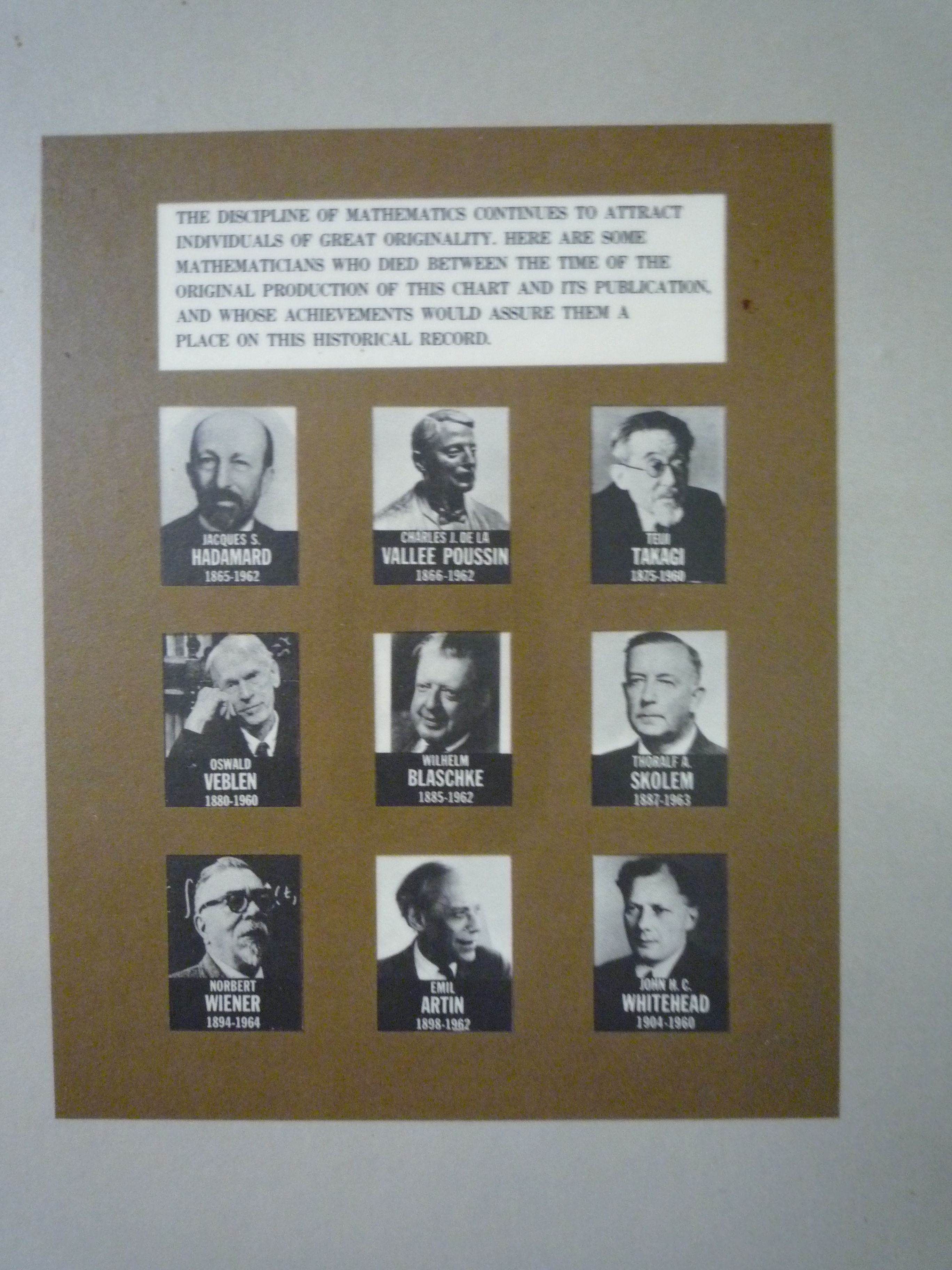
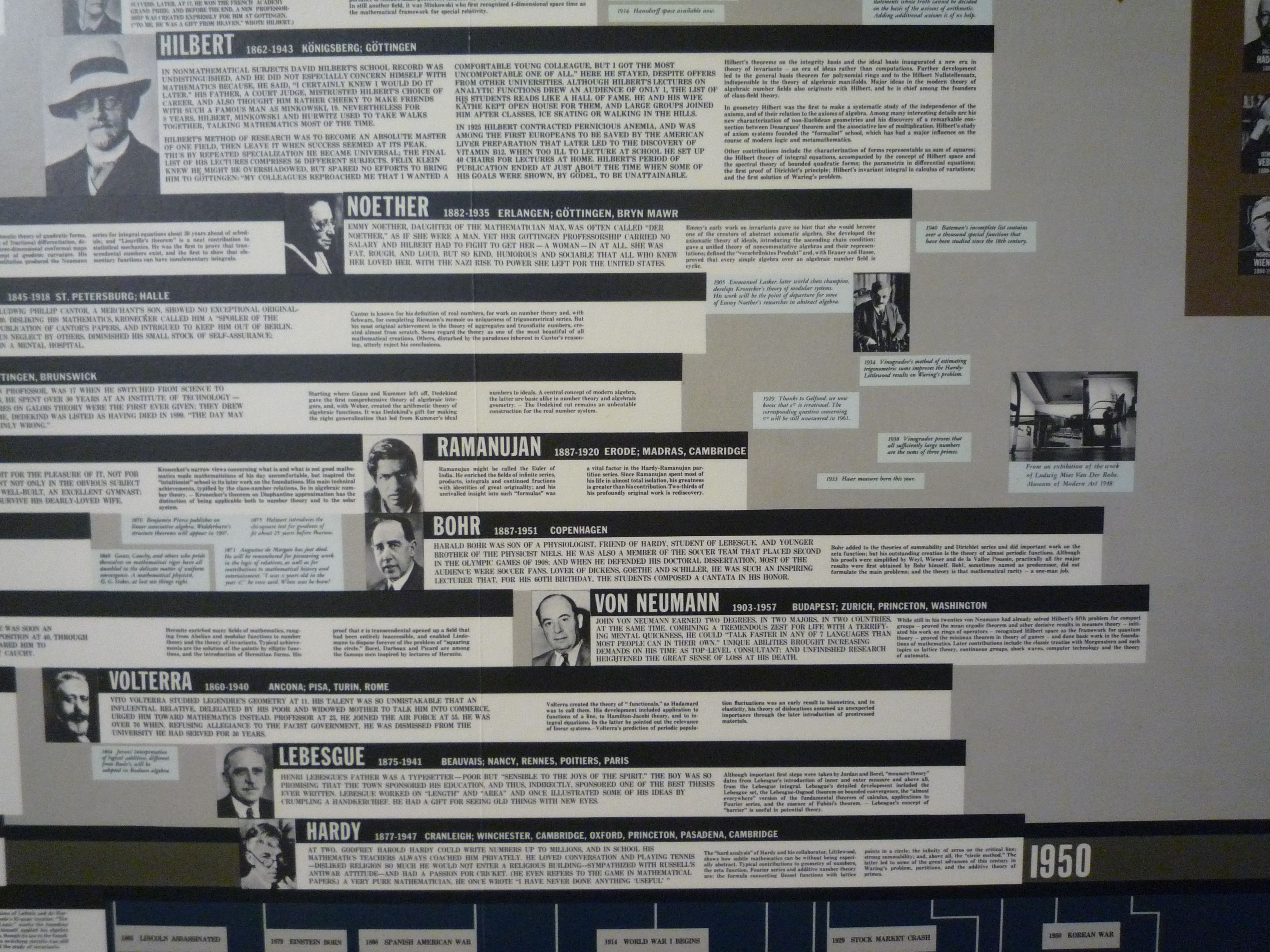
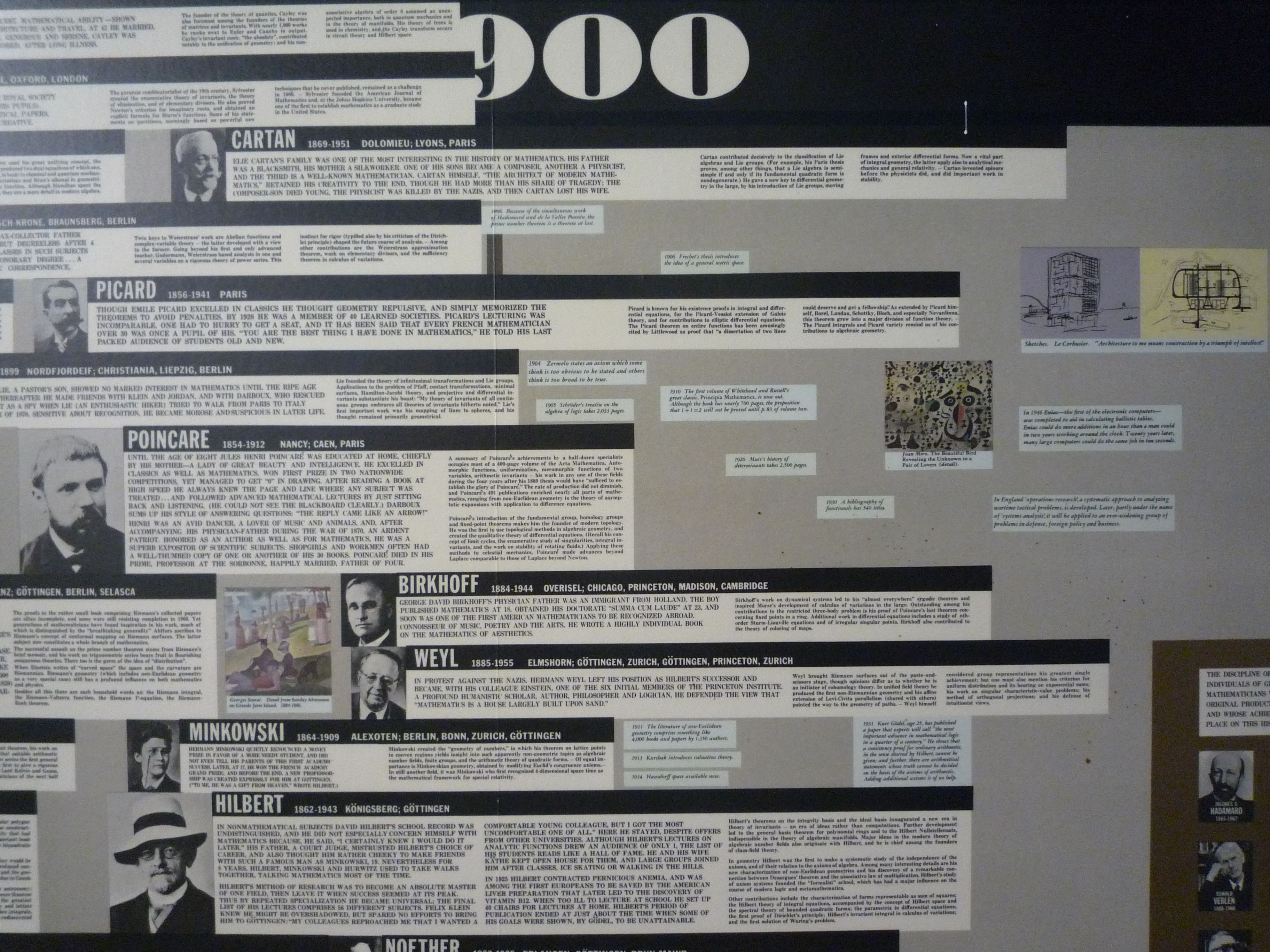
This did not fit in a comment. By popular (or at least Kevin Lin's) request, I took some photos of the IBM Mathematicians Poster on the 5th floor of the James Clerk Maxwell Building of the University of Edinburgh, just in front of the Common Room of the School of Mathematics. (My usual place of work.)

There are four photos: 1, 2, 3 and 4.

The poster only includes mathematicians who had already died at the time the poster was designed. Before the final printing other notable mathematicians who had since died were added (in name only) to the poster.

Their choice of 23 mathematicians are as follows, where I have italicised the ones who were added after the production of the poster:

  • Henri Poincaré (1854-1912)
  • Émile Picard (1856-1941)
  • Vito Volterra (1860-1940)
  • David Hilbert (1862-1943)
  • Hermann Minkowski (1864-1909)
  • Jacques Hadamard (1865-1962)
  • Charles de la Vallée Poussin (1866-1962)
  • Élie Cartan (1869-1951)
  • Henri Lebesgue (1875-1941)
  • Teiji Takagi (1875-1960)
  • GH Hardy (1877-1947)
  • Oswald Veblen (1880-1960)
  • Emmy Noether (1882-1935)
  • George Birkhoff (1884-1944)
  • Hermann Weyl (1885-1955)
  • Wilhelm Blaschke (1885-1962)
  • Ramanujan (1887-1920)
  • Thoralf Skolem (1887-1963)
  • Norbert Wiener (1894-1964)
  • Harald Bohr (1997-1951)
  • Emil Artin (1898-1962)
  • John von Neumann (1903-1957)
  • John Whitehead (1904-1960)

  • 1
    Thanks a lot! There are still six names that appear on every list so far: Hilbert, Minkowski, Cartan, Noether, Weyl, von Neumann. Although Godel and Weil were still alive at that time, and at this point some kind of consensus summary would be more interesting than the dwindling intersection. – Greg Kuperberg Jan 14 '10 at 00:04
6

For the sake of metahistorical accuracy (and for fun), what would a distillation of Pete's excellent list (and perhaps Greg's bookends, plus the stragglers in the 1840s) to a shortlist of 15 or 20 look like? This would better match the "density" of mathematicians in the later part of the era Bell covers, after all.

My humble proposal (not including Cantor, Kovalevskaya, and Poincaré, who are in Bell already):

Lie, Klein, Hausdorff, Hilbert, Minkowski, the Cartans, Hardy, E. Noether, Weyl, Littlewood, Ramanujan, Banach, von Neumann, Kolmogorov, Godel, Weil, Mac Lane, Turing, Erdos, Feynman.

That's 20, counting Elie and Henri Cartan as one a la the Bernoullis. In attempted keeping with the flavor of the original, I gave special consideration to mathematicians whose life could be "romanticized" to some degree, hence the inclusion of von Neumann, Turing and especially Feynman.

Thoughts? Keep in mind that I'm trying for "original flavor," so look at biographical considerations as well as mathematical, and play nice.

  • Feynman is debatable. As much as I like the guy, I'm not sure how much serious mathematical work he's done (are you thinking of the path integral?). – Qiaochu Yuan Dec 31 '09 at 01:28
  • The path integral and the proto-quantum computing stuff. I'm not sure he belongs on mathematical merit either -- although neither am I convinced that QED should be disqualified as "serious mathematical work" just because it happens to describe our universe -- but I'm going for an E.T. Bell vibe, and he was a really interesting guy. – Harrison Brown Dec 31 '09 at 01:44
  • 6
    The case for Feynman is that he is an architect of quantum field theory. (Not just QED by any means.) If we are to include Lie as an architect of Lie groups and Weil as an architect of arithmetic geometry, then we should also think about the position of quantum field theory. Much of QFT is non-rigorous mathematics, but maybe that's our fault as mathematicians, because arguably it is profound mathematics. – Greg Kuperberg Dec 31 '09 at 02:09
5

Teiji Takagi (1875--1960)

Emil Artin (1898--1962)

Helmut Hasse (1898--1979)

Claude Chevalley (1909--1984)

  • That's a pretty short list! Are those the only names you would include? Or are these the best of the best? – Jonas Meyer Dec 30 '09 at 23:26
  • I think that this is a list focused on the development of class field theory. In other words, it highlights the key developments in algebraic number theory in the given time period. – Emerton Dec 31 '09 at 03:43
  • This list was not meant to be exhaustive ! I merely wanted to say that these four should be part of any list of "greats". I deliberately left out Hilbert, Ramanujan, Weil... because they were there on other lists. – Chandan Singh Dalawat Dec 31 '09 at 04:25
5

Lefschetz, Bochner, Zariski, Italian school of alg-geometers

David Lehavi
  • 4,309
5

To extend Pete Clark's very nice work, I imitated his methods for the decades before and after the period that he covered. It is exhausting to keep making one decision after another, and I didn't bother separating people into main list and honorable mention. Maybe Pete or someone else can help with the latter — feel free to edit this answer!

1850: Sonia Kovalevskaya
1852: William Burnside
1853: Heinrich Maschke, Gregorio Ricci-Curbastro
1854: Henri Poincaré
1856: Andrei Markov, Emile Picard
1858: Edouard Goursat, Giuseppe Peano
1859: Otto Hölder, Adolf Hurwitz

1911: Shiing-Shen Chern, Garrett Birkhoff
1912: Alan Turing, Hans Zassenhaus
1913: Samuel Eilenberg, Paul Erdős, Israel Gelfand, Paul Teichmüller
1915: Kunihiko Kodaira, Yuri Linnik, Laurent Schwartz
1916: George Mackey, Claude Shannon
1917: Irving Kaplansky, Atle Selberg
1918: Richard Feynman

It's clearly time to stop around 1920, not just because of the Fields Medal, but also because more and more mathematicians born after then are still alive. Also, I understand that Feynman is a debatable choice as a mathematician, but I think that he should at least be considered.

  • I added Burnside, who hopefully won't be too controversial, to this list, and Garrett Birkhoff, who I fear will be. Note that Frobenius misses the 1950 cutoff by 2 + epsilon months. – Harrison Brown Dec 30 '09 at 23:32
  • By which I mean the 1850 cutoff, of course... – Harrison Brown Dec 30 '09 at 23:33
  • 1
    Maybe Schottky? (1851) Bolza? (1857) Witt? (1911) Kakutani? (1911) Eichler? (1912), Kac? (1914), Hamming? (1915).

    I humbly suggest replacing Feynman (one of my all-time heroes, but no more a mathematician than Einstein) with Abraham Robinson (1918).

    – Pete L. Clark Dec 31 '09 at 01:33
  • Pete, as much as I want you to retain final control of your long answer, I'd like to let you edit these bookends. Maybe the list of 20 that I posted below will be the one that stays with me. – Greg Kuperberg Dec 31 '09 at 01:37
  • I'm not sure that Garrett Birkhoff merits inclusion (and thus I confirm the prediction of controversy). On the other hand, I agree with the inclusion of Burnside. – Emerton Dec 31 '09 at 03:49
  • Honorable mention: Oliver Heaviside (1850-1925)? – Tom Copeland Nov 12 '11 at 03:13
5

I was going to request an answer like Harrison's, then I was going to post an answer like Harrison's, but Harrison scooped me. So by a happy accident, we have two independent lists of 20 people. My list has a slightly narrower time frame. I agree about Lie and Klein, but arguably they should have been in E. T. Bell's book rather than in the list compiled here. I concede that I also see Harrison's argument to include them here (if you also don't skip Cantor, Kovalevskaya, and Poincaré). Also, I respect Harrison's point about including people whose lives can be romanticized, and I even agree that a biography should try to romanticize the lives of mathematicians, but I think that the math should come first in deciding who to write about. (Besides, Erdős, Feynman, and Turing have already provided enough human interest for biographers.)

Anyway, here is my list. (I cheated in just one spot; I replaced one of mine by Kolmogorov.)

1856: Emile Picard
1858: Guiseppe Peano
1859: Adolf Hurwitz
1862: David Hilbert
1864: Hermann Minkowski
1868: Felix Hausdorff
1869: Elie Cartan
1875: Henri Lebesgue
1882: Emmy Noether
1884: Solomon Lefschetz
1885: Hermann Weyl
1892: Stefan Banach
1896: Carl Siegel
1898: Emil Artin
1903: John von Neumann
1903: Andrey Kolmogorov
1906: Kurt Godel
1906: Andre Weil
1909: Claude Chevalley
1913: Israel Gelfand

Are there other things to say about the symmetric difference, (Harrison's list) ∆ (my list)? We intersect in 11 people; should our lists be made to converge? Are there fundamental mathematicians who we both missed?

  • For what it's worth: Picard was almost on my list but was a casualty of the decision to emphasize "romanticizable" mathematicians, and Artin and either Peano or Hurwitz would probably have taken the places of Lie and Klein. Apart from that, I think I might be somewhat biased toward analytic number theorists (Hadamard was another last-minute cut), probably because books about the Riemann hypothesis were my E.T. Bell. That would explain Hardy and Littlewood. – Harrison Brown Dec 31 '09 at 01:34
  • I fought against my own bias, then I caved and decided that I should include Minkowski even if I am biased in his favor. As for Picard, look at what the St. Andrews site says: Hated math at first, but studied it to avoid punishment! Three children killed in World War I! Educated 10,000 French engineers! Compelling human interest comes in many guises. – Greg Kuperberg Dec 31 '09 at 01:47
5

I'd like to bring to your attention Emil Leon Post (1897-1954).

Also Karol Borsuk (1905-1982), and mathematicians of the Soviet era: Lev Schnirelmann (1905-1938) and Alexander Gelfond (1906-1968).

2

Two names haven't been mentioned yet:

Alfred North Whitehead (1861 - 1947)

Bertrand Russell (1872 - 1970)

While Whitehead and Russell were not principally mathematicians, each published works in the field prior to their collaboration on Principia Mathematica (1910 - 1913; 1927); e.g.,

Russell, An Essay on the Foundations of Geometry (1897) and Principles of Mathematics (1903), and Whitehead, A Treatise on Universal Algebra with Applications (1898).

grshutt
  • 833
  • 8
  • 11
0

Chern, Freedman, Donaldson, Thurston, Perelman from the topology-geometry realm...

Jonas Meyer
  • 7,279
John
  • 1