19

I am teaching an undergraduate course in linear algebra this fall. I am dissatisfied with most existing textbooks, and indeed with the way in which this subject is usually taught. I hope to find a textbook that has many or all of the following characteristics:

  • It emphasizes linear transformations as the central object of study. This, in my view, is what the subject is about, and I think a linear algebra course should start with them (perhaps only in R^2 or R^3) from the very beginning.

    Instead, most books start with solutions to systems of linear equations, which I personally believe is of secondary importance. Moreover they use "augmented matrices" which (in my mind) obscure the relationship between matrices and linear transformations. I would prefer to never write down a matrix which does not represent a linear transformation in the usual way.

  • It takes a heavily geometric approach. Linear transformations can be visualized and drawn, and I think a linear algebra course which doesn't emphasize this is selling itself short.

    As an example, I think the following would make a great homework and exam question: Shown are a pair of coordinate axes and a cartoon drawn on the plane. A 2x2 matrix is given. Sketch the image of the cartoon under this linear transformation.

  • It de-emphasizes the carrying out of algorithms by pencil and paper. I have memories of row reduced echelon forms, pivots, etc., etc. but as a working mathematician, none of this really stuck. I memorized the techniques, regurgitated them for the exam, and although I could reconstruct them if needed I don't really remember them.

  • It de-emphasizes axiomatics. In my opinion it is uninspiring to see a list of axioms for a vector space and to prove statements like "If v + 0 = 0, then v = 0". This goes especially since my students won't have the mathematical background or maturity to appreciate some of the more eclectic examples of vector spaces, or why you would be interested in working over any field other than R or C. They are also somewhat unlikely to have seen examples from any area of math where intuition leads you astray.

  • It really tries to teach the "meaning" of a matrix. To my embarrassment, it was after I finished my Ph.D. that I realized the columns of a matrix are just the images of the basis vectors. This was probably said in the book I used as an undergrad, but not really emphasized. Similarly, when we solve linear equations we write each equation as a row vector rather than a column vector because row vectors in fact represent "covectors", i.e. elements of the dual space.

    I don't want to go overboard with this (i.e., to the extent of introducing category theory), but I do want to present some of the notions of duality that are at the heart of linear algebra and more advanced mathematics.

  • It is a good book overall.

  • It doesn't cost $300 or whatever exorbitant price publishers are charging these days.

I should mention that my university offers "applied" (using Strang) and "honors" versions of linear algebra, and that the course I'm teaching is neither.

Based on the preferences I've described, does anyone have books to recommend? Thank you very much.

Frank Thorne
  • 2,249
  • 17
  • 21
  • 3
    I agree that such a book is needed. Although, I almost disagree that we should "never write down a matrix which does not represent a linear transformation in the usual way". The one near exception is the matrix of a bilinear form. This can be thought of as a linear map, of course, but thinking of it as a gadget which eats two vectors by $v^\top A w$ is also important. – Steven Gubkin Jun 25 '15 at 13:39
  • 1
    While no book is quite what you want here, I think Damiano and Little is more in this direction than most. It's a Dover reprint and I used it last year for linear algebra. Take a look at it: http://www.amazon.com/Course-Linear-Algebra-Dover-Mathematics/dp/0486469085 (one caution, the exercises without solutions do not have the most elegant solutions imho) – James S. Cook Jun 25 '15 at 14:03
  • I'm not sure this is quite the book you want, but there's something called The Geometry Toolbox, reissued as Practical Linear Algebra, by Farin & Hansford. It has a lot of visualisation of linear transformations. – Marius Kempe Jun 25 '15 at 17:35
  • 1
    You may want to look at Winitzki's Linear Algebra via Exterior Products and its corresponding webpage here. It is, at the very least, not your conventional linear algebra book. The PDF is legitimately free, and the printed version is ... wait for it... 9.88 USD. – pjs36 Jun 25 '15 at 18:02
  • 1
    @StevenGubkin: Point well taken. That said, I stand by my bigger point, which is that in linear algebra we really need to be careful about writing down matrices, and to resist the urge to do so when it's nothing more than a mildly convenient shorthand. – Frank Thorne Jun 25 '15 at 18:29
  • Calculus by Tom Apostol comes to mind in terms of the type of presentation you want. It's unlikely to be a real solution though, because it's expensive and the linear algebra material is split between the two volumes. I agree with the general idea of starting with vectors in $\mathbf{R}^n$ and geometry in $\mathbf{R}^2$ and $\mathbf{R}^3$, as well as looking at the general theory of systems of linear equations bigger than $3 x 3$ only after linear mappings have been discussed. However, it is important to talk about vector spaces at some point for several reasons. Firstly, a linear... – Keith Jun 26 '15 at 02:56
  • algebra course is often a prerequisite for differential equations. And the space of solutions to a differential equation has no privileged basis, so it is best to think of it as an abstract vector space for which various coordinate systems can be selected, but no one of which is special. Secondly, the abstract, axiomatic approach is the best way to show that a subspace of $\mathbf{R}^n$ is nothing but a miniature copy of $\mathbf{R}^p$ sitting inside the ambient space. Again, this is a situation where there is no privileged basis. Thirdly, the longer you work in $\mathbf{R}^n$ on its own,... – Keith Jun 26 '15 at 03:03
  • using its standard basis, the harder it is to understand that all the theory developed surrounding lines, planes, other analytic geometry not involving orthogonality, and linear mappings more generally, works exactly the same way in any other coordinate system. Lastly, change of coordinates is best understood when it is made clear that there is no particular reason for one coordinate system to be special. In countries where vectors are used extensively in geometry in high school, the transition to vector spaces is usually much easier. Correction: I meant a linear differential equation. – Keith Jun 26 '15 at 03:06

1 Answers1

8

I am intrigued by this book, but (a) I haven't used it myself, and (b) it lists @$200:

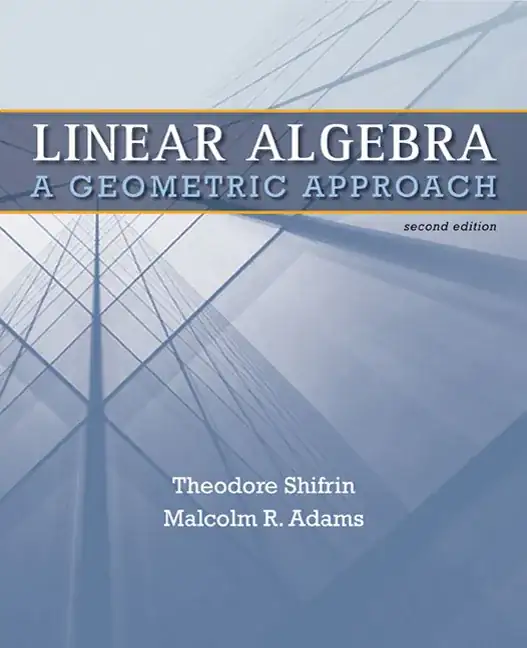
Shifrin, Ted, and Malcolm Adams. Linear algebra: A geometric approach. Macmillan, 2ndEd, 2011. (Macmillan link.)


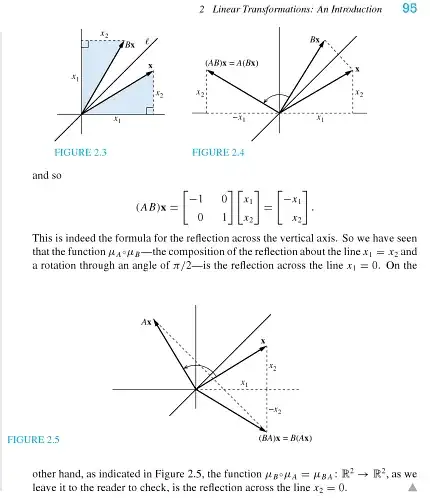
Perhaps it could serve as a guide in your teaching even if you don't ask the students to purchase it...?


          Page95
Joseph O'Rourke
  • 29,827
  • 6
  • 61
  • 140
  • 18
    The authors are likewise ashamed of the price tag. When we first wrote the book, we fought hard to keep the price down among the lowest, but textbook pricing has been a train wreck this past decade. ... I will also add that we slant the book toward teaching students proofs more than most of the comparable texts. BTW, the snippet above is from the second edition, whereas the picture of the book above is the first edition. – Ted Shifrin Jun 27 '15 at 15:42
  • @TedShifrin: Thanks, Ted! Yes, I realize the pricing is out of your control. I'll have repaired the 1st vs. 2nd edition error. – Joseph O'Rourke Jun 27 '15 at 18:46