Could an effective and 'comprehensive' course on advanced math be taught through a series of fun comic books, say a fun and adventurous series of stories each exploring advanced math principles somehow entangled in the story. I know of a fair amount of advanced math books with some cartoons but I don't think they get much respect. Could one teach a PhD level cource in math with lots of cartoons?
Asked
Active
Viewed 1,063 times
14

JPBurke
- 7,463
- 19
- 50

user128932
- 479
- 2
- 9
-
5Could you cite such advanced math books with cartoons? – Mark Fantini Jul 19 '14 at 06:25
-
2@Fantini Not particularly advanced, but Knuth's Concrete Mathematics has the occasional cartoon. – Gamma Function Jul 19 '14 at 13:49
-
How advanced is advanced? I see that the question has been tagged
(in an edit), but that still leaves quite a range of courses. On the other hand, the body of the post mentions PhD level. – J W Jul 19 '14 at 14:50 -
@JW I retagged it in my edit, the previous one was secondary education. I looked for more advanced tags but didn't find any hesitated to create. – Mark Fantini Jul 20 '14 at 03:42
-
@GammaFunction Occasional cartoon is nice, but I think the OP question is along the lines of "could one learn Kähler systems through manga-designed books?" – Mark Fantini Jul 20 '14 at 03:43
-
@Fantini There is a
tag. – J W Jul 20 '14 at 05:46 -
@JW Guess I missed it. Thanks for the heads-up! – Mark Fantini Jul 20 '14 at 05:47
-
2Related question: Why are most math textbooks so dry?. In a comment there I mentioned the books by Lillian Rosanoff Lieber, which I listed in my answer to the math StackExchange question Dr Seuss style prose advanced mathematics text. – Dave L Renfro Jul 21 '14 at 18:24
-
Icon Press has a series of books with titles of the pattern "Introducing ... : A Graphic Guide". They have one on mathematics as well as Logic and Infinity, but most of their higher subject ones cover science and philosphy. I also don't know how well they'd work as a text book, specifically. – Joe Mar 06 '15 at 18:18
-
I think such a book could certainly be written. The question is if it would be the best way to learn/instruct. And in this, I think there's an implicit MISTAKE in emphasizing explication as opposed to working problems. The latter is the path to learning math, more so than the former. – guest troll Jan 02 '23 at 16:39
8 Answers
13
Graphic novels are an underappreciated means of pedagogy. Please look at: Galois' Dream by Michio Kuga It teaches:
- Group Theory
- Differential Equations
To first-year undergraduates from a course at University of Tokyo.

(source: springer.com)

Graphics should certainly make the material more engaging, but I suspect difficulty is getting an artist and mathematician to collaborate on the same project.

Glorfindel
- 234
- 1
- 3
- 11

john mangual
- 878
- 6
- 14
-
3
-
4Here's a book in the same spirit that I've seen (and looked at some) in the public library where I live: Who Is Fourier?: A Mathematical Adventure. – Dave L Renfro Jul 21 '14 at 18:29
8
I wanted to add:
The Manga Guide to Linear Algebra
This was published in 2012, and, is apparently one of an ongoing series of such texts. Now, as they currently stand it's not a stand-alone textbook, but it might be a fun supplemental for some courses.

James S. Cook
- 10,840
- 1
- 33
- 65
7
The Cartoon Guide to Calculus by Larry Gonick should be mentioned.
http://www.amazon.com/The-Cartoon-Guide-Calculus-Guides/dp/0061689092

midtiby
- 416
- 3
- 4
6
Edit: There was a relevant talk just last week (with some names that may be worth following up on) entitled Visual Learning and Teaching (and headlined with: Cartoons Can Teach Science).
I see that the top answer is about Galois Theory. A number of years ago, I thought it might be nice to try and create some supplementary materials (in the "cartoon" or storybook spirit) for a course on Abstract Algebra II. I only made a few PPT slides, but I've uploaded them here.
A sample slide:
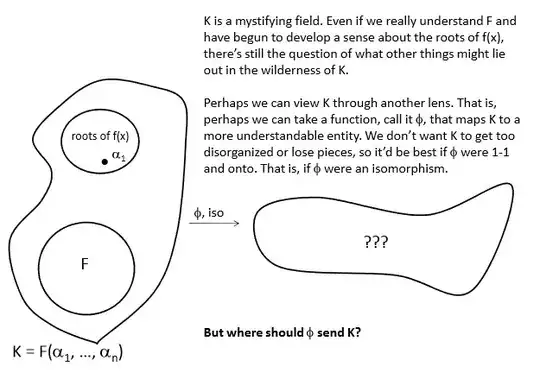
I should re-caveat that these slides are not only old, but also unedited; in particular, there are some things that I would change today (e.g., my field definition is really for a commutative field, and the examples of "non-fractions" in this context should really be algebraic over $\mathbb{Q}$, meaning that $\pi$ and $e$ should be removed).
With regard to using the slides: Anyone is free to modify these notes, though I would be interested to see anything that could be squeezed out of them! My overarching wish was to start with something conceptually small, such as the single number $i = \sqrt{-1}$, and (perhaps at the expense of rigor) build outwards towards something more general, such as Galois Theory.
In the end, I have only a vague proof of concept, which is enough to convince me that the answer to the question here is Yes; however, I do not have any plans (personally) to develop the slides linked above.

Benjamin Dickman
- 18,470
- 2
- 41
- 114
-
4It seems the diagrams to heuristically explain various subfields of math rarely make it to textbooks. But, when you talk to someone, so often, the picture makes all the difference. That said, I think the OP is looking for something really different than the commonly held mental pictures of experts. – James S. Cook Oct 11 '14 at 23:55
-
@JamesS.Cook I fully agree. My quixotic plan was to sketch heuristic diagrams with blurbs to develop the mathematics along some reasonable trajectory, and then to go back and see if I could write it up as a storybook. Probably not a comic or cartoon, but something heavy on the pictures (diagrammatic or otherwise) and ideally with an actual plot. You can see from the inchoate nature of the slides linked above that I never followed through with the initial trajectory sketching; still, I thought making the PPT available here might be of interest to someone. – Benjamin Dickman Oct 12 '14 at 06:34
-
2I'm glad you posted it here, I think direct answers to the OP are difficult. Both the Manga Guide and Galois' Dream really don't use the cartoons to tell the main storyline of the math. I mean, the technical details are far removed from the cartoons. In contrast, your diagrams and the heuristics I mentioned are far better, but, lack the rather difficult to achieve cartoonish goal of the OP. As far as I'm aware, there is no work which really does both math and cartoon with equal emphasis. – James S. Cook Oct 12 '14 at 14:30
3
Be sure to look Logicomix: An Epic Search for Truth, by Doxiadis.

user52817
- 10,688
- 17
- 46
-
9You will need to go into more detail on this to make it a quality post worthy of votes. For example, why would you look at this instead of something else? What does it do particularly well, and what does it do not-so-well? – Chris Cunningham Jul 21 '14 at 02:53
-
@ChrisCunningham I think you're right.....unless this should be converted to a comment? (note that you need 50 rep to post comments on posts not your own) – Tutor Jul 27 '14 at 03:04
-
It is quite an intellectually stimulating comic book, but if I recall correctly, the "advanced math" aspects of Logicomix is rather limited, especially by modern standards. Furthermore, most of the mathematics are presented through dialogues of the characters, and the math principles don't very much intrude into the story telling. So while I like the book a lot, I am in doubt as to whether it is a good answer to the posted question. – Willie Wong Oct 27 '14 at 14:31
3
I think that if the Ph.D. level course were in mathematics education and focussed on using cartoons in class, then yes. Otherwise, no.
The major reason is that most material in graduate level classes is about serious stuff. That's not to say you can't have fun with it and make it more enjoyable, but in addition to the key concepts that can be quickly conveyed by cartoon, there is a lot of history, ancillary detail, context on when to use and not use a result, counterexamples, and other things that are not easily reduced to a cartoon. Supplement a lecture with a cartoon or two? Sure. Do this for every lecture? Maybe, give it a try. Have a comic-book or graphic-novel style textbook as the main text? I don't think so, Tim*: I think the students will miss out on some of the things they need to learn. (Illustrated text books are different: that is for a different question.)
*Reference to the American TV show "Home Improvement"
Gerhard "Moderation In All Things Funny" Paseman, 2015.03.05

Gerhard Paseman
- 2,554
- 9
- 7
2
The book Teoria das Categorias para Ciência da Computação has some cartoons involving a cat. The book is about category theory, it is meant for computer science students and written in Portuguese.

fla
- 21
- 1
2
"Indra's Pearls" (by Mumford, Series, and Wright) is just a wonderful book describing the mathematics behind Schottky groups. It is accessible to undergraduate students, and has fun projects for computer visualization.
One of the nicest features of the book is the cartoons drawn by Larry Gonick. His character, Dr. Stickler, cuts and glues rubber material to construct manifolds in an entertaining and very intuitive way.

Rodrigo A. Pérez
- 1,019
- 6
- 8
-
The 'Demystified' books and the 'such and such FOR DUMMIES' books are very good. – user128932 Oct 12 '14 at 03:34