32

Why are students taught to represent one and a half as $1 \frac{1}{2}$ rather than $1 + \frac{1}{2}$? This mode of expression seems standard at least throughout North America. I believe that it is bad pedagogy for a couple of distinct reasons.

First, doing it the 'correct' way would give students a great deal of personal experience equating the English word 'and' with the mathematical symbol '+'. This is a good thing, since it fosters the notion that mathematical statements (or in this case expressions) have tangible meaning. Students who understand what a half is do well with understanding what 3 and a half is, and I expect that representing it as $3 + \frac{1}{2}$ can do a great deal to cement the 'true meaning' of addition in their understanding. Consider that the previous experience of students at this age is dominated by calculating 8+4 either counting 9-10-11-12 or by rote, neither of which is all that connected to the physical reality of addition (this much and also that much).

Second, students will reach a point where they are expected to abide by the convention that $ab$ represents $a * b$. Strong students will do OK with this other than a few early mistakes during an adjustment period. But students struggling in math, especially those experiencing phobia or anxiety around the subject, will have little chance but to understand this shift in notation as yet another in an unending string of indications that what's expected from them in math class is entirely arbitrary, changes from one teacher to another, and is some sort of arcane magic. The horrible thing is that in this case they're correct to interpret it this way!

I have to be missing something. What advantages does the current scheme provide?

NiloCK
  • 4,980
  • 22
  • 41

6 Answers6

16

One reason is that mathematics was not handed down by the gods fully formed and unambiguous. It is a human construction over a very long time and mathematical notation even more so.

Any time a notation doesn't "work" for all possible contexts, it's an opportunity for us to talk about this human side of mathematics, and about the pros and cons of notation conventions.

As to why the missing +, I think it is so that you feel that $1\frac{1}{2}$ is an actual number in its own right, which is harder to perceive with the plus. Also, we write a lot of other numbers in shorthand: 35 and not 30+5, for example, so it feels similar to other representational conventions.

Finally, perhaps some of the reasons you mentioned are why most mathematicians avoid mixed numbers in their own work, preferring improper fractions (not that I advocate this for children - it's much easier to get a feel for the size of $1\frac{1}{2}$ as opposed to $\frac{3}{2}$).

EDIT: The history section of the wikipedia article on fractions http://en.wikipedia.org/wiki/Fraction_%28mathematics%29 has some interesting notes about the history of mixed number notation.

DavidButlerUofA
  • 9,083
  • 33
  • 67
  • 4
    $1~1/2$ is shorter than $1 + 1/2$. – vonbrand Jul 11 '14 at 23:27
  • 1
    And the shortest is the accepted convention. This is an example of learning to accept a convention. – user 85795 Jan 24 '15 at 22:56
  • @vonbrand. You'd never see 1 1/2 in Ireland. It would always be 1½. I'm talking about numbers appearing in newspapers, etc. I find 1 1/2 quite hard to read. – TRiG May 15 '17 at 11:59
  • 1
    @TRiG I don't see 1 1/2 either. I just didn't think to actually make it look like a proper inline fraction. – DavidButlerUofA May 15 '17 at 19:38
  • 1
    @DavidButlerUofA I do see it, including in beautifully typeset magazines, but only from American publishers, never in anything local. – TRiG May 15 '17 at 19:46
13

Manipulation

The mixed fraction form makes subtraction and negative values easier to parse.

$2\frac{1}{2} - 1\frac{1}{4}$ is substantially easier to read, write, and understand at this stage than either $2+\frac{1}{2} - (1+\frac{1}{4})$ or $2+\frac{1}{2} - 1-\frac{1}{4}$. Students at this age have not encountered the distributive property (or even brackets?), and they may have trouble attaching the '$-$' to the $\frac{1}{4}$.

The simple expression of a negative value are similarly challenging.

I don't think that this is a good enough reason (in particular, I'm not sure if I'm a big fan of doing manipulations with mixed fractions at all) but it's a rationale that occurred to me.

NiloCK
  • 4,980
  • 22
  • 41
8

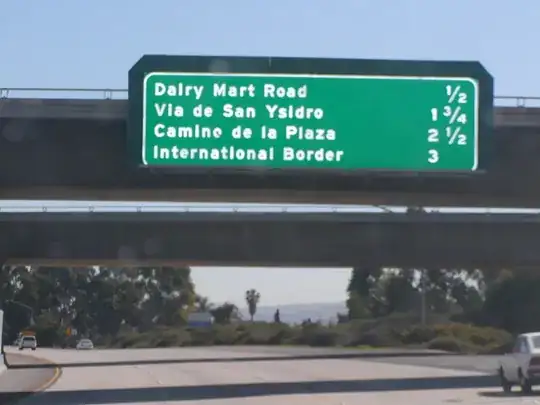
That's the way non-mathematicians write it. Surely you have seen road signs, showing distances, with entries like $$ 1\,\frac{1}{2}\;\text{mi} $$ at least if you are in the US.... I wonder, in Europe would they write it that way, too? or maybe, for example, $$ 5.5\;\text{km} $$ ???
enter image description here

Gerald Edgar
  • 7,489
  • 1
  • 21
  • 33
  • 4
    Clearly, you need to write it as $5 + .5$ so that someone doesn't multiply and come up with $2.5$. Erm, I mean $2 + .5$. – JPBurke Jul 29 '14 at 08:05
  • 2
    @JPBurke meant in jest, but after a while of dealing with integer polynomials, when seeing decimal numbers again this dual use of a dot caused exactly this confusion for one of my students! Just to show that brief, consistent, and unambiguous mathematical notation is probably an unachievable goal. – Richard Jan 28 '15 at 00:46
  • 2
    You are absolutely right in your assumption that in Europe it would be written as 5.5 km (or 5,5 km depending on your decimal separator). In fact I had no idea that 'mixed fractions' existed outside of cookbooks before today. – Evpok Apr 10 '15 at 22:30
  • 1
    @Evpok On the other hand, in the UK they simply round to an integer. – Jessica B May 15 '17 at 06:28
  • 1
    This is the best possible answer. It's not merely a pedagogy issue as assumed in the question. – Daniel R. Collins May 16 '17 at 04:13
  • 1
    @JPBurke A decimal point should be at the bottom, whereas a multiplication dot should be higher up, in the middle. Somehow, however, when rumour of this first reached me it did so the wrong way round, which just annoyed me. When I later found the correct convention I was much more comfortable with it. – Jessica B Aug 04 '17 at 06:34
  • @JessicaB ... It seems in the UK a decimal is commonly seen as $2\cdot 5$, whereas multiplication is seen as $2; . 5$ ... Which of course seems strange to me, in the US... – Gerald Edgar Aug 04 '17 at 12:06
  • @GeraldEdgar My experience is that it is the other way round (I am British). – Jessica B Aug 05 '17 at 06:22
7

This is a typical case of emphasis trade off. Omitting the $+$ sign wants to show that this is a single number (result) rather than an arithmetic expression to be processed further. I don't see any problem with it as long as the mentioned confusion with multiplication can be avoided in the context. Numbers written in the mixed form can be compared to each other more easily than pure fractions by mortals like me.

Thinkeye
  • 741
  • 4
  • 8
6

The university math department where I work runs a math competition for high school students each year. One year there was a problem with answer $7/2$. May students put $3\frac{1}{2}$ down as the answer. Professors who were grading all marked this as incorrect--not because they abhor mixed numbers, but because they naturally parsed it as $3\cdot\frac{1}{2}=\frac{3}{2}$. Later when some students questioned the grading, we all had an aha! moment.

user52817
  • 10,688
  • 17
  • 46
  • 1
    Were the professors just being difficult? The reason I ask is that $3 \cdot \frac{1}{2}$ would be a very strange way to give a numerical answer. Normally one answers a question that asks for a number with a numeral: a representation of a number rather than a calculation. – Ben Kovitz May 16 '17 at 12:07
4

I was educated in different country, even so I was taught to write $1\!\frac12$ not $1 + \frac12$. I think it is less clear when $1 + \frac12$ is used.

Chris Cunningham
  • 21,474
  • 6
  • 63
  • 148
Andrew
  • 41
  • 1