8

Since the beginning of time, candy has been used to illustrate the principles of distributions in early lessons on statistics.

A recent informal study seems to indicate that the flavors of Skittles are not uniformly distributed. While it would be a great exercise for more advanced students to ascertain the extent to which a given bag is distributed evenly, it does not serve as hefty a purpose in the very early stages of learning.

Have any educators or statisticians systematically studied different varieties and brands of candy expressly for their pedagogical value in primary- and secondary-level statistics?

jonsca
  • 743
  • 1
  • 4
  • 14
  • 3
    While the title was a bit tongue-in-cheek, I am asking this in earnest. – jonsca May 02 '14 at 22:45
  • 1
    Have you already searched for any? E.g., http://scholar.google.com/scholar?hl=en&as_sdt=0,33&q=skittles+statistics – Benjamin Dickman May 02 '14 at 23:09
  • There are quite a few articles on using them as a method in the classroom, but I'm more interested in whether they are a useful model. – jonsca May 02 '14 at 23:15
  • Have you approached the manufacturer? – Jim Hefferon May 03 '14 at 14:10
  • 3
    I've done this informally for a brand of colored candy called Nips. (I did this for an undergraduate class in statistics.) I don't know their manufacturing color distribution, but for the 36 packages I opened (having 432 pieces), those with "delicious" colors (red 82, orange 81, yellow 62) outnumber those with "non-delicious" colors (violet 59, dark blue 52, light blue 51, green 45). – JRN May 04 '14 at 06:29
  • @JoelReyesNoche While I have accepted the M&Ms answer, I think that this may be good as an additional answer. – jonsca May 25 '14 at 21:49

1 Answers1

7

(Sorry if my answer is as offensive as responding to a question about Coca-Cola with data about Pepsi!)

There are certainly some lesson plans around looking at statistics for M&M colors.

For example, see Supplemental Activity S3.3 from COMAP's "Mathematics: Modeling our World" here. COMAP (COnsortium for Mathematics and its APplications) is my general go-to for modeling related activities; for example, see the discussion of a different sugary item in my MESE post on cake-cutting.

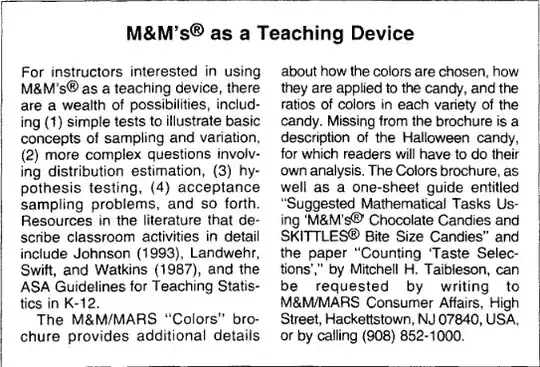
Another brief write-up that I saw online recommended two other sources. One of these sources includes a classroom activity and has 'teaching' as a keyword; it is entitled: Testing Colour Proportions of M&Ms. The other source, The Mysterious Case of the Blue M&M's, recommends the following:
enter image description here

The article is from 1996, so I'm not sure if this "teaching device" is still available (though I suppose you could call and ask). You might also look up the (Landwehr et al, 1987) source mentioned at the end. Googling did not lead me to that particular one-sheet guide, though I did find yet another M&M project on the subject described online.

Lastly, you might download this thesis and search for mentions of M&Ms (e.g., p. 33, p. 243).

In response to your comment ("There are quite a few articles on using them as a method in the classroom, but I'm more interested in whether they are a useful model") I would say there are enough different items online to put something of interest together.

Benjamin Dickman
  • 18,470
  • 2
  • 41
  • 114
  • 2
    This is fantastic! No, I'm not as particular about my teaching candy as I am about my cola. – jonsca May 25 '14 at 21:47