19

While talking about different types of equations, a student in my class asked: Why we use the word quadratic to refer to second-degree equations?

Here is some context:

1) Linear ($x^1$) equations make sense, because the graph of a linear equation is a straight line.

2) Exponential ($a^x$) equations make sense, because $x$ is in the exponent, and my students will soon learn to recognize graphs of exponential equations.

3) Cubic ($x^3$) equations make sense, because $x$ is being cubed, and my students will soon learn to recognize graphs of cubic equations.

... so why do we use the word "quadratic" to refer to second degree equations? My students already know that the graph of a quadratic equation can be called a "parabola," and the word QUADratic sounds like it has something to do with the number four, rather than squaring.

Follow up question: Would it be better to call $x^2$ equations "parabolic" referring to the shape they make when graphed? Or why not call them "squared" equations in the same way we use for higher-degree equations?

David Ebert
  • 3,895
  • 2
  • 22
  • 36
  • 3
    To expand on @MichaelE2: For "biquadratic" one needs to be careful what is meant. It can mean quartic (degree 4), yet this is now very rare. More frequently it means an equation of the form $a x^4 + b c^2 + c =0$, in this sense it is somewhat common in some contexts such as field extensions/Galois theory. – quid Apr 28 '14 at 14:30
  • 1
    Possibly duplicate: http://english.stackexchange.com/questions/151217/why-does-quadratic-describe-second-power-while-quad-usually-describes-four – user26486 Apr 28 '14 at 15:09
  • 1
    I suggest that you use the word coined by Robert Recorde in his ground-breaking work The Whetstone of Witte, which is also famous for having introduced the $=$ sign. The word Recorde used deserves to be revived. It is “zenzic”. – Mark Dominus Apr 28 '14 at 17:24
  • @MichaelE2: yes, you are right my "list" was rather not exhaustive. And, the reference to field extensions I made is not optimal as the usage there is in fact still somewhat different though related. – quid Apr 28 '14 at 18:05
  • 2
    I would not use "parabolic equation" as that already has a meaning in higher mathematics. The linear heat equation, for example, is a parabolic equation. – Eric Lippert Apr 28 '14 at 18:20
  • "Quad" is widely used in computer graphics programming to mean square. – Davor Apr 29 '14 at 07:04
  • 1
    A similar issue: we know from linear algebra that a linear function from $\mathbb{R}$ to $\mathbb{R}$ is actually a function of the form $x\mapsto ax$ for some $a\in\mathbb{R}$; a function of the form $x\mapsto ax+b$ for some $a,b\in\mathbb{R}$ is an affine function. Now try to go and change all the elementary math textbooks... There are more things like that. Part of mathematical maturity is getting used to such ambiguities. – mbork Apr 29 '14 at 10:26
  • Possible duplicate of http://math.stackexchange.com/questions/4601/why-are-quadratic-equations-called-quadratics – Blazemonger Apr 29 '14 at 15:51
  • @mbork, the issue in linear algebra arises only if you do not distinguish between the geometric space of points, and the vector space of translations (i.e. vectors) on that geometric space. A linear map on the geometric space is a function that sends lines to lines, preserving incidence. These induce linear maps (in the sense of linear algebra) on the vector space of translations. – Vladimir Sotirov Apr 29 '14 at 18:56
  • And yet, the word "sQUARe" is not perceived as related to the number 4. Go figure. – dan04 Apr 30 '14 at 01:52
  • I notice that you've asked 12 questions but only accepted answers to two of them. Assuming you did get useful answers to the other ten questions, it's good to reward the people who helped you by accepting their answers. And it gives you a reputation bonus, too, as well as encouraging more people to answer your questions in the future. – David Richerby Nov 15 '14 at 12:40

5 Answers5

27

It may be as simple as the fact that the word quadratic derives from the Latin quadratus which means square. A square has 4 sides, but the word squared is used to mean "to the power of 2".

To answer the follow on - No. Changing anything means re-writing the complete body of text to use the new designation, and un-learning the old definitions for all existing students. See discussion of tau vs pi.

21

The situation for quadratic equations is in one sense exactly analogous to the one for cubic equations, except that for reasons of the development of the language some discrepancy between square, squaring and related and quadratic arose.

I am not well placed to discuss this in English but see on the English.SE site for the etymology of "quadratic": Why does “quadratic” describe second power while “quad” usually describes “four”?

Also, note that in other languages this split did not happen. In German a square is a "Quadrat," and to square is "quadrieren," and quadratic is "quadratisch." In fact from the link above it seems to quadrate was used in English too (long ago).

Thus the naming linear, quadratic, cubic follows the logic line, square, cube (as said by Joe Taxpayer) only that the development of language took one of the terms slightly apart.

I would rather advise against using the terminology parabolic equation, because this in fact breaks the logic of the naming. To add the "s" and to call them something like squared equations, as you propose, would seem relatively better to me, though also not good.

If you want to avoid any naming issues I suggest to call them first degree, second degree, third degree equations.

To sum this up: Either explain the origin of the terminology to make the (hidden) logic clear or use a simple systematic naming. But avoid introducing the term parabolic in this context.

quid
  • 7,692
  • 2
  • 32
  • 63
  • 2
    Indeed, "parabolic equations" have a completely different meaning in theory of PDEs. – Ruslan Apr 28 '14 at 11:12
  • I much prefer the terminology of first/second/third degree. – Mark Fantini Apr 28 '14 at 11:25
  • 1
    Not to mention, a 'quadrangle' is still an English word for a square (with some tolerance for rectangles that are close to being square in practice). Many large older buildings in the UK have quadrangles (usually shortened to 'quad'), which are square(ish) internal courtyards, usually with a pristine lawn. – dbmag9 Apr 28 '14 at 20:20
  • 1
    Another connection in (mathematical) English between "quadrat..." and "square" is that "quadrature" means finding areas (or, more generally, integrals), so that "quadrature of the circle" is the same problem as "squaring the circle". – Andreas Blass May 03 '14 at 18:20
13

When something has a standard name, use the standard name, especially when it's something so fundamental. Calling quadratic equations anything other than quadratic equations just means you end up with a class of students who become confused when they discuss quadratic equations with anyone who wasn't taught by you (i.e., almost everybody else on the planet).

As mentioned in the other answers, explaining to your students why the term "quadratic" is used, should help them to remember and understand it.

David Richerby
  • 318
  • 2
  • 10
9

Quoting Wikipedia:

The adjective quadratic comes from the Latin word quadrātum ("square").

Summarizing succinctly: Consider objects of side-length $a \in \mathbb{R}^{+}$.

$a^1$ gives the size ("length") of a line segment, hence linear.

$a^2$ gives the size ("area") of a square, hence squared.

$a^3$ gives the size ("volume") of a cube, hence cubed.

Benjamin Dickman
  • 18,470
  • 2
  • 41
  • 114
4

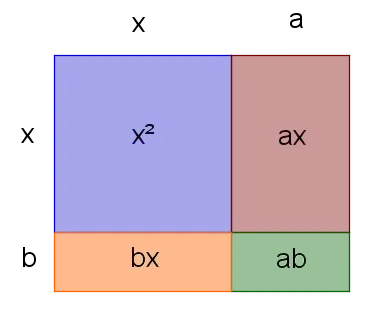
I don't have any scholarly justification for this suggestion, but it seems very plausible that quadratic equations are so called because they split the rectangle up into quadrants as so

Quadratic

Obviously not all quadratics can be expressed in the form $(x+a)(x+b),$ but the ones that were considered solvable when the word quadratic was first being used (i.e. before the invention/acceptance of imaginary numbers) all could.

Just to add to an already interesting debate.

Edit:

Here's an idea. Cubes are bounded by $6$ faces, so let's call $x^{3}$ a hexic. No, wait. That should be $x^{6},$ surely. In which case $x^{3}$ should be called... triadic? Or even better, $x^{4}$ could be called a tesseractic!

I'm only half joking here. The point is that trying to create too profound a link between the language used to describe things and the things themselves can result in linguistic or logical hiccups. Squares have a lot to do with the number four, it being the number of vertices, edges, lines of symmetry and number of rotational symmetries, but this breaks down for cubes, and so the language instead settled on extending the verb 'cubed' into the adjective 'cubic'. Poor language, it tries so hard to be non-arbitrary, but it was seduced by the 'fourness' of squares when, really, two is the more important number.

Shai
  • 541
  • 2
  • 6
  • This is what I always thought the answer was ... The standard form of a parabola is just a quadratic that simplifies into three monomials ... But if you expand it into its geometric representations, it represents four sides and I believe the name stems from this representation. It always seemed obvious to me ... now it seems less so – oemb1905 Apr 29 '14 at 00:11
  • "I disclaim that I don't have..." Does this mean that you "have"? :) –  May 02 '14 at 12:50
  • It looks that way, doesn't it? I'll change it because it's not clear what I'm trying to say there; 'exclaim' would be more sensible, but then it just sounds pretentious! Thanks. And :P – Shai May 03 '14 at 14:01