-2

I will be teaching geometry for the first time ever this summer. I teach at a community college, and we only offer this course in the summer. (Mostly high school students take it, but it is a college course.)

I have just started to read the textbook we use: Elementary Geometry for College Students, by Alexander and Koeberlein. So far I am not impressed.

I would like to know of good textbooks others have used for such a course. Sadly, the only book I found that's OER is a photocopy.

ETA: Problems with the current textbook: It feels like a mish mash. I saw a definition that was incorrect. ("Adjacent angles have one corresponding side." Well, that would be true if one angle were inside the other, and I don't believe we call those adjacent.) I don't care for the two-column proofs, and the way they try to teach them. I don't see what the goal is when I work through this book. There are 'theorems' with no proof in sight. How do you prove things if you don't know what your starting point (the axioms) is?

My criteria for a good textbook: It will work with me to strengthen the students' visual reasoning skills. It will do a good job with construction. (I can do that on the side, though.) It will do undefined terms to axioms / postulates to proofs well. It will have a good flow / progression. It will inspire me and the students (fun and meaningful). For example, I mostly like what I see in James Tanton's book.

amWhy
  • 2,095
  • 1
  • 17
  • 34
Sue VanHattum
  • 20,344
  • 2
  • 42
  • 99
  • 2
    By "OER," do you mean open educational resource? – JRN Feb 15 '19 at 03:55
  • Is the content supposed to be the same as a high school course? Could you look at high school books? – Anonymous Feb 15 '19 at 07:54
  • 1
    It would be helpful to know what context "geometry" is meant to entail. The word is quite broad. – Dan Fox Feb 15 '19 at 20:37
  • 1
    Yes, OER = Open Educational Resource. I believe the content is similar to a high school course. (Although my high school geometry course was 45 years ago.) No, I don't believe we can use high school textbooks. (Silly, huh?) – Sue VanHattum Feb 16 '19 at 04:38
  • @BPP, you could make that into an answer, and give the titles. If you don't want to, I will. I would love to use Dover books, so our students don't have to pay so much. Thank you. (I may not be able to get the book changed for this summer, but I will get these two books, and if they seem better than what we have (or equal) I will get it switched for next summer.) – Sue VanHattum Feb 16 '19 at 04:39
  • @DanFox, lines, angles, triangles, parallel and perpendicular lines, quadrilaterals, circles, locus, area, coordinate geometry. – Sue VanHattum Feb 16 '19 at 04:40
  • There's also two books from the master Coxeter... – user5402 Feb 16 '19 at 19:53
  • ...and there's the more advanced book (Dover) in case you want to include an advanced section. – user5402 Feb 16 '19 at 19:53
  • 1
    It would help if you could describe what your criteria are and what you don't like about the book your school is currently using. Presumably someone likes this book -- at least the people at your school who originally adopted it. Do you want to emphasize proofs? It's hard to know what to say about remedial courses at community colleges, because they have such incredibly low success rates. Personally what I didn't like about my kids' high school geometry books was that they took the beautiful simplicity of Euclid and replaced it with a baroque crap collection. –  Feb 17 '19 at 01:08
  • 1
    What I don't like: Yeah, baroque crap collection kind of captures it. It feels like a mish mash. I saw a definition that was incorrect. ("Adjacent angles have one corresponding side." Well, that would be true if one angle were inside the other, and I bet we don't call those adjacent.) I don't care for the two-column proofs. I don't see what the goal is when I work through this book. There are 'theorems' with no proof in sight. How do you prove things if you don't know what your starting point (axioms) is? Does that help? – Sue VanHattum Feb 17 '19 at 20:45
  • We have a high school STEM connection program so this course might have a better success rate. I'll look into that. What I want: strengthened visual reasoning skills, construction, proof, and to have it be fun and meaningful. – Sue VanHattum Feb 17 '19 at 20:46
  • Note to self: Lots of good resources here: https://matheducators.stackexchange.com/questions/15157/book-recommendations-on-mathematics-education-focusing-on-geometry/15166?noredirect=1#comment39098_15166 – Sue VanHattum Feb 17 '19 at 20:57
  • @BPP, the Coxeter books look too advanced. I might get the first one for me. I want to be inspired to play with geometry from now until this course ends. (It meets in June and July.) – Sue VanHattum Feb 17 '19 at 21:10
  • The course is done now. The book provided useful problems, so I stuck with it. I think the first two chapters were the worst - it got better. I used some great online resources to supplement. – Sue VanHattum Oct 28 '19 at 18:08

4 Answers4

2

@BPP answered in a comment. Their answer suggested two Dover books:

College Geometry: An Introduction to the Modern Geometry of the Triangle and the Circle, by Nathan Altshiller-Court

and

Geometry: A Comprehensive Course, by Dan Pedoe

Dover does not do the common publisher scam of new editions every few years, and their books are inexpensive. Not OER, but way less burden on my students.

I am also buying some high school-level books as resources. Henri Picciotto recommends Geometry: A Guided Inquiry by Chakerian, Crabill and Stein. (I use bookfinder.com to find the cheapest used copies of books. This title with Chakerian as author was very expensive, but the same title by Stein was inexpensive. Odd.)

I am still interested in hearing about other possibilities.

Sue VanHattum
  • 20,344
  • 2
  • 42
  • 99
  • 1
    +1 for Dover's prices – Gerald Edgar Feb 17 '19 at 12:47
  • 1
    Altshiller-Court and Pedoe both look more like upper-division books than the kind of thing a community college would call "Basic Geometry"...? –  Mar 16 '19 at 19:21
  • You are correct. I bought both to look at, and I might get one or two interesting ideas out of each. But they are definitely not the content I am teaching.

    My current status on this: I am using the textbook, since there are two sections and the other teacher, a part-timer, has already used this book and would have to do more work to switch. But I am doing lots more than the book. I will devote a significant portion of classtime to 'labtime', and we'll be doing lots of constructions, by hand or online (using http://sciencevsmagic.net/ and http://euclidthegame.com/, along with geogebra).

    – Sue VanHattum Mar 17 '19 at 15:32
1

This sounds like a great opportunity to teach the course a few times, keeping track of what you do, then writing up your own book. I've done that, and even have written a blog about each day's topics, which gets pre-publication feedback.

1

I really fell "in love" with "Elementary Geometry from an Advanced Standpoint" by Edwin E. Moise when I have taught undergraduate geometry. Many of the students, but not all, have been secondary math education majors.

The book is rigorous, as it has challenged the brightest of the undergraduates.

amWhy
  • 2,095
  • 1
  • 17
  • 34
  • Thanks. I ordered it to check it out. – Sue VanHattum Apr 01 '19 at 20:36
  • 3
    I was going to suggest Ed Moise’s book or his high-school level book (named Geometry, with Floyd Downs). He’s a big believer in 2-column proofs, which is why I shined away from it a little. I also used it in undergraduate, and liked that he built up “synthetic geometry”—geometry sans postulate 5—before showing alternatives that arise from it. – Sciolism Apparently Apr 02 '19 at 13:47
  • 1
    I, also, was going to suggest Moise's book. It was one of the three books used in my undergraduate geometry course. I have forgotten the other two. :\ – Xander Henderson Oct 27 '19 at 22:01
1

I wonder if one could run a geometry course through GeoGebra? This requires laptops or workstations, but the software is free. I am not finding the ideal textbook based on GeoGebra, but here are two links that give some sense of what is available.


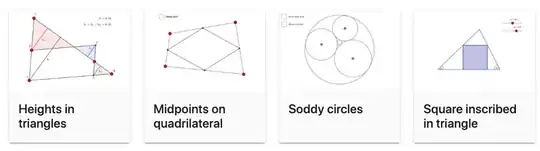
          Snapshot from MalinC's GeoGebra-book.

This seems too advanced for your purposes:

Venema, Gerard. Exploring advanced Euclidean geometry with GeoGebra. MAA, 2013.

Joseph O'Rourke
  • 29,827
  • 6
  • 61
  • 140
  • 1
    I used http://www.euclidthegame.com/ for construction problems the students were required to do. They had to do 15 levels of this 'game'. It is built on geogebra. This was the most successful element of the course. – Sue VanHattum Oct 28 '19 at 18:10