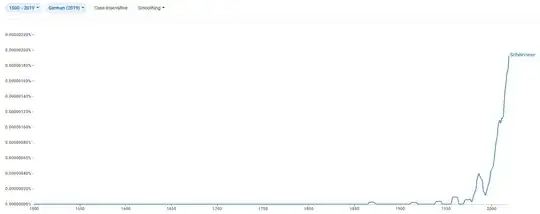
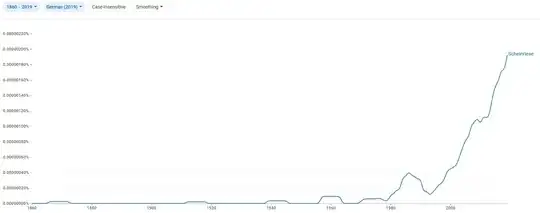
Google Ngram found a few earlier appearances:
1869 : "Der lachende Mann" by Victor Hugo (translated into German by Georg Büchmann)
Quote from p.152:
Wirklich waren beide Kämpfer gut ausgewählt, [...]. Phelem-ghe-madone, dieser Scheinriese, hatte alle Nachtheile seiner Vorzüge; er bewegte sich schwerfällig; seine Arme waren massig; aber sein Körper war dafür eine bloße Masse.
1915 : "1914: Vom Ausbruch des Krieges bis zur Einnahme von Antwerpen" by Eduard Engel
Quote from p.XI
Und endlich bot sich ihnen der verführende Helfer, der Scheinriese Rußland dar, um ihre Vergeltung und seine Raubgelüste zu befriedigen.
1933 : "Das Deutsche Volksspiel, Band 1"
Quote:
[...] Scheinriese wird durch einen tapferen Sirtenknaben besiegt
1942 : "Yüan Schi-kai - Tragödie eines Usurpators" by Ernst Wurm
Quote from p.307
[...] Scheinriese, von Scheinenergie erfüllt. Den Drachenmantel hatte er in wilden, seidig gebauschten Falten um Arme und Schultern hochgezogen und sah aus wie ein wutentbrannter Uhu oder wie ein Tiger in äußerster Gereiztheit [...]
It is hard to say whether Ende was aware of these earlier instances.
I guess that in a political context the concept "Scheinriese" was known to some people.
Anyway, the word became popular only after Ende had used it in his novel. This may be the reason why Wikipedia attributes it to Ende although this is factually incorrect.
Quote from Wikipedia (translated with DeepL.com):
The Scheinriese is a literary character from the 1960 children's book Jim Button and Luke the Engine Driver. The author Michael Ende describes him as a peaceful, empathetic, helpful, lonely (but actually sociable) gentleman called Tur Tur, who can't help it if others are afraid of him because of his apparent size.
Since the end of the 1960s, the term "Scheinriese" has also been used as a catchphrase in journalism - especially in a political context - to characterize people, groups of people, states and other things. In this context, the metaphor usually has ironic or pejorative connotations and refers to an object that falsely or unjustifiably displays or claims the appearance of greatness, strength or power. In this type of use, the metaphor stands in contrast to the nice, pitiable illusory giant Tur Tur in the children's book.


