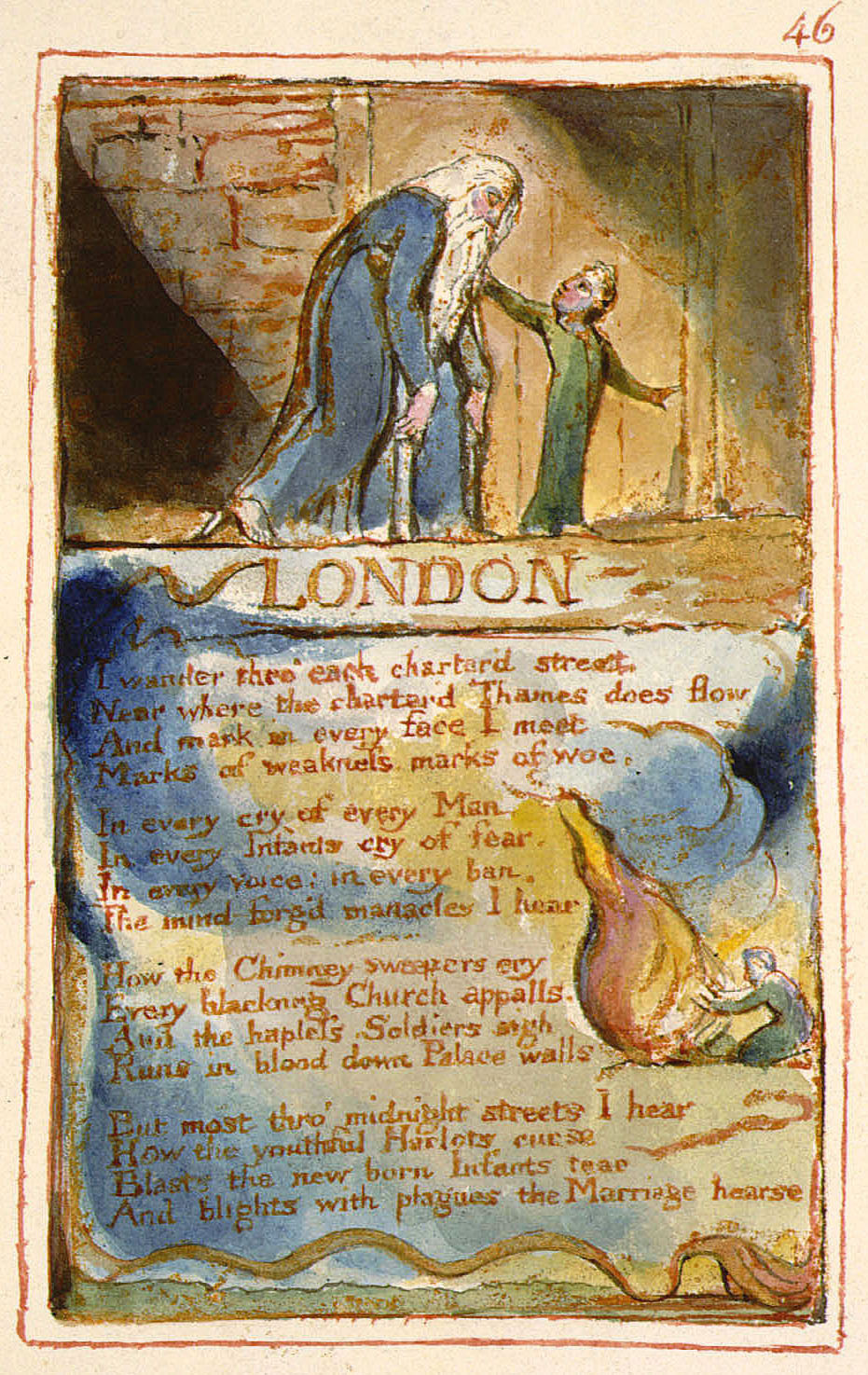
The original punctuation of the poem seems to be:
I wander thro' each charter'd street,
Near where the charter'd Thames does flow,
And mark in every face I meet
Marks of weakness, marks of woe,
In every cry of every Man,
In every Infants cry of fear,
In every voice: in every ban,
The mind-forg'd manacles I hear
How the Chimney-sweepers cry
Every blackning Church appalls,
And the hapless Soldiers sigh
Runs in blood down Palace walls
But most thro' midnight streets I hear
How the youthful Harlots curse
Blasts the new-born Infants tear
And blights with plagues the Marriage hearse
where I'm using commas everywhere, because I can't tell Blake's commas from his periods in his punctuation.
It seems to me that the colon after voice requires that there is a comma at the end of the first stanza, i.e., after woe. And then, the first 2½ lines of the second stanza are all describing where the poet hears marks of weakness, marks of woe.
In this case, the mind-forged manacles are mainly connected to the bans. That is, when people are forbidden from doing something. I would thus interpret the mind-forged manacles as being forged by the people themselves, and forcing them to follow the bans.
I would interpret the next stanza as the Church (the building, not the institution) feeling guilty when the oppressed chimney-sweepers clean it, and the Palace (again the building) feeling guilty when the soldiers guard it.
And I think you should look at Blake's poem The Garden of Love for help in interpreting the last stanza, but I haven't reached a satisfactory interpretation of it yet.


&h=1475&w=931&tbnid=80clArRlBRtmOM:&tbnh=160&tbnw=100&usg=__QW8b69C0m9KLKesKVYDWPJx60NI%3D&vet=10ahUKEwjo2IDUpZDZAhVkoFkKHQ-uDp0Q_B0IsgEwEg..i&docid=PTU5MaFPVYfxzM&itg=1&sa=X&ved=0ahUKEwjo2IDUpZDZAhVkoFkKHQ-uDp0Q_B0IsgEwEg#h=1475&imgdii=80clArRlBRtmOM:&tbnh=160&tbnw=100&vet=10ahUKEwjo2IDUpZDZAhVkoFkKHQ-uDp0Q_B0IsgEwEg..i&w=931)