20

From the Wikipedia page on Tintin in America:

For the 1973 edition published in the U.S., the publishers made Hergé remove African-American characters from the book, and redraw them as Whites or Hispanics because they did not want to encourage racial integration among children.

Two citations are given to this sentence, Thompson 1991 and Farr 2001, but I don't have either of those books. I'm seeking more information about this, to pin down exactly what happened and how racist the publishers were (as Hergé's original texts weren't exactly free of racism either).

  • Which US publisher made this demand, and what exactly did they say - how clearly did they phrase their motivation?
  • How much of the story was changed to accommodate this demand (e.g. how many panels redrawn, any textual changes)?
  • Was this the first English-language edition of the story, so that the redrawing was done together with translation, or was there already a British English version which kept the African-American characters intact?
Rand al'Thor
  • 72,435
  • 26
  • 236
  • 488

1 Answers1

26

The first efforts to market Tintin to an American readership happened in the early 1960s, in the ill-fated "Golden Press debacle", when, among other things, the American publisher Golden Press demanded the removal of scenes of the consumption of alcohol (what would happen to Captain Haddock?), wanted to rename "Snowy" to "Buddy", and also required the removal of black characters from The Crab with the Golden Claws:

The US censors didn’t approve of mixing races in children’s books, so the artist created new frames, replacing black deckhand Jumbo with another character, possibly of Puerto-Rican origin. Elsewhere, a black character shown whipping Captain Haddock was replaced by someone of North African appearance.

The effort flopped, however, and the release of Tintin albums in the USA stagnated until the publishing house Atlantic-Little, Brown took over the rights in the 1970s. As the Wikipedia article notes, problems again arose with the depiction of black characters, this time in Tintin in America. From Thompson's 1991 book Tintin: Hergé and his creation, cited in the Wikipedia article:

The Americans put themselves firmly in the wrong when they refused to print any frames that pictured black people at all. Outrageously, as late as the 1960s, Hergé was forced to go over parts of his work and remove black characters. The doorman at the half-built bank in this same scene was originally black, as were the mother and baby whom Tintin inadvertently disturbs on page 47.

Micheal Farr's work Tintin The Complete Companion (freely available from the Internet Archive) notes that just three frames were changed:

Hergé returned for a third time to the American adventure for a 1973 edition, when apart from tightening up the formatting of the script by cutting out whenever possible hyphenated breaks, he made significant concessions to his American publishers by removing in three cases blacks from the narrative. They objected to the placing of blacks alongside whites in a story destined for young readers.

[The album had first been released in black and white in 1932 and been transferred to color, and generally tightened up, in 1946, hence the remark that Hergé returned to it "for the third time"]. The three frames in question are on the first page: when Al Capone address his henchmen, the black man on the far right is changed to a swarthy Italian/Puerto Rican type character in the new version. On page 29 the commissionaire on duty at the "Petroleum and Cactus Bank" was changed from a black to a white man, and on page 47 a mother and her crying baby were changed from black to white.
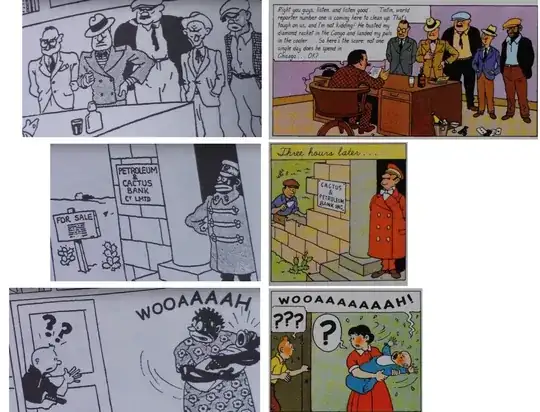
Altered frames in "Tintin in America"

Although done for bad reasons - presumably as in the 1960s this was done to remove evidence of racial desegregation, although neither Farr nor Thompson explicitly state this, or who required it - it was not wholly a bad thing. The images of black people Hergé drew are rather stereotypical and offensive.

Thompson gives the publication date of the English version of Tintin in America as 1978, post-dating the redrawing, so it seems there was no previous English language version which contained the African-American characters. Some European translations were made earlier, but I have not been able to locate one, to see the African-American characters in a color version of the album.

Clara Diaz Sanchez
  • 10,742
  • 1
  • 31
  • 64
  • 5
    What is the purpose of the paragraph immediately following the images? It is mostly passing very anachronistic judgments that bear no relation to the question or the rest of your answer. –  Aug 27 '23 at 09:28
  • 11
    It states that the precise reasons for the changes were not actually given by the references in the wikipedia article. And I wouldn't say that criticizing the offensive artwork is an "anachronistic judgement" – Clara Diaz Sanchez Aug 27 '23 at 09:56
  • 19
    @user19187 I, for one, was pretty shocked by Herge's racist caricatures so I found it helpful to have it clarified that the purpose of the redrafting was to remove suggestions of racial integration rather than to remove the racist stereotypes. – Matt Thrower Aug 27 '23 at 10:14
  • 3
    @MattThrower In the context of your comment, it would make more sense to emphasize in this paragraph that these images were not considered bad or offensive at the time. Instead of emphasizing that, as we all know, we find them bad and possibly offensive now, nearly a century later. –  Aug 27 '23 at 14:14
  • 7
    @user19190: I expect they weren't considered offensive in Belgium in 1932. I'm much less certain about in the U.S. in 1973 (which is 40 years later, and a different country which was already being transformed by the Civil Rights movement). – Peter Shor Aug 28 '23 at 02:06
  • I find it interesting that they would white-wash a doorman. African-Americans in subserviant jobs like doormen, elevator operators, and maids were common and not a sign of integration (at the end of the day they went home to their ghettos). – Barmar Aug 28 '23 at 15:16
  • 4
    I find the first frame interesting. While the intention may be a “swarthy Italian/Puerto Rican type”, I for one think the replacement looks much more like a black man than the original does. I would never have guessed that was supposed to be a Latino-looking person, rather than a black one. – Janus Bahs Jacquet Aug 28 '23 at 20:24
  • @Janus: the first frame has these racist stereotypically exaggerated thick lips. The second has been redrawn without them (although I agree he still looks black). – Peter Shor Aug 28 '23 at 22:04
  • 1
    What's puzzling about this story is that integration was all over popular culture by 1973. Sesame Street and Zoom had integrated casts and were very popular. Charles Schulz had introduced a Black character into Peanuts in '68 or '69 (although he did get some flack for it from southern letter-writers). By '73 I would have expected US book editors to reject those drawings because the caricatures were so inappropriate. But that's not what the quoted sources say. – Mark Foskey Aug 29 '23 at 04:34
  • 2
    I completely agree. I'd love to see some primary documentation to confirm (or otherwise) these sources, but I haven't been able to find anything – Clara Diaz Sanchez Aug 29 '23 at 09:33
  • @PeterShor The character also gains a more triangular nose. He is also quite lightly colored by Herge's standards - his black characters are usually jet-black. – Clara Diaz Sanchez Aug 29 '23 at 10:57
  • @Clara: The character's skin is not that dark in the original drawing, when he's clearly intended to be black because of his thick lips. So maybe he's still black in his redrawn form. But in redrawing him, Hergé has given him an enormous nose, so maybe he's even intended to be Jewish. – Peter Shor Aug 30 '23 at 12:45
  • 1
    This seems to be an image from the 1947 Casterman edition on abebooks, showing that the characters were indeed still black the first time the images were coloured: https://pictures.abebooks.com/inventory/20025144584_2.jpg – Showsni Sep 03 '23 at 14:03