12

Yes I know it sounds like a superslang portmanteau of modern obscenities (and indeed it is), which is why I was surprised to see it in a 1742 book, and why I'm asking.

Toward the beginning of Book 4, Chapter 5 of The History of the Adventures of Joseph Andrews and of his Friend Mr. Abraham Adams is the following passage, with bolding added by me

"Why, there it is in peaper," answered the justice, showing him a deposition which, in the absence of his clerk, he had writ himself, of which we have with great difficulty procured an authentic copy; and here it follows verbatim et literatim:—

The depusition of James Scout, layer, and Thomas Trotter, yeoman, taken before mee, one of his magesty's justasses of the piece for Zumersetshire.

"These deponants saith, and first Thomas Trotter for himself saith, that on the — of this instant October, being Sabbath-day, betwin the ours of 2 and 4 in the afternoon, he zeed Joseph Andrews and Francis Goodwill walk akross a certane felde belunging to layer Scout, and out of the path which ledes thru the said felde, and there he zede Joseph Andrews with a nife cut one hassel twig, of the value, as he believes, of three half-pence, or thereabouts; and he saith that the said Francis Goodwill was likewise walking on the grass out of the said path in the said felde, and did receive and karry in her hand the said twig, and so was cumfarting, eading, and abatting to the said Joseph therein. And the said James Scout for himself says that he verily believes the said twig to be his own proper twig," &c.

Google Ngram shows virtually no use of the word other than, presumably, copies of this book itself (huge spike in 1742) and, after 1880, mostly few analyses of it.
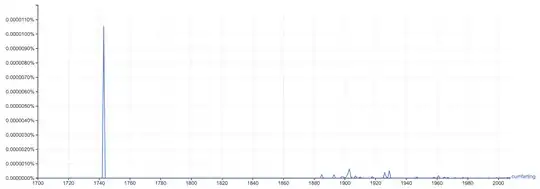
Ngram graph of "cumfarting" in English corpus, 1700-2012

I found one dissertation by Przemysław Uściński which suggests in a footnote the word cumfarting is part of "a brilliant parody of tedious legal language" (pg. 164).

Helen Thompson suggests something similar, though more specific, in Fictional Matter, her book on chemistry and English novels. In fact she quotes the word specifically and individually (pg. 215):

Typography concretizes—and, in the eyes of the reader whose literacy enlists her in Fielding’s game, rectifies—an abuse of justice also enacted in words.

“Cumfarting” obviously invalidates the juridical text’s claim to propri- ety. In this capacity, language in Joseph Andrews acts: by turning words into things, Fielding lends them qualities that override the prejudicial enactment of the law they would enable.

However everyone seems to be skirting the question: What did cumfarting mean? Or, assuming it's a neologism, what might it have been imagined to mean by an 18th century reader?

Did "cum" and "fart" have the same meanings in 1742 as today (to orgasm & to flatulate, respectively)? Did one but not the other, and it pairing just sounded funny?

Or was it just a completely meaningless pun on "comforting" that only today sounds sexual/filthy? If so, what’s the evidence of meaninglessness? Thompson and Uściński seem to argue it was a double entendre, but don’t specify the second entendre.

bobble
  • 9,774
  • 4
  • 35
  • 81
Jacob Ford
  • 223
  • 1
  • 6
  • 14
    Given the number of other spelling differences, I'd bet that just means "comforting, aiding and abetting" – muru Mar 31 '20 at 03:28
  • I think it's @muru who has the right of it. – Matt Thrower Mar 31 '20 at 07:41
  • 1
    @muru is of course right. Bear in mind that the author is famous for his use of Somerset dialect: he is the 18th century exemplar listed in https://en.wikipedia.org/wiki/West_Country_English#18th_century . – kimchi lover Mar 31 '20 at 12:01
  • 2
    @muru & kimchi lover, I have a hard time believing there's no double entendre intended to it at all, and that this just just dialect or funny spelling. Thompson and Uściński both suggest there's significant double meaning to the puns. See for example (in the same passage) "justasses." They just don't specify what that meaning might have been for the word "cumfarting," in 1742. Still, I encourage you to write up an answer! All answers are helpful. – Jacob Ford Mar 31 '20 at 18:42
  • 1
    Surely this is too obvious to merit a formal answer. It’s patently a malapropism, the speaker meaning “comforting” but the reader is expected to laugh at “farting” and at the comical pomposity of the speaker. I greatly doubt “cum” had its modern alternative meaning, but any etymology of the latter would resolve this. – Chappo Hasn't Forgotten Apr 05 '20 at 23:30
  • To take one example, until about 1970, "gay" meant "happy" and not "homosexual." Likewise, the sexual meaning of "come" is a modern usage also dating back to the 1970s.https://www.etymonline.com/word/cum?ref=etymonline_crossreference – Tom Au Apr 22 '20 at 16:24
  • 2
    @TomAu, Long before 1970. "gay" was used like a dogwhistle word in the 1938 film Bringing Up Baby: bringing up baby - Was Cary Grant the first actor to say "gay" onscreen? - Movies & TV Stack Exchange. – Ray Butterworth Mar 08 '21 at 13:36

1 Answers1

8

This is not an obscenity about "climaxing" or "passing gas." It's a phonetic rendering of what was then spoken English. For instance, the sexual meaning of "come" is a modern usage dating back to the 1970s.

The bolded text, "and so was cumfarting, eading, and abatting," reads in modern English, "and so was comforting, aiding, and abetting..." That might be a pleading in a court proceeding.

Mark Dominus
  • 274
  • 2
  • 12
Tom Au
  • 441
  • 2
  • 11
  • 2
    The OED has citations for the sexual meaning of "come" back to 1604 (Dekker & Middleton Honest Whore "a wench that will come with a wet finger") – Gareth Rees Mar 07 '21 at 15:48
  • The etymonline reference is only for the three-letter spelling variant. – Ray Butterworth Mar 08 '21 at 01:40
  • @RayButterworth OED dates the "cum" spelling to Middle English. – Gareth Rees Mar 08 '21 at 08:23
  • 1
    @GarethRees, yes, I think we're both saying the same thing. The etymonline entry isn't very good, and this answer further misinterprets what it does say. – Ray Butterworth Mar 08 '21 at 13:30
  • @GarethRees Although the earliest date the OED quotes where the spelling 'cum' specifically refers to the sexual meaning is 1987. 'Come' may have had the orgasm meaning in 1742, but was it differentiated by spelling? Is there any reason that doesn't rely on a modern spelling convention to suggest that cumfarting is intended to evoke the sexual meaning. Are the references to Francis having a disputed twig in her hand enough to support it? I'd suggest only of the rest of the tale can be imbued with hidden meaning also. – Spagirl Oct 26 '21 at 16:36
  • @Spagirl The answer says that "the sexual meaning of "come" is a modern usage dating back to the 1970s" — I quoted the OED to shows that this is wrong by several centuries. I don't have an opinion on the original question about whether there is a pun in Joseph Andrews. – Gareth Rees Oct 26 '21 at 16:45