18

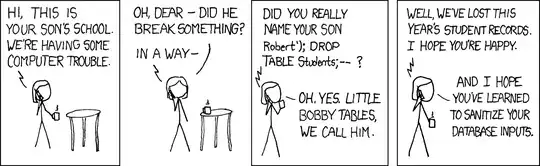
A mother is talking on the phone. The person on the phone says, "Hi, this is your son's school. We're having some computer trouble." The mom responds, "Oh dear — did he break something? The other person answers, "In a way — ... Did you really name your son Robert'); DROP TABLE Students;--?" The mom says, "Oh, yes. Little Bobby Tables, we call him." The other persons says, "Well, we've lost this year's student records. I hope you're happy." The mom says, "And I hope you've learned to sanitize your database inputs."

I think it's obvious that Little Bobby Tables's mom has broken the law. Let's assume this is his legal name and does not break any naming laws; it's still probably illegal, because she obviously gave him that name with intent to harm computer systems.

However, when Robert'); DROP TABLE Students;-- grows up, he will also have to type the name into many online forms - and it may have the same effect. Would he be commiting a crime by entering his legal name into a computer if the name was intentionally chosen by his parents to harm computer systems?

This is not a duplicate of an existing question about this comic. That question is about the consequences for the mother, while this one is about the future consequences for the child after he becomes an adult. The title of that question does ask about the child, but the body is about the parent.

Someone
  • 17,046
  • 10
  • 84
  • 177

6 Answers6

29

It depends on the mens rea element of any given statute.

If Bobby's home state makes it a crime to purposefully enter harmful data into a computer system, he is unlikely to ever run afoul of that law while conducting legitimate business; his purpose is to pay his taxes or renew his driver's license or sign up for classes.

However, if he moves to a state where it is a crime to knowingly enter harmful data into a computer system, he could face liability if he's learned what his name means and knows the system won't sanitize the input.

If he moves to a state where it is a crime to negligently enter harmful data into a computer system, he's on the hook once he knows the effects of entering his name.

And if he moves to a state where it is a strict-liability offense to enter harmful data into a computer system, he is on the hook every time he causes a problem by entering his name, regardless of whether he understands the consequences of doing so.

PC Luddite
  • 107
  • 6
bdb484
  • 58,968
  • 3
  • 129
  • 184
  • Comments have been moved to chat; please do not continue the discussion here. Before posting a comment below this one, please review the purposes of comments. Comments that do not request clarification or suggest improvements usually belong as an answer, on [meta], or in [chat]. Comments continuing discussion may be removed. – Dale M Jan 09 '24 at 08:56
16

If Bobby was born in Germany, he won't have this problem. German laws requires the parents to select a name appropriate for the gender of the newborn, and DROP TABLES is not a suitable name for a boy (or a girl, for that matter). The parents would have to try and explain to the registry clerk that there is a culture where '); is a perfectly normal name, the clerk would be unlikely to believe that, and the matter would go to court -- where much less absurd names have been rejected as being akin to child abuse.

If Bobby immigrated to Germany, there would be an official transliteration of foreign characters into German documents (mostly following the ISO standards). Here it may get tricky, since ', ) and ; are valid characters of the standard latin character set, just not alphabetic. Still, a clerk who lets that pass would never live the embarassment down.

So Bobby (or Bobby's parents) would have to win a precedent-making lawsuit to make the name possible. And after that makes national headlines, the excuses for sloppy input validation/escaping run thin.

A nice question would be if Bobby, should he win the court cases, now has a right to be addressed in his full name in official communications ...

o.m.
  • 17,538
  • 3
  • 37
  • 64
  • Do note we have a couple cases from the BGH against free naming - iirc the BGH limited it to 5 names and at most two can by combined by hyphen... – Trish Jan 04 '24 at 21:55
  • 8
    This answer spends a lot of time discussing why this wouldn't happen because of the specific name. However, I don't think the name itself is particularly relevant. There are perfectly valid names consisting only of Latin letters that could cause issues with poorly designed apps. – PC Luddite Jan 05 '24 at 06:43
  • 12
    @PCLuddite: Indeed. Christopher Null wrote about his plight for example. – Matthieu M. Jan 05 '24 at 09:47
  • @PCLuddite, a valid name under German law is not just defined by the character set. For instance, the perfectly normal word 'Regen (i.e. rain) was rejected because it was no name. If a server crashes because of a valid name, I would always blame the programmers. – o.m. Jan 05 '24 at 14:46
  • 2
    Does German law regulate last names as well as first? If not, the situation in the comic could still apply with someone named “Hans Gruber'); DROP TABLE Students;--“ – fyrepenguin Jan 05 '24 at 15:56
  • @fyrepenguin Yes, last names are even more strictly regulated than first names: A couple either choses a common last name from one of their two last names (BGB §1355, the partner who adopts the common last name is free to append their own, "old" last name for themselves but not for the child); and the child adopts this common last name, or the child adopts either the last name of the father or of the mother (BGB §1617). Changes in last names are only possible under specific circumstances and must be approved (NamÄndG) – Narusan Jan 05 '24 at 16:39
  • 11
    Many real, acceptable names contain apostrophes, and apostrophes are enough (without parentheses or semicolons) to exploit real SQL injection vulnerabilities. Something like Timmy O'or't'is't looks a bit strange but isn't obviously not a real name from some culture. – kaya3 Jan 05 '24 at 17:16
  • @o.m. You and I are using the same criteria of "validity". There are valid names that German courts wouldn't be able to dismiss so easily. Name that have been used for generations, are culturally reasonably, contain no special characters and possessed by entire families. The most prominent example was mentioned by Mathieu M in a previous comment – PC Luddite Jan 05 '24 at 17:37
  • 3
    @PCLuddite, I'm nó judge, but if entering a name like 'Null' into a database causes a crash, I would always blame the programmers and not the users. Certainly a Mr Null has a much more reasonable expectation that the string is valid than a Mr '); drop database. – o.m. Jan 06 '24 at 10:00
  • 6
    (-1) because the question clearly states "Let's assume this is his legal name and does not break any naming laws; " This answer does not address any consequences. – infinitezero Jan 07 '24 at 12:43
  • 1
    @infinitezero, there is no other answer for Germany because the name would not be the legal name. – o.m. Jan 07 '24 at 15:02
  • 3
    @o.m. If someone with this name visited Germany as a tourist, or otherwise did business with German entities, such that their actions fell under German law, they wouldn't be required to change their name, so I think better answers are certainly possible for Germany. – Dewi Morgan Jan 07 '24 at 19:37
  • 2
    @DewiMorgan Yes. "Your hypothetical is unlikely/implausible/impossible" is always a bad answer. – bdb484 Jan 08 '24 at 15:25
6

For someone born in France, no consequences, because it would never happen. The état civil officer registering the name of newborns has the power to veto names that "seem contrary to the interest of the child". The relevant text is Code Civil, Article 57. Parents can contest the decision, to be adjudicated by a court.

Famous examples include:

  • In 1999, Mr and Mrs Renaud tried to call their daughter Mégane. This was initially blocked by the état civil officer, on the basis of it being suspiciously close to Renault Mégane, a then-new French car model. A judge later ruled the daughter could be named Mégane after all.

  • In 2009, a couple decided to call their child Titeuf, a French comic series. This was blocked, and the decision was confirmed by the courts. Because it went up to the highest jurisdiction of the land, this decision is now legal precedent.

  • In 2015, the name Nutella was blocked (a brand of hazelnut spread). The same year, Fraise (French for "strawberry") was also blocked. In both cases, parents changed the name.

While only the French alphabet is allowed for use in names (excluding e.g. ñ) plus space and dash, beyond that there is no hard rule to what names are allowed. A line of computer code would definitely never be allowed as a name.


For anyone else with such a legal name, then it would most likely be a crime.

There is a Code Pénal chapter concerning the relevant computer crimes. Articles 323-1, 323-2, and 323-3 forbid entering or staying into a data system fraudulently, or to introduce, modify or delete data, to modify the operation of the system.

French law does recognise lack of intent as exonerating, however it also recognises imprudence and négligence (Art. 121-3). It would be quite difficult to convince a court that you did not know your name was malicious code and would disrupt a computer system. Using the mother's argument (i.e. the operator should have had better security) would almost certainly play against you in showing you were aware of the risks involved in using your name.

If your name isn't transparently computer code but simply a regular name in a different culture, it would likely be recognised as an innocent happenstance.

AmiralPatate
  • 784
  • 4
  • 7
  • Actually, the rule under the Napoleonic code was that your name had to be in a calendar (although later it was determined that it did not matter which calendar) and there was an exception for foreign names (i.e. Mohammed, Ivan). Now the rule is that – LMR Jan 05 '24 at 13:52
  • I added some descriptions to the things you linked for context as they were mostly unfamiliar to me except for one. With regards to 'fraise', you had included a link to strawberries, but I wonder if you had instead intended to link to 'fraise tagada' (https://en.wikipedia.org/wiki/Fraise_Tagada). – Pyrotechnical Jan 05 '24 at 14:31
  • 3
    This analysis ignores the possibility of immigrants (or even visitors) to France who bear names that would qualify. – Tiercelet Jan 05 '24 at 15:00
  • 4
    Like the other "this wouldn't happen" answer, the problem here is that you are assuming any malicious string would be obviously not a valid name. But names can have apostrophes, apostrophes are enough to exploit SQL injection vulnerabilities in string input fields, and not all code is obviously code. Would an immigrant who wants to name their child Timmy O'or't'is't absolutely, definitely be rejected by the government? – kaya3 Jan 05 '24 at 17:25
  • 2
    Again, I and others have linked examples under nearly every answer of perfectly valid names under any reasonable naming statute or convention that break poorly configured applications – PC Luddite Jan 05 '24 at 17:41
  • 3
    How could French law reasonably justify banning a name such as "Jennifer Null" or "George True"? – PC Luddite Jan 05 '24 at 17:44
  • What if Bobby receives an acceptable French name at birth, but once he becomes an adult, he wants to legally change his name to "Robert'); DROP TABLE Students; --"? Are French adults not allowed to name themselves whatever they like? – jwodder Jan 05 '24 at 18:15
  • @jwodder no, it has to be a name – Trish Jan 05 '24 at 18:34
  • @Trish: But this answers says that "There is no hard rule to what names are or aren't allowed". Are you saying that's wrong, or are different definitions of "name" used when naming a child versus an adult changing their name? – jwodder Jan 05 '24 at 18:36
  • @jwodder no, I an saying, that the age does not matter. The office will need to accept the name. – Trish Jan 05 '24 at 18:55
  • @kaya3 no in france a name with a apostrophe is never accepted and an immegrant has to give a different name and change it when immigrating my family had to change names in the way past for this reason. It's the clerk who's entering the details his responsibility to make sure a name is unharmful. – paul23 Jan 07 '24 at 10:08
  • 3
    -1: As with o.m.'s answer for Germany, trivia about baby-naming laws are irrelevant to the question, which specifically precludes this line of argument ("assume this is his legal name and does not break any naming laws"). Further, if someone with this name visited France as a tourist, or otherwise did business with French entities, such that their actions fell under the law of France, then they wouldn't be required to change their name. So the claim "it would never happen" is false, and this answer is incorrect. – Dewi Morgan Jan 07 '24 at 19:42
  • 1
    @PCLuddite The main justification is the interest of the child. E.g. pun names are generally considered against the interest of the child. Your example would likely be fine, provided Null and True are a family name of the mother and/or father. If that breaks a computer system, it wouldn't be on you. – AmiralPatate Jan 08 '24 at 10:18
  • 1
    @jwodder Name change is subject to a number of rules and requirements, you generally couldn't pick a name that wouldn't be accepted at birth. – AmiralPatate Jan 08 '24 at 10:24
  • @AmiralPatate and what if a parent gave you that surname as a given name (which is not uncommon to do) with the intent that you would later break computer systems? – PC Luddite Jan 11 '24 at 13:10
  • @PCLuddite that doesn't break computer systems at all. – Trish Jan 11 '24 at 14:10
  • @PCLuddite Odds aren't great. Because intent is clearly against the interest of the child; Null and True sound like nul (lame, lousy) and trou (hole); and additional arcane rules. – AmiralPatate Jan 11 '24 at 14:15
  • @AmiralPatate again, the specific name doesn't matter. Those were just examples. – PC Luddite Jan 12 '24 at 01:37
5

This has already happened, with a name that's not inherently malicious.

Some badly-designed systems parse values and convert their names from strings to something else automatically. An example I've heard is actress Rachel True, whose last name has locked her out of Twitter as well as iCloud.

ulatekh
  • 159
  • 1
1

From the cartoon, I don't think it is obvious that he typed in his name. My first assumption was that school administrators and teachers are typing in his name. If that is correct then there is no actus reus on his part and therefore no crime has been committed.

If he is typing his name in then the analysis regarding mens rea holds.

Does the cartoon require that he use his given name (is Tables his surname?) as a username to have this effect?

For a fascinating article on the laws in the U.S. concerning naming children, read here.

LMR
  • 167
  • 6
  • 10
    The question was about a hypothetical situation in which he, years after the comic, does have to enter his name. It's not about the actual situation in the comic. – Someone Jan 04 '24 at 21:46
  • 2
    @Someone the problem with the comic is, that, as the other question elaborated, the name is not possible in most places. – Trish Jan 04 '24 at 23:24
  • 1
    @Someone the comic and the specific name are incidental to the core of the question, which is about the legal liability of someone who possesses a name that causes problems when entered into poorly configured computer systems. – PC Luddite Jan 05 '24 at 06:33
  • 7
    The likelihood of someone possessing such a name is higher than you would expect. Any name that may be interpreted as part of a SQL statement could be an issue for poorly programmed applications (meet Mr. Null) – PC Luddite Jan 05 '24 at 06:38
  • It is not true that the name is not possible in most places. Cite the rule please. Naming a child is a fundamental liberty in most Western countries; the State has to show the parents' chosen name is illegal. There is no rule prohibiting a child's name from interfering with computer networks. Legal rule: the name is against the interest of a child to bear that name. It is more flexible and harder to apply. How could this name harm the child? Not a third party, but the child. In Georgia (USA), you can give your child any surname you wish. See https://www.bbc.com/news/world-us-canada-39413653 – LMR Jan 05 '24 at 14:14
  • 3
    @PCLuddite: Even in the days before computers, I would expect someone called "FNU" might have cause trouble in police departments that would normally use that "name" as a placeholder for suspects whose first name was unknown. A resolution to this problem would be to say that anyone whose actual name happened to be "FNU" should have their name recorded as "XFNU", and recognize that two entries related to XFNU SMITH may or may independently refer either to people actually named XFNU JONES or FNU JONES. Of course, the concept wouldn't be anything unusual--entries related to... – supercat Jan 05 '24 at 16:55
  • e.g. JIMMY JONES might independently refer to JIMMY A. JONES, JAMES B. JONES, JIM R. JONES, or to other people not on file. – supercat Jan 05 '24 at 16:57
  • @Someone my apologies, my previous comment was meant to tag Trish – PC Luddite Jan 05 '24 at 17:32
  • 1
    @LMR: You can name your child whatever you wish, but that doesn't mean you can get the name on the child's ID or birth certificate. In many places in the US, the local authorities do not have the practical ability to record an unlimited number of arbitrary Unicode characters as a person's name (in databases, on documents, etc.). For that matter, there are names which are not even encoded in Unicode, and as far as I'm aware, nobody has managed to solve that problem yet (other than by adding more characters to Unicode, which is why it keeps getting new CJK extensions). – Kevin Jan 05 '24 at 17:53
  • 1
    I can't believe the comments have gone on so long without a mention of little X Æ A-12. – shoover Jan 05 '24 at 23:16
  • 3
    @PCLuddite the comic isn't simply about names that cause "problems" with systems. Most such names cause problems only for the user whose name it is. Someone named "Robert'); DROP TABLE Students;--" will cause damage to the system affecting everyone, not just an inability to process certain data. – phoog Jan 06 '24 at 03:02
  • @phoog Someone named O'Connor, if poorly escaped, will damage a website which lists its users, preventing it from performing that function. If the output of a query in which his name is unescaped is used in processing the data, perhaps listing active users in order to cull inactive ones, then that operation would find no active users, and could wipe all users as inactive. Improper behavior can cause damage even in the absence of deliberate code injection. – Dewi Morgan Jan 07 '24 at 19:51
  • @phoog that's a fine distinction and not really relevant to my argument. My point was that the name itself is immaterial. one could name their child something with the intent to cause problems (or damage) to computer systems and that name could be valid under existing norms. – PC Luddite Jan 11 '24 at 04:05
1

Believe it or not, this is not an unfamiliar problem for bureaucracies.

See this for another example in comedy, and a certain style of solution:

Derek (drops lighter) Nippl-e

The standard way of handling it is that bureaucracies have rules about how names must be represented in writing.

In the Anglophone world, a typical requirement is that names be represented only with letters of the English alphabet.

In terms of "legal" names - that is, presumably meaning a name recorded at the registry office upon a standard set of life events like birth, marriage, or death - the registrar (an official employed by the state) may also control the proposed registration of names which he thinks are motivated by mischief or would contribute to mischievous ends.

The string Robert'); DROP TABLE Students;-- is not therefore a person's "name" in an English-based legal jurisdiction. It is not a name firstly because it does not consist only of English letters, and secondly because (even when shorn of the punctuation elements) a registrar could well suspect mischief and therefore refuse the registration of such a name for any official purpose of the state.

In terms of whether entering such a string into a computer system would be criminal, that is likely to be highly dependent on context, including whether it was done with a malicious purpose.

If the purpose of making the entry was not malicious - for example, if some waggish computer programmer chose it as a screen name, and then "damage" was caused (i.e. the computer belonging to the bureaucracy reacted differently than the bureaucracy would have preferred) - then I doubt it would be a criminal act.

There is not in general any requirement for the public operating or making entries into computer systems, when explicitly or implicitly authorised to operate the computer as a member of the public, to understand technical matters or (even if they do understand technical matters) to anticipate how the computer may react adversely to their use.

Nor are they required to understand what opinion the bureaucracy may have on whether certain reactions by the computer are desirable for their ends, and the mere fact that a computer has reacted adversely in the opinion of the bureaucracy which owns and programs it, does not determine the question of whether the operator was engaged in a criminal act by triggering that adverse reaction.

By analogy, if we had a `Robert Jump-Off-Roof Tables" who submitted his name to a bureaucracy, and a human clerk administering records with this name then proceeded to the roof of the building and jumped off, a court may well decide that the result is too remote for the mere submission of that name to be a criminal act.

It might be too remote even if the submission was performed mischievously to see what reaction it provoked amongst the clerical staff, because no reasonable person would think that a clerk should react to seeing such a name by jumping off a roof, even if they did in fact do so. Likewise, if a computer reacts to certain inputs in ways that are unreasonable.
Steve
  • 2,615
  • 8
  • 15
  • 1
    But it is rather common for English names coming from Irish or Romance languages to include ', and - is common as well. – phoog Jan 06 '24 at 18:04
  • @phoog, in other words the definition of "not English"! Other societies might of course tailor their rules to their circumstances. These elements are not normally regarded as part of the name itself, but as stylistic elements, so that "O'Neil" and "Oneil" would be regarded as the same name. That is, the law is unlikely to recognise any material distinction between the two forms and will consider them interchangeable, and that's pertinent to the "legal name" aspect of the question. – Steve Jan 06 '24 at 19:01
  • 3
    "In the Anglophone world, a typical requirement is that names be represented only with letters of the English alphabet". Citation needed. This is certainly not the case in the UK or the US. In the UK we have for example Cowley vs. Cowley where the following is stated: "Speaking generally, the law of this country allows any person to assume and use any name, provided its use is not calculated to deceive and to inflict pecuniary loss". In the US we even have practical examples thanks to good ol' Elon Musk that this is not the case. – Voo Jan 06 '24 at 23:13
  • @Voo, Cowley is completely irrelevant. That concerned the right to use a name of one's choosing, not the question of which writing system must be used to represent that name. The idea that a English registrar would even accept names written in Cyrillic or Arabic (i.e. other coherent but foreign writing systems), let alone one written in arbitrary punctuation symbols, is a claim so extreme and contrary to experience that it is this which ought to be supported by citation, not the basic claim that names registered in England must be written in English as we know it. – Steve Jan 07 '24 at 00:16
  • 5
    @Steve I have a US friend who has a â in his legal first name - which I'm sure you know was never part of the English alphabet. So if your only argument against this is that the "claim so extreme and contrary to experience" then you simply don't know enough people. I just looked it up and in the US the rules vary from state to state, but there are several states that don't seem to have any legal limits on the chosen name. – Voo Jan 07 '24 at 10:33
  • @Voo, yes but is that considered distinct from a mere a (a standard English letter)? I think a majority of English speakers would not even know how to pronounce or articulate the difference. My original claim was that "in the Anglophone world a typical requirement [of bureaucracies] is that names be represented only with letters of the English alphabet". This isn't exclusive of other practices in certain places. US rules might vary because certain states have, for example, a large Spanish heritage - and therefore local rules might accommodate specific cases (not arbitrary symbols). – Steve Jan 07 '24 at 10:55
  • 2
    @Steve It's a completely different letter which is not part of the English alphabet and is part of his legal name. Sure many people wouldn't know how to pronounce it - but that'd be a weird legal requirement (the same is true for many names using only the English alphabet). But now that we agree that having a non English alphabet character in your name is very much not "extreme and contrary to experience" do you have any actual citation for your claim? – Voo Jan 07 '24 at 11:07
  • @Voo, you say this, but to any sheltered English speaker, it's the lowercase letter A, perhaps with a smudge on the page. In other words, it is clearly parsable as an English letter to an English speaker. The fact that it isn't English doesn't mean it wouldn't be treated as English and treated as interchangeable with plain a by the relevant bureaucracy. You tell me a registry office that will accept Robert'); DROP TABLE Students;--, or any name consisting of arbitrary characters (not locally-conventional characters), then we'll talk. – Steve Jan 07 '24 at 11:46
  • 4
    @Steve "Naming Baby: The Constitutional Dimensions of Parental Naming Rights", written by a law professor from UC Davis explicitly states on page 168 that only some states prohibit ideograms and pictograms and later says that there are several states that explicitly state there are no limitations on the name. – Voo Jan 07 '24 at 18:20
  • 3
    I mean I agree that for practical purposes there will be limits even if there's no legislation contrary to it (gov IT systems being what they are), but it seems very clear to me that contrary to other countries that have very strict legislation about naming, common law legislation is for the most part very laissez faire on this issue. – Voo Jan 07 '24 at 18:28
  • @Voo, you're assuming "laissez-faire" means the right of the individual to decide and impose their decision upon a bureaucracy, rather than the other way around, the right of a bureaucracy to decide and impose its decision upon the individual. What we mean by a "government IT system" is simply an information system belonging to a bureaucracy; a bureaucracy that was no less rigid or rule-based when it worked with information on paper, than it is now it works with mechanised information systems. – Steve Jan 07 '24 at 19:09
  • 1
    -1. Conflation of "bureaucratic rules" and actual law. Uncited, vague claim that "In the Anglophone world, a typical requirement is that names be represented only with letters of the English alphabet." (a decidedly atypical requirement!), leading to weird claim that "It is not a name" (an unusual definition of "name"!). The question explicitly excludes these lines of argument anyway ("assume this is his legal name and does not break any naming laws"). Second half of answer ("In terms of..." on) seems good and answers the question, but needs citations and to state what jurisdictions it covers. – Dewi Morgan Jan 07 '24 at 20:43
  • 2
    @Steve I've given you a written paper by a law professor for the US that supports my point. We have a legal case in the UK which states you can pick any name except for a few reasons (none of which is "contains non-english alphabet letters). I've given you real counter examples of people who have non-english alphabet letters in their name. And all your counter argument is just "I don't think that's how it works". Clearly no objective evidence is going to convince you, not much point in continuing the argument. – Voo Jan 07 '24 at 20:48
  • @DewiMorgan, I really didn't realise the idea that names have to be written in English was such a disputable point. At any rate, I'd refer to Voo's "Naming Baby" reference - it's really quite an interesting and amusing read, but it supports all my points. – Steve Jan 07 '24 at 20:58
  • @Voo, I don't think it does support your points. It explicitly reinforces my point that most bureaucracies have rules, and many of them centre on requiring the use of the English alphabet. You've given me the odd exception, and all I've pointed out is that there may be some local exceptions about punctuation or diacritics which reflect established traditions and are regarded as peripheral to the spelling, nothing detracting from my original claim that: "in the Anglophone world a typical requirement [of bureaucracies] is that names be represented only with letters of the English alphabet". – Steve Jan 07 '24 at 21:06
  • Disputability isn't the main problem: vagueness is. Without identifying where you believe this is true, your claim cannot even reasonably be rebutted except by iterating over every single jurisdiction across the "Anglophone world" and disproving it for each. You haven't identified even a single exemplar jurisdiction where you believe your claims true. If "...a person's "name" in an English-based legal jurisdiction" refers to jurisdictions based on English (UK) law, what British legal definition of "name" are you using? Claims in law.se are typically backed by citations of the relevant laws. – Dewi Morgan Jan 07 '24 at 21:20
  • @DewiMorgan, the claim isn't supposed to be rebutted, and the part you're taking issue with wasn't a specific claim about the law in any jurisdiction but about the "typical behaviour of bureaucracies", and an analysis of a specific string mentioned by the OP and whether any bureaucracy would accept it as a name. If you want an example of how a British registrar will approach the question, see this for example: https://www.whatdotheyknow.com/request/restrictions_on_childrens_names. (1/2) – Steve Jan 08 '24 at 00:45
  • Nevertheless I think you're being extremely churlish about my point which is common sense and obviously correct. Are there really people here who seriously think you can just draw a picture, record a series of unpronounceable symbols, or employ foreign scripts, insist that it's your "name", and that both the state and various private bureaucracies must accept this and somehow accommodate its recording in a way in which you alone determine? It's utterly risible. In England, names have to be in English. You can choose how it's spelled in English, but not whether English itself is used. (2/2) – Steve Jan 08 '24 at 00:48
  • 1
    The OP is about punctuation, not pictures, unpronounceable symbols, or foreign scripts.

    At https://www.ons.gov.uk/peoplepopulationandcommunity/birthsdeathsandmarriages/livebirths/datasets/babynamesinenglandandwalesfrom1996 the UK govt's "Office for National Statistics" lists UK birth certificate names from 1996 to 2021: 5,304 of those names (given to 226,452 babies) include punctuation. "Aj" is counted distinct from "A.J.", "Aaidah" from "Aa'Idah", "Abbiegail" from "Abbie-Gail", and "Aimee" from "Aimee-". So punctuation is permitted, and considered significant, by the UK government.

    – Dewi Morgan Jan 09 '24 at 01:37
  • 1
    @DewiMorgan, specific locally-common forms of punctuation might be permitted by certain bureaucracies. So for example, one hyphen linking parts of so-called double-barreled names, or one apostrophe, in the UK. The guidance on passports, for example, specifically excluded diacritical marks. https://www.gov.uk/government/publications/names-names-that-cannot-be-used-in-passports. In my view, the OP was not specifically about punctuation, but about anything which a bureaucracy may not properly accommodate and which may cause malfunction of a computer. – Steve Jan 09 '24 at 08:37