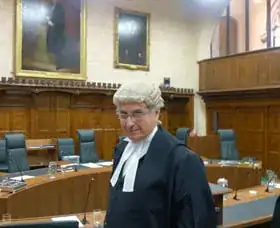
The cited case (Ross [2012] UKPC 3) is not a Canadian case. It is from St Kitts and Nevis, an appeal from the Court of Appeal of that small Caribbean country to the Privy Council. The two barristers are from the same firm based in Canada (WeirFoulds LLP), a firm which also has a cross-jurisdictional practice encompassing several countries in the eastern Caribbean who share their appellate court system. Those nations also have a common pathway for onward appeals to the Privy Council, for essentially historical reasons dating from the era of the British Empire. Thus, counsels' appearance in this case is not because they are Canadian, but because of their separate entitlement to appear in Caribbean appeals.
- Frank Walwyn's biography (linked in the question) says he is "He is licensed to practise law in Canada, and is also a member of the bars of Anguilla, Antigua and Barbuda, Barbados, Belize, the British Virgin Islands (BVI), Dominica, Grenada and St. Kitts and Nevis." (my emphasis). Membership in the St Kitts bar was enough for him to be able to also appear before the Court of Appeal of the Eastern Caribbean Supreme Court, and therefore the JCPC as well.
- Bryan Finlay's biography does not specify, but as senior partner in the same firm he may well have the same status. In any case, since "duly qualified members of the Bar in countries from which appeals to the Queen in Council lie have a right of audience before the Judicial Committee of the Privy Council" (Halsbury's Laws of England, vol. 66, para 795, 2020 ed.) he could appear before the JCPC whether or not he was allowed to do so in lower courts.
Regarding your Q2 (Why Canadians?): In this case, the appeal was from St Kitts, which is a very small country of about 50k people. This would give a small talent pool from which to draw, if only barristers from St Kitts were eligible to practise in appeals. That is why the shared Eastern Caribbean court system exists and why there is some added generosity about qualifications between the participating countries. While the appellant Ross might have had many choices, he himself is "a Canadian lawyer who was at the time [= 1983] practising in Halifax, Nova Scotia", and could therefore have been drawn to a Canadian firm with a Caribbean practice.
The appeal, moreover, does not appear to have turned on any local peculiarity of St Kitts' law. It was mainly about how certain commercial documents should be interpreted. The issues arising would be accessible to practitioners from many common-law countries. Canada is not especially at an advantage or disadvantage, and neither is England. There are several barristers in London who have Caribbean experience and qualifications and who are more commonly instructed to appear on Caribbean-related cases (London is a nexus for commercial litigation, and several Caribbean jurisdictions are commercially important in this way, such as the Cayman Islands).
I have no data on your Q1 (How many Canadians?). I expect that there are not many, because the natural choice of counsel might be either a London-based barrister, or one from the jurisdiction of origin who has been handling the case so far, rather than from a third country with no recent history of JCPC appeals. You could gather your own data from case reports if you are so inclined; as far as I know there isn't a systematic pre-existing study available.