28

Inspired by Is it true that men are forced to pay child support for children they didn't consent to have?

Let's say Alice rapes Bob and becomes pregnant. She then carries the child to term, against Bob's wishes. Can she then compel Bob to pay child support? Compared to the linked question, here Bob did not consent to sex.

ohwilleke's answer to the linked question says that if Bob rapes Alice and Alice carries the child to term, then she is required to care for the child. On the other hand, presumably Alice can choose to abort the child if she doesn't want to care for the child. In the case where Alice rapes Bob, Bob presumably can't compel Alice to terminate the pregnancy.

Some Googling led me to Hermesmann v. Seyer, which asserts that in Kansas, "a woman is entitled to sue the father of her child for child support even if conception occurred as a result of a criminal act committed by the woman". However, the text of the article seems to say that although Seyer (the man in the relationship) was underage and therefore incapable of providing consent under statutory rape law, he had actually given consent to the acts under civil law since he didn't complain to his parents. In the hypothetical scenario described above, Bob did not consent to the acts since he was raped.

I'm interested in all jurisdictions.

Ian Kemp
  • 137
  • 7
Allure
  • 2,563
  • 3
  • 18
  • 36
  • 12
    Your story needs more focus on Charlie, the child. Alice would be getting child support for Charlie, not for herself. If Bob gets custody of Charlie, there would be no question of child support. Would a family court leave Charlie with Alice? – o.m. Apr 28 '22 at 04:59
  • 5
    @o.m. hmm presumably if Bob didn't want the child in the first place, then he wouldn't want custody of Charlie either. – Allure Apr 28 '22 at 05:24
  • 12
    'Presumably Alice can choose to abort' - location dependent – Jon Custer Apr 28 '22 at 13:13
  • 15
    @Allure, the point remains that it is child support we're talking about, not spousal support. The child is clearly innocent of any wrongdoing, and entitled to support from both parents, regardless of what the parents think of each other. – o.m. Apr 28 '22 at 15:00
  • 1
    FWIW, there is a variation by jurisdiction, rather than a common U.S. or global rule on point. – ohwilleke Apr 28 '22 at 17:41
  • 1
    @BCLC: the question linked by this one, (Is it true that men are forced to pay child support for children they didn't consent to have?) was in HNQ a couple days ago. Yesterday, another question that cited it as inspiration (Does Bob have a case if he ends up paying child support due to Alice's deceit?) was also in HNQ. I found these again easily by following the "linked question" in the sidebar of this and then the other question. (And remembered them as the ones that were in HNQ) – Peter Cordes Apr 29 '22 at 01:30
  • 3
    A person being responsible for their child they don't want is why there's laws for it. The title says man but the body talks about 'minors' : "If both parents are under 18 (and unemancipated) at the time of the child’s conception, their parents (the child’s grandparents) share primary responsibility for supporting the child. This responsibility lasts until both minor unemancipated parents become age 18 or are emancipated." https://www.womenslaw.org/laws/nc/child-support/when-parent-minor – Mazura Apr 29 '22 at 02:02
  • 2
    @o.m. is right. First of all, the fact that Bob did not consent to having sex with Alice does not imply that Bob doesn't want custody of the child. It's also possible that (even if Bob does not want custody) Alice would be deprived of custody. Who then would have custody if Bob does not want custody? Where would the child go? It's really impossible to consider the question of child support without figuring out the custody issue first. – phoog Apr 29 '22 at 07:26
  • 1
    The insightful analysis from ohwilleke helps to clarify that the question is (intentionally or not) a red herring (MRA fantasy?). While conceptually possible, its not clear that U.S. courts have ever adjudicated a single case which includes a confirmed instance of forcible sexual assault against a man, that results in ejaculation and impregnation of the offender; followed by the seeking of child support from that male victim. – retriever123 Apr 29 '22 at 19:16
  • 1
    @retriever123 Intentionally. – ohwilleke Apr 29 '22 at 19:31
  • 4
    @retriever123 It is impossible for the main question to be a "red herring". A red herring is something that distracts from the intended target. By asking a question, Allure made it the intended target of this discussion. You don't get to make "You're derailing the conversation" type accusations against the person who started the conversation. Furthermore, the question is useful in elucidating the philosophical stances involved in positions regarding cases that have happened. – Acccumulation Apr 29 '22 at 23:47
  • 1
    @ohwilleke Accusing others of bad faith is quite uncivil, and you have not presented any basis for it. – Acccumulation Apr 29 '22 at 23:48
  • @Acccumulation, Law.SE questions do not exist in a vacuum. Insofar as a question here on the topic of paternity rights, responsibilities, and protections can contribute to any reader's larger understanding of parental rights and equity; a question could be a red herring.
    In fact, its now very common for politicians/media to influence voters by posing questions that appeal to base instincts, while ignoring the fact that the hypothetical situation posed is virtually (or actually) nonexistent.
    – retriever123 Aug 05 '22 at 17:38
  • @retriever123 Semicolons are used to separate independent clauses. But the first of your second sentence starts with "insofar", which makes it a dependent clause, making that sentence incoherent. If we replace the semicolon with a comma, it still doesn't make sense; a question contributing to someone's understanding is the opposite of a "red herring". Your third sentence seems to accuse the question of being an emotional appeal, which is different from being a "red herring". That something has an emotional impact does not preclude it from having a valid rational point. – Acccumulation Aug 08 '22 at 05:00
  • As for the issue of this being uncommon and/or nonexistent, I already addressed that point three months ago. Waiting three months to repeat an argument that has already been rebutted, and not acknowledging let alone addressing the rebuttal, is poor rhetorical behavior. – Acccumulation Aug 08 '22 at 05:00
  • @Acccumulation, Policing grammar is snobbery and deflection. As a hypothetical, this question's relevance is in its ability to clarify a larger or real question. This author was perceiving a lack of equity for men and wanting to make that point with a situation that evokes a visceral sense of unfairness. But this is misleading as it elicits feelings about the larger issues of child support, (men are treated unfairly), without sufficient grounding in reality to have relevance. |-| Since Law.SE is a trusted by many, I called this a red herring to highlight a need to consider its relevancy. – retriever123 Sep 14 '22 at 21:13
  • @retriever123 I'm not "policing" anything. I'm simply pointing out incorrect use of punctuation. No one's being arrested. Your punctuation had a material effect on the comprehensibility of your comment. Calling it "snobbery" to comment on that is uncivil. It's not "deflection", either. I made my best guess as to what you meant, and addressed that. "Relevance" is not a property that something has in itself. Something is "relevant" only with respect to something else, so your use of the term is obfuscatory. – Acccumulation Sep 17 '22 at 19:36
  • Does it make a difference if Alice and Bob are both transgender? – Michael Hall May 16 '23 at 16:47
  • 2
    In that case Alice isn’t going to get pregnant, so practically yes. – gnasher729 May 16 '23 at 18:29
  • 1
    A little late to the party, according to statistics from a 2012 CDC report, of the reported cases of rape that involved a male victim being forced to penetrate their rapist, 78.5% of the victims report that their rapist or rapists were female only. While I found no statistic as to how frequently this type of male rape occurs compared to penetration of the victim, (in which female rapists are accused in only 13.5% of cases) there is a non-zero number of cases, and these cases may not all be statutory in nature. – hszmv May 18 '23 at 18:49

3 Answers3

26

The treatment of how paternity is handled in cases of rape, from which child support and child custody determinations flow, varies by U.S. state in the United States as a result of an ongoing and recent wave of legislative innovation, prompted by cases in which convicted male rapists sought child custody in connection with children conceived in acts of rape for which they were convicted. A state by state summary of the applicable laws as of January 2020 (which oversimplifies the situation in which there are additional distinctions not noted, some of which are differences in wording that could be relevant to how these statutes apply in the OP case) can be found here.
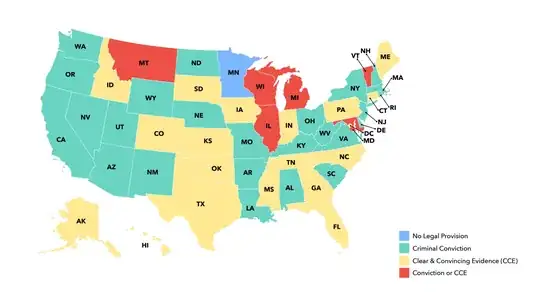
enter image description here

All of these laws are targeted at the case of a woman raped by a man who becomes pregnant, which is factually predominant, something that happens many thousands of times each year in the United States as a whole, and not at the case of a man who, in the course of being raped by a female, causes the female to become pregnant as a result.

Cases of men being raped that are handled by the legal system, and do not involve statutory rape, predominantly involve sexual interaction that is not reproductive, i.e. something other than a man involuntarily having vaginal sex with a woman, often prison rape by a same sex inmate or rape with an object, and also, as in other cases of rape, often doesn't result in a conception of a child due to random chance. Likewise, many women convicted of rape are convicted as co-participants in a crime that involves physical penetration of a victim by a man or an object, rather than sexual intercourse with the woman convicted of the crime. So, the number of cases that could potentially be litigated with respect to this issue is much smaller.

It is also worth noting that under U.S. criminal law, sexual intercourse procured by deception (other than deception regarding the person with whom one is having sex, for example, because of a blindfold or darkness, or deception regarding one's status as a medical practitioner making a medical examination, or as a law enforcement officer making a legally authorized cavity search) is not a crime and does not constitute rape.

Also, generally speaking, having sex consensually in a manner not intended to lead to conception, which, in fact, does result in conception with consent to the sex giving rise to conception (e.g. where there is an agreement to "pull out" that isn't performed due to the acts of one or both parties involved), will almost never be prosecuted criminally as rape, whether or not a jury with perfect knowledge of the facts of the interaction could convict under the law of the minority of U.S. states where this might be possible.

As @user6726 notes, the primary fact pattern related to the OP historically has involved instances of intercourse that are consensual in fact, but constitute statutory rape due to the age of the father which makes it impossible for him to legally consent, and in those cases, the default rule that the biological father of a child is recognized as the father for custody and child support purposes has been the predominant rule.

But much of that case law predates modern rapist-paternity statutes and there is an equal protection argument that those statutes should have a parallel construction, although to the best of my knowledge, there are no reported appellate cases that have tested that issue. It remains an open issue of first impression in most, if not all, jurisdictions that have adopted rape-paternity statutes.

In Minnesota, which had not adopted such a statute as of January 2020, being raped would not be a defense to a paternity, child custody, or child support claim.

ohwilleke
  • 211,353
  • 14
  • 403
  • 716
21

There is a substantial pattern of decisions to the effect that a male, being an underage minor legally incapable of consenting to sex, who fathers a child is still responsible for child support despite the potentially criminal nature of the circumstances. See in re. Paternity of KB, 104 P.3d 1132

courts from other states confronting similar facts have uniformly concluded legal consent under criminal law is irrelevant in a civil action for support of the child born of a minor father and an adult mother

Hamm v. OCSE, 985 S.W.2d 742:

The rule generally accepted in other jurisdictions is that a putative father who had been below the age of consent for sexual intercourse under criminal sexual conduct statutes at the time of conception is liable for supporting the child resulting from that union. Jevning v. Cichos, 499 N.W.2d 515 (Minn.App.1993); see also Dept. of Rev., Bennett v. Miller, 688 So.2d 1024 (Fla.App. 5 Dist.1997); State Ex Rel. Hermesmann v. Seyer, 252 Kan. 646, 847 P.2d 1273 (1993); Mercer County Dep't of Social Servs. v. Alf M., 155 Misc.2d 703, 589 N.Y.S.2d 288 (N.Y.Fam.Ct.1992); In Re Paternity of J.L.H., 149 Wis.2d 349, 441 N.W.2d 273 (App. 1989); Schierenbeck v. Minor, 148 Colo. 582, 367 P.2d 333 (1961); 14 C.J.S. Children Out-of-Wedlock § 42 (Supp.1998).

The reasoning in these decisions affirms by constantly reciting the fact that these are actually-consensual cases of intercourse despite the overarching doctrine that the minor is incapable of consent, which could easily provide a basis for distinguishing actually-nonconsensual rape of an adult male from the preceding circumstances. However, these cases also rely on the plain language of statutory requirements that a father must provide support for his child. While it would seem quite unjust to victimize a man twice in such a circumstance, the plain language of the statute says what it says, and it is (traditionally, in the US) the duty of the legislature and not the courts to write laws. Since there does not appear to be case law that directly addresses the matter, it's not a forgone conclusion how such a case would be resolved but the weight of precedent is in favor of the statutorily-mandated paternal obligation, lack of consent notwithstanding.

user6726
  • 214,947
  • 11
  • 343
  • 576
-7

Of course not.

Responsibility involves volition, which always excludes force.

Pretty-much the only exclusion is negligence, and how could that apply in rape?

Who thinks otherwise, why not cite a few cases?

Robbie Goodwin
  • 322
  • 1
  • 6
  • 1
    Having read all the Answers and Comments here, I think accepting what the courts have said removes any useful meaning the Question might have had.

    The other option is that the courts were wrong… not impossible but again, who thinks otherwise, why not cite a few cases?

    – Robbie Goodwin May 09 '22 at 20:40
  • Your second sentence seems like a reasonable moral position. However that does not mean it is what the law says. Particularly in an obscure corner case like this. – Martin Bonner supports Monica May 16 '23 at 16:38
  • Yes and I'm sorry I allowed myself to stop at 'if a man is raped' when neither a legal man nor a physical rape is involved.

    I myself think the little beggar should be responsible for his trouser snake… and I don't see how a court could see that as over-riding the fact of his minority

    – Robbie Goodwin Jul 09 '23 at 23:41