13

This is a bit cheeky, but I'm trying to find out the meaning of what may be an 18th century abbreviation of a Latin phrase (for an answer to a question in EL&U.SE). Since I have no Latin, I've been fumbling around a bit.

The abbreviation is qsd (with a macron over the s). The context is a business letter between two brothers (which I do not have). I could find no ready interpretation online. Without going through all my researches, I eventually came up with quod sine dictum (that without mentioning), i.e. "keep your mouth shut".

Does it sound reasonable, and if so, have I got the Latin (and translation) right? I couldn't decline a Latin verb if you threatened to string my up by my testes.

Acknowledgements will be given.

Alternatively, feel free to provide your own answer. I'm sure that the denizens of EL&U will be grateful for any assistance.

Here's the context:

In transcribing a business letter written in 1776, I keep finding an apparent abbreviation, 'qsd' with a line over the s, e.g "this to be qsd my brother." The letters are hand-written by William Phelps in London to James Morrissey in Madeira and concern the shipping of wine and other commodities between England and Madeira. William, his brother Joseph and James M were in partnership. I have screenshots of the word in context but don't know how to attach them.
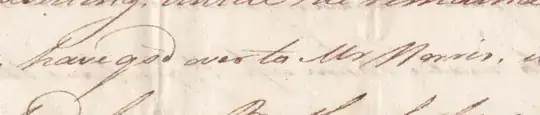
Mick
  • 231
  • 1
  • 7
  • 3
    It should be quod sine dicto, and it means "don't wait to be told". – Tom Cotton Oct 23 '16 at 15:49
  • @TomCotton Would "it goes without saying" also be reasonable? – Mick Oct 23 '16 at 16:34
  • @TomCotton =Isn't the Supine 4th Declension.? as in "mirabile dictu" – Hugh Oct 23 '16 at 16:51
  • @Hugh Yes, but this isn't a supine. The noun is dictum (as in obiter dicta, etc.), which sometimes serves as "command" or "order" – Tom Cotton Oct 23 '16 at 18:16
  • Mick — in a word, yes, but it depends on context. – Tom Cotton Oct 23 '16 at 18:18
  • I hate to say this, but my colleagues in EL&U are wondering if qsd is simply a nonce-abbreviation for questioned. It wouldn't explain the alleged macron, though. We have asked for more context. – Mick Oct 23 '16 at 18:37
  • @TomCotton I have added what context we have so far. – Mick Oct 23 '16 at 18:53
  • 4
    QS is a standard abbreviation for QUASI, "sort of". But Q.S. is a standard abbreviation for QVOD SUPRA "as above (previously)" And Q.S.S standard abbreviation for QUOD (QUAE) SUPRA SCRIPSI: "Which thing(s) I have previously written." The Bar over the S may be a differentiation between Supra previously and Sub below (later). *Unless this is a private code,* it would be understood to mean "As I said before," QUAE SUPRA DIXI. This is based on a dictionary which devoted 20 pages to Latin abbreviations Ainsworth revised Morrell 1783 – Hugh Oct 23 '16 at 18:58
  • 3
    This is an interesting question. (+1) I am not very familiar with the Latin of that era, so I can only guess. It would be extremely helpful to see that abbreviation in action. The context from a passage or two would really help. Perhaps someone can answer without further details, but I hope the asker at ELU can provide examples where the abbreviation is used. – Joonas Ilmavirta Oct 23 '16 at 19:17
  • @Hugh Yes, that's more sensible. – Tom Cotton Oct 23 '16 at 19:19
  • @Mick, I should ignore quod supra dixi, if you follow me! – Tom Cotton Oct 23 '16 at 19:19
  • Would you guys be prepared to deal with the original question if I can get it transferred? – Mick Oct 23 '16 at 19:23
  • @Mick, it depends on some details of the original question. I believe the letters were written in English. (If it was in Latin, ELU is definitely a bad choice.) Is there a reason to believe the abbreviation is in Latin? I have no definitive opinion before the OP supplies an example containing the abbreviation. – Joonas Ilmavirta Oct 23 '16 at 19:28
  • We are waiting on the OP. All that we have is what I quoted. The OP states that there's always a horizontal bar over the s, which makes me think that it's not an abbreviation of an English word or phrase. – Mick Oct 23 '16 at 19:31
  • @Mick An image of the abbreviation would definitely be helpful. If you don't know Latin, a naive transcription can often be very deceiving in these cases. – brianpck Oct 24 '16 at 10:57
  • @brianpck I've passed on your request. However, I have a feeling that the OP has lost interest in the question since she has made no further contact with us. – Mick Oct 24 '16 at 11:28
  • 1
    Our OP has come back to us. Hopefully, she will be uploading screenshots of the original text, once we have shown her how to do it. – Mick Dec 04 '16 at 21:00

3 Answers3

5

Ainsworth revised Morrell 1783 has 20 pages Quarto, three columns each page, of Latin abbreviations. It does not show QSD with or without macron. So here are some near-misses.

QS (also qs) is a standard abbreviation for QUASI, "sort of," "as if".

But Q.S. (with stops) is a standard abbreviation for QVOD SUPRA "as above (previously)" And Q.S.S standard abbreviation for QUOD (QUAE) SUPRA SCRIPSI: "Which thing(s) I have previously written." 'Explicatio Literarum & Notarum frequentius in antiquis Romanorum monumentis occurrentium.' Robert Aimsworth 1236 revised Th Morell 1783

The Bar over the S may be a differentiation between Supra previously and Subter below (later).

Unless this is a private code, it would be understood to mean "Which I said before," QUAE (QUOD) SUPRA DIXI.

Hugh
  • 8,683
  • 2
  • 17
  • 27
  • 1
    A better answer has been added to the discussion on English Language and Usage, listing abbreviations for various Quarter Sessions. The third letter identifies specialities. So, English after all. – Hugh Oct 26 '16 at 14:40
  • Where is that answer listing abbreviations for various Quarter Sessions? I can't find it at https://english.stackexchange.com/questions/354909/abbreviation-in-a-business-letter. – Jasper May Jun 27 '20 at 10:07
4

Quod sine die, a legal term, literally "which without a day", meaning there will be no day set to appear in court. In other words, to hold harmless; will not pursue the matter further, legally.

2

QSD: I believe it represents Quis ut Deus which translates into English as: "Who is like God?" It is a Latin translation of the Hebrew name "Michael," even though it does not appear directly in the Vulgate, and can also be rendered as, "Quis Sicut Deus."

brianpck
  • 40,688
  • 5
  • 94
  • 204
Terri Bull
  • 49
  • 1