9

Typically the gerundive is employed when one using a gerund with an object seems possible. For example, I have understood that aqua bibenda est and rei faciendae causa are preferable to aquam bibendum est and rem faciendi causa. It seems that one can always transform a gerund with an object into a gerundive (as an attribute to the object), but my grammar tells that this is not strictly necessary in all situations.

Tuomo Pekkanen's Ars grammatica states that the gerund can take an object only if the gerund is in genitive (without causa or gratia) or in ablative (without prepositions) and in all cases the gerundive can also be employed. For example, one can say spes urbem capiendi or spes urbis capiendae and librum legendo or libro legendo. Instead, one cannot say aquam bibendum est and rem faciendi causa. This rule sounds weird to me, and I wonder how confident we really are that classical Latin uses gerundives with objects in these and only these situations.

How strong is the rule? That is, do we have strong evidence that the Romans always obeyed this rule? Do ancient authors always follow this rule? Do other modern grammarians agree about these limitations to a gerund having an object?

Joonas Ilmavirta
  • 113,294
  • 21
  • 192
  • 587
  • Good question. But I believe a gerund is not used in the nominative or in the accusative without a preposition (the infinitive is used instead), so **aquam bibendum est* shouldn't be possible regardless. – Cerberus Jul 07 '16 at 11:53
  • @Cerberus, good point. In bibendum est the bibendum is always a gerundive, never gerund, even when there is no object like water. It's not hard to confuse me with these... – Joonas Ilmavirta Jul 07 '16 at 12:19
  • Exactly. A gerund never has the modal ("ought to be drunk") sense that a non-dominant gerundive has. – Cerberus Jul 07 '16 at 16:43
  • My understanding is that part of the reason the genitive/direct object is allowed is to avoid things like discipulorum docendorum, which the Romans found supremely inharmonious. This doesn't, however, actually answer your question. – Joel Derfner Jul 13 '16 at 07:44
  • @Joonas llmavirta: Bamboozled with these, perhaps unnecessary, gerund-gerundive conflicts? I know exactly how you feel! Following on from Joel: to avoid ugly-sounding jingles e.g. "ars oppidorum oppugnandorum" the Romans allowed a gerund to govern a direct object "ars oppugnandi (genitive) oppida". Mitomino states that "aquam Bibendum est" & "mihi epistulam scribendum est" are attested. For me, if these two are translated as gerunds, the nouns return to the nominative case e.g. "the writing (verbal noun) is the letter (epistula) to me". Therefore, "gerund + accusative direct-object" fails? – tony Jun 16 '20 at 12:04
  • @tony It sounds like you are adhering to a narrow interpretation of gerunds, and that misguides the translation you offer. If mihi scribendum est is "I have to write", why should adding an object make it so different? My question here was whether such objects are allowed in Latin, and now I'm convinced that they indeed sometimes are. – Joonas Ilmavirta Jun 16 '20 at 13:09
  • @Joonas llmavirta: For me it's a gerundive-of-obligation: "the letter (nominative) it-ought-to-be-written-by-me". It cannot be a gerund + (accusative) direct object (epistulam). In the other oblique cases, e.g. genitive "oppugnandi" (above) this is possible. – tony Jun 16 '20 at 13:39
  • @tony I agree that it's a gerund(ive) of obligation, but I think that forcing that translation obfuscates the structure unnecessarily. Whether the thing in mihi bibendum est is called a gerund or a gerundive is a matter of taste. While opinions differ on that (and it doesn't mean much), the important observation is that you can indeed add a direct object to it. So you can say aqua bibenda est or aquam bibendum est. – Joonas Ilmavirta Jun 16 '20 at 13:54
  • @Joonas llmavirta: You have changed your mind since 2016--"in Bibendum est Bibendum is always a gerundive, never a gerund..."; in the light of new evidence e.g. "aquam Bibendum est"? An alternative translation: "one must drink the water"--this use of an accusative direct-object (aquam) negates the passive nature of the gerundive. Similarly, "mihi epistulam scribendum est"--"one must write the letter to me"; therefore, why use the gerundive in these non-passive circumstances? – tony Jun 17 '20 at 08:02
  • 1
    @tony The fact that there can be objects leads to one of two conclusions: (1) It's a gerund or (2) the gerundive is not strictly passive. I would perhaps like to deny both, but I can't. I am open to interpretations, but I think strict passiveness of the gerundive is not a viable view. // It's not unusual for me to change opinions; new evidence and insight from this site leads my thought to new directions. – Joonas Ilmavirta Jun 17 '20 at 08:51

2 Answers2

3

Allen and Greenough (504) say that a gerund in the genitive can take an accusative object, "especially a neuter pronoun or a neuter adjective used substantivally". Examples:

nulla causa iusta cuiquam esse potest contra patriam arma capiendi (Cic. Phil. 2 53)

artem vera ac falsa diiudicandi (Cic. Or. 2.157)

They say that such constructions are rare or nonexistent with the other cases of the gerund in classical prose (though Plautus has two examples with a gerund in the dative).

TKR
  • 31,292
  • 2
  • 66
  • 120
  • Good examples. I think Joonas meant to say that a gerund can only take a direct object if the gerund itself is not in the accusative. (I wouldn't call ablative and genitive complements 'objects'.) – Cerberus Jul 07 '16 at 16:41
  • @Cerberus is right, I meant that the gerund itself needs to be in genitive or ablative (with the parenthetical restrictions). I updated the question to clarify. I think your examples fall in the category where Pekkanen allows objects. Nevertheless, the examples are good. – Joonas Ilmavirta Jul 07 '16 at 17:06
  • @JoonasIlmavirta Oh, I misunderstood. I'll edit the answer accordingly. – TKR Jul 07 '16 at 18:06
  • Good. I believe different grammarians phrase the rule differently, and I'm glad to see different formulations. Can you give those examples from Plautus (or some coordinates so one can find them)? – Joonas Ilmavirta Jul 07 '16 at 20:47
  • @JoonasIlmavirta Unfortunately A&G simply say "there are two examples in Plautus" but don't specify what or where they are. – TKR Jul 07 '16 at 23:22
  • Oh, I see. No need to go through the works of Plautus to satisfy my curiosity. – Joonas Ilmavirta Jul 07 '16 at 23:37
  • 1
    @JoonasIlmavirta Here you go: http://www.perseus.tufts.edu/hopper/text?doc=Perseus%3Atext%3A1999.04.0070%3Achapter%3D5%3Apara%3D43 – Anonym May 20 '17 at 04:46
3

A good discussion and summary of this interesting question can be found in this work: VESTER, ELSELINE (1991). "Reflections on the gerund and gerundive". In Robert Coleman (ed.). New Studies in Latin Linguistics. 295-310. Amsterdam/Philadelphia: John Benjamins.

Vester points out that the gerund cannot take objects in the following contexts. In these cases the use of gerundive is quite pervasive (but see below for some relevant exceptions).

dative: aptus scribendo (*epistulam)

in+ablative: in scribendo (*epistulam) obdormivit

ad+accusative: paratus ad scribendum (*epistulam)

As for your (sub)questions "How strong is the rule? Do we have strong evidence that the Romans always obeyed this rule? Do ancient authors always follow this rule?", the prohibition of using objects with gerunds is, for example, very strong in in+ablative and ad+accusative contexts across many authors of different periods (and for me this is a very interesting issue: there must be a grammatical (i.e. not merely stylistic) explanation accounting for the consistent absence of objects in these particular contexts, an explanation that, by the way, is not provided by a functionalist linguist like Vester). As for other cases, the norm varies across authors: e.g., the gerund in ablative often takes objects in Vitruvius, less so in Sallust, and much less so in Cicero('s speeches/orationes). See some relevant data and percentages in Vester (1991). Here is a useful information extracted from her Figure 4a:

DISTRIBUTION OF GERUND (+/- OBJECT) AND GERUNDIVE BY CASE FORM (corpus: Pl(autus), Ter(entius), Var(ro Lingua Latina), Sal(lustius), Caes(ar), Cic(ero Orationes), Vitr(uvius), Col(umella), Curt(ius), and Gel(lius)).
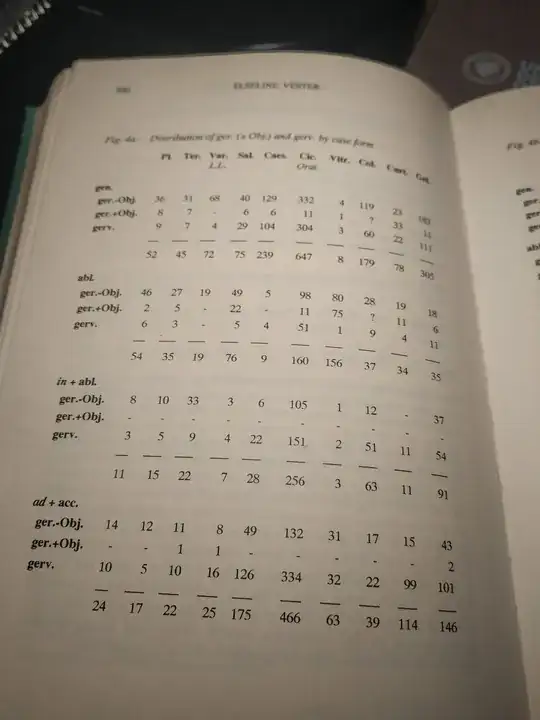
enter image description here

As is well-known, it is often stated in many Latin grammars that one can say/write cupidus videndi urbem (gerund) and cupidus videndae urbis (gerundive). However, when one looks at the data & percentages, one realizes that there are some important differences across authors of different periods: the usage of gerund+object in this context is more typical of Early Latin than of Classical Latin, where the gerundive is by far much more used.

Note also that the strong statement in your post "one cannot say aquam bibendum est" is not fully correct: there are some few attested examples of this usage: agitandum est vigilias (Pl. Trin. 869); aeternas poenas in morte timendum est (Lucr. 1, 111), i.a. See also some further discussion & comments in this post. See also Vester (1991: 297): "it is evident that scribendum is a gerund in mihi epistulam scribendum est, but for some scholars it is less evident in mihi scribendum est", where most of them assume it is a gerundive (NB: Bolkestein, who has been considered as the second authority after Pinkster in functional approaches to Latin linguistics, assumes it is a gerund). For a more detailed analysis of this issue, see Miller's (2000) formal/generative approach.

To conclude, if one is not interested in philological differences of usage (e.g., the usage of non-prepositional ablative plus object is typical of Vitruvius but not of Cicero, the usage of aquam bibendum est is not typical but it is found in ...), the simplified rule for learners/"speakers" of Latin is to use the gerundive instead of the "gerund plus object" (except under the well-known circumstances pointed out by TKR and Joel Derfner. For a nice summary of these circumstances, i.a., I recommend the reading of the excellent chapter XVII "The Gerund and Gerundive" (pp. 157-166) by E. C. Woodcock (1959). A New Latin Syntax. London: Methuen).

Mitomino
  • 8,791
  • 1
  • 16
  • 29
  • Why would scholars advocate "aquam Bibendum est"? A neuter, impersonal gerundive with a feminine, accusative, direct-object; to be translated as "one must drink the water"; which negates, completely, the passive nature of the gerundive. Therefore, why deploy a gerundive in such circumstances? What can this be but a grammatical violation? Why do you appear to be a proponent of this? – tony Jun 12 '20 at 08:48
  • 1
    @tony It is not the case that some scholars theoretically "advocate" for the existence of examples like aquam bibendum est. These examples are attested, which has been taken by some scholars as evidence for considering the -nd- form as a gerund. I've always taken it for granted that in nunc est bibendum the -nd- form is gerundive. However, my current view is influenced by Haspelmath (1987), who considers the gerund as a sort of an impersonal gerundive. In his view, gerund and gerundive represent the same category: http://publikationen.ub.uni-frankfurt.de/frontdoor/index/index/docId/24318 – Mitomino Jun 12 '20 at 20:04
  • Thank you. I agree that by using "aquam" the gerundive is nullified. But this transmutes the g'dive into a gerund?!? Translating as "the drinking (verbal noun) is the water". Would that not put "aqua" back into the nominative? Though downloaded, Haspelmath's paper won't display, on screen. It must require a ridiculously high fee. Intriguing & baffling is "gerund as a sort of impersonal gerundive". If this theory is so apposite why has it not filtered-down onto the net/ the literature, in the intervening 33-years? – tony Jun 13 '20 at 10:46
  • May I be a nuisance, please, and ask yourself for one example of a gerund functioning as an impersonal gerundive? Thank you. Returning to your Q: https://latin.stackexchange.com/q/10809/1982, did my answer not "prove" that "Bibendum" was a gerundive? – tony Jun 13 '20 at 10:50
  • Haspelmath's paper can be freely downloaded from the link above. On page 12 you'll see his claim ("we can call the gerund the impersonal form of the gerundive") and his argumentation for this claim. The following link contains Pinkster's (2015) summary of some relevant bibliography on the debate: https://books.google.es/books?id=yxxfCgAAQBAJ&pg=PA164-IA70&dq=%22excursus:+the+relationship+between+the+gerund+and+the+gerundive%22&hl=ca&sa=X&ved=0ahUKEwj5naewgoDqAhVHCxoKHTWfARQQ6AEIJzAA#v=onepage&q=%22excursus%3A%20the%20relationship%20between%20the%20gerund%20and%20the%20gerundive%22&f=false – Mitomino Jun 14 '20 at 00:13
  • Finally located Haspelmath's paper, though it is the typewriter-written draft that would have been submitted to the publisher. The printed-out published-version eludes me. A supplementary Q., please? On p.12; Ex. 41: "superstitione tollenda religio non tollitur" = "by abolishing superstition religion is not abolished". Is "superstitione tollenda" an Ablative Absolute? How would a gerundival AA be translated, literally--"with superstition it-must-have-been-abolished"? Given the passive nature of both gerundives and AAs, why can't the one be melded into the other? – tony Jun 21 '20 at 10:16
  • Hence, or otherwise, why would Vester say: "Gerundives do not enter into true AAs." – tony Jun 21 '20 at 10:17
  • @tony I surmise that Vester's claim that Gerundives do not enter into "true" Ablative Absolutes is due to the fact that the "absoluteness" criterion does not hold in AAs with gerundives, where the agent of the action involved in the gerundive is necessarily dependent on the agent of the main clause. In contrast, note that in (true) Ablative Absolutes such a dependency is not required: e.g., Urbe capta ab hostibus, cives fugerunt (NB: in this example the agent encoded by the by-phrase of the AA does not coincide with the agent of the predicate of the main clause). – Mitomino Jun 22 '20 at 03:39