そうか
そういや
[ペッパー]{おまえ}は
昔のユトを
なにひとつ
思い出せねえん
だったっけ。
So the first part, そうかそういや is preamble, "Is that so? come to think of it..." ペッパー is the name of the protagonist who's being addressed. But then I have trouble.
昔のユト: the Ute people from the old days? ユト, so far as I can see, is only used to refer to the Native American Ute tribe, which fits the context because this is a Western.
So I'm assuming they are the object of the next phrase: ないひとつ思い出せねえんだったっけ
But I can't parse this. 思い出せねえんだったっけ is obviously 思い出せる, to recall, but I can't understand this conjugation. The だったっけ ending is past tense copula plus the -ke particle to indicate the speaker is trying to remember something?
It's also confusing because so far I haven't seen any reason to think they are talking about the Ute tribe. The conversation thus far ran something like:
"So, Pepper, I got a message from the State Police. Some guy saw a $10,000 bounty up near Diamond Hill. It's Wild Job, a survivor from the Cassidy Gang."
"The Cassidy gang...?"
「そうだ
ぺッパー
郡警察から連絡でな
ダイヤモンド・ヒルのあたりで1万ドルの首を見た奴がいる。
ワイルド・ジョブって奴だよ
キャシディ一味の生き残りだ。」「キャシディ一味...?」
And no mention of "Ute"...
Here's a picture, so you can see the katakana for yourselves:
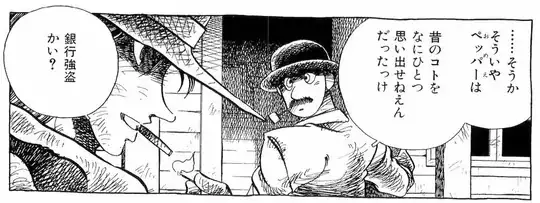
Having skimmed ahead, I'm now actually pretty sure it's actually a person's name, though what "Yuto" is supposed to be in a Western setting I've no idea...


I still don't get the conjugation they're using for 思い出せねえん though...
– Celandine Crane Nov 05 '19 at 17:35