9

日本のテレビを見ると、サブタイトルがいつも出てきます。でもサブタイトルじゃなくて。。。何と言いますか?

what does one call Japanese "subtitles" that constantly appear in Japanese television and to a lesser extent movies? I'm referring to a sentence that someone on TV says, which is then immediately written onscreen to emphasize the expression (often for humor).

OK so I asked my friend, and she said it's called テロップ is this right?

On a cultural level, any guesses as to why this phenomena is so frequent in Japanese media, yet the equivalent is pretty rare in Western countries?

yadokari
  • 10,419
  • 7
  • 47
  • 91

2 Answers2

12

I think テロップ is right. It is also called スーパー. As for its extensive use, it seems to have started in TV programs in the late 1980s and 1990s such as 探偵!ナイトスクープ, 進め!電波少年, and 天才・たけしの元気が出るテレビ!!, and became widespread under the influence of these TV programs. The most typical Japanese comedy style consists of 1. Someone saying/doing a silly thing (ぼけ) and 2. Someone pointing that out (つっこみ). It looks like テロップ has taken over part of つっこみ under certain occasions. Or, a more general answer to why such thing developed in Japan would be that Japanese develop technologies over subtle things that other people do not care.

Reference: wikipedia 1, wikipedia 2

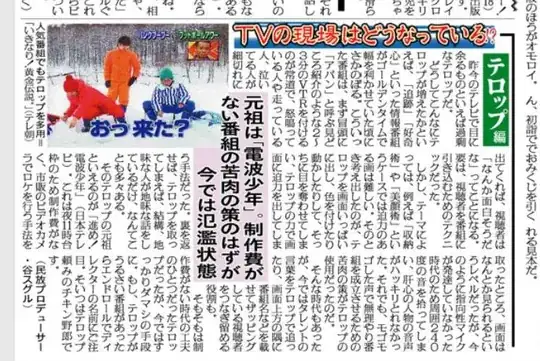
From one of the links

日刊ゲンダイ 2010年3月3日

  • 2
    ".. Japanese develop technologies over subtle things that other people do not care." - so true. this, this and this! – Lukman Sep 28 '11 at 03:38
  • 1
    @Lukman Ha ha ha. Those are jokes. I have never seen them in daily life. –  Sep 28 '11 at 03:41
  • That does not explain though why in movies the name of the characters and of the actors are shown, if not more. I remember watching die hard last year: there were subtitles to explain that a bomb was a bomb. Duh! – Axioplase Sep 28 '11 at 07:15
  • @Axioplase I don't get what you mean. Don't movies from other countries show the ending caption? In English movies that have scenes of countries that use other languages, I see English captions for text that appears in the film. –  Sep 28 '11 at 07:28
  • @Sawa: in the middle of the film, when an important character appears, his name and the name of the actor appear as captions. Sometimes, objects too have captions to explain what they are. This happened in maybe all the foreign films I have seen on Japanese television. I do not know if it is the case at the cinema. – Axioplase Sep 28 '11 at 07:42
  • @Axioplase I see the same thing in American movies as well. It is not just Japanese. –  Sep 28 '11 at 08:25
  • @Axioplase: Similarly I have seen in written works (primarily translations into Japanese) explanations in the space usually used for furigana, e.g. "a town in California", for foreign places/terms, particularly less well known ones. – nkjt Sep 28 '11 at 14:29
  • The source of the article would be a nice addition. – Tsuyoshi Ito Sep 29 '11 at 20:09
7

テロップ is probably the correct term. The dictionary agrees with you, in any case.

However, in my daily experience, people are as much or more likely to just refer to the text you are talking about as 字幕{じまく}("subtitles"). Yes, technically subtitles are a different thing in terms of purpose (translations), but in terms of how they appear (words on a screen), I guess people don't really differentiate.

For why... I've talked about this with people before, and the most common theory I've come across that because Japanese has so many homonyms, a little kanji helps people along. Or at least, that's how it started out, but then took on a life of it's own and now is just an accepted norm as far as emphasizing or dramatizing what people say.

Questioner
  • 24,694
  • 15
  • 95
  • 232
  • I once read a discussion about their origins and that theory came up. Someone seemed rather bewildered and offended by the idea that people would need subtitles to comprehend their own language. – Louis Waweru Sep 28 '11 at 08:30
  • @Louis: There are always people who get over sensitive about things. ;) Personally, I can't say I see what is so offensive about the concept. Every language has its own quirks, and in Japanese the limited number of sounds and the expansive number of characters seems to be a rather obvious setting in which seeing the words would help clarify meanings. It's not a value judgment, it's just the way it is. – Questioner Sep 28 '11 at 09:27
  • You're probably right... – Louis Waweru Sep 28 '11 at 09:56