4

It seems like 留める can be read as either とめる or とどめる. JED, my Android dictionary app, cites とどめる, and so does wiktionary. But wiktionary's kanji entry for 留, it lists とめる, とどまる, and とまる as kun readings, not とどめる; my IME also accepts both とめる and とどめる when typing 留める, and my Anki cards generate 留【と】める when I type in とめる. Is this a wiktionary boo-boo, or are there two ways to read 留める? If so, which is more commonly used?

Please clarify other kanji you use in an answer with furigana.

Lou
  • 2,791
  • 3
  • 26
  • 34
  • 1
    There are two ways of reading 留める. There is a question about its difference with 止める etc. (when read as とめる) here. – Earthliŋ Jan 03 '15 at 11:03
  • Yours is a useful answer, although it doesn't seem to address とどめる vs とめる, specifically re 留める. Would you be willing to address the difference between the two? – Lou Jan 03 '15 at 12:09

1 Answers1

6

It's NOT 留める has two readings, but two similar but distinct words share the written form 留める.

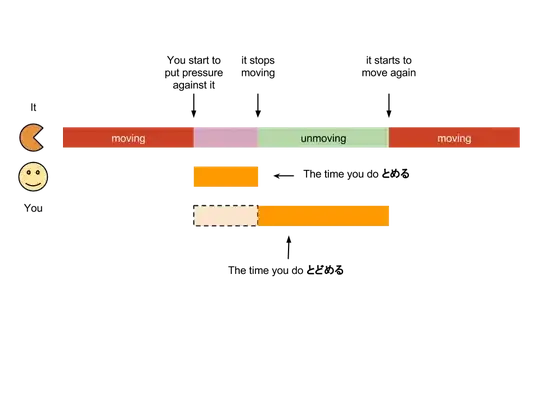
As for how different (or how similar) they are, I could say the main difference between とめる and とどめる is aspect. The figure below explains how.

EDIT: Note that とめる only happens in the transitional duration, while とどめる does as long as you're keeping it still (maybe forever). とめる vs とどめる

broccoli forest
  • 50,861
  • 1
  • 78
  • 181
  • Once you record something on document, until unspecified time ( may be forever ), it is still とどめる。So yours, sorry, does not look correct to me. I would like to look into further. This could be a challenge. ( for foreigners, we, Japanese "unconsciously" may be using them. –  Jan 04 '15 at 14:00
  • あー、上の図だとそう解釈されるかもしれないですね。ポイントは、対象が止まっている間「とどめる」が有効だということです。なので永遠に移動しなければ永遠に「とどめて」いるわけです。直しておきます。ありがとうございます。 – broccoli forest Jan 04 '15 at 15:38
  • あ〜日本人の方でしたか。スミマセン(m_m)。私的には意味不明な サムダウンみたいなのを食らわなければまあいいといえばいいので 上の図の下の図を違う事を違う事を御説明されたら宜しいのでは? そうなれば解りやすいように思えますが^^。確認ですけど留(と)める=再稼働可,留(とど)める=まあ一応永久を前提に、で宜しいのでしょうかね?では^^。 –  Jan 04 '15 at 17:45
  • 1
    Wait, how is this related to Pac-Man? – istrasci Jan 04 '15 at 19:08
  • It's only I didn't want to spend more than 10 minutes on the diagram, so used a preset shape in Google Drawing --- "pie chart". – broccoli forest Jan 05 '15 at 06:28
  • @KentaroTomono ■「感染者を2週間自宅に留{とど}める」という場合は最初から期限付きですね。辞書を見ると「とめる」も「とどめる」も同じ様な説明が書いてありますが、例えば「とめるのに失敗した」という時は、動いている(動き出した)ものがとまった状態にならなかった、という意味にしかなりませんが、「とどめるのに失敗した」という時は、その他に、今までとまっていたものをとまり続けさせられなかったという解釈も可能です。こういうことから、「とめる」の実体は対象がとまるまでの間にあり、「とどめる」の実体は対象がとまっている間にあると説明することができます。専門用語で言うと「とめる」は概ね金田一の瞬間動詞、「とどめる」は継続動詞に相当します。(「泊める」と書く時は大体継続動詞なのでややこしいですが)■どうもここの人たちは懇切丁寧な説明より単刀直入な説明、辞書や用例のサンプルより文法的な解説を好むようなので、それを心がけると評価が良くなると思います。あと何か、週末になるとやたら点の辛い人(荒らし?)が来ますので注意してください。 – broccoli forest Jan 05 '15 at 06:43
  • 3
    これ結構難しくありませんか?例えば「時間を3分間とめる」は上の「とどめる」の定義に合致しますが、この例では「とどめる」は不適です。単なる静動ではなく、いかなる様態で「静」であるかも関係あるかも。つまり「とどめる」は動きを制限するものの停止ではないという感じ。It's acctually a fairly difficult question. For example, "to stop time for 3 min" requires とめる despite your definition seems to match とどめる. Maybe it has something to do with a manner how it does, i.e. とどめる stands for to restrict movement but not to freeze. – user4092 Jan 05 '15 at 07:33
  • @user4092 Your analysis sounds fascinating and probably better (at least covers wider scope) than mine. So is your point that とめる is achieved only the target is dead static, while とどめる just aims to confine its movement "within" some areas? – broccoli forest Jan 05 '15 at 14:57