2

There is some controversy about whether no-adjectives exist.

I have chosen a random no-adjective (not having another meaning as noun): [丸腰]{まるごし}

Sentence with this word with case particle:

丸腰を見る

Is this sentence grammatically correct?

If this sentence is grammatically incorrect, then no-adjectives must exist as syntactically distinct group from ordinary nouns.

If this sentence is grammatically correct, then what is meaning of this sentence? Would it be understood as something with implicit の + 人 / 者 / 物 etc. (e.g. 丸腰の人を見る)?

Arfrever
  • 1,516
  • 1
  • 2
  • 11
  • That で is a particle. The sentence doesn't mean the same as 丸腰であり敵に立ち向かう. – aguijonazo Oct 02 '23 at 02:07
  • @aguijonazo If you supply a topic, the structure becomes clear: 竜馬は丸腰で敵に立ち向かう (<— 竜馬は丸腰であり、敵に立ち向かう). – N. Hunt Oct 02 '23 at 05:12
  • @N. Hunt, then how would you explain that “すごく病気” is grammatical but “すごく人” is not. There is clearly a difference between “病気” and “人” here and that difference seems to be that what would commonly in linguistics be called the difference between an adjective and a noun. I'd say “負け者” is also an adjective because “すごく負け者” does occur. – Zorf Oct 02 '23 at 06:50
  • @Zorf The string すごく病気 is meaningless. Do you have context? One can turn nouns into phrases functioning as adjectives by adding なる, thus 怠け者なる会社員, thus in both of your examples なる (な) is understood. – N. Hunt Oct 02 '23 at 07:28
  • 「竜馬は敵に丸腰で立ち向かう」と語順を代えられますし、他にも「敵地に丸腰で赴く」などの文を見れば、「で」は「だ」の連用形ではなく助詞の「で」であることがわかりますよね。「竜馬は敵に丸腰であって、立ち向かう」「敵地に丸腰であって、赴く」とは言い換えられませんから。「敵に」は「丸腰で」ではなく「立ち向かう」を修飾し、「敵地に」は「丸腰で」ではなく「赴く」を修飾しているので。 – chocolate Oct 02 '23 at 14:16
  • 2
    I really don’t understand why one has to prove that the の in so-called の-adjectives is always replaceable with である, or insist that the で in 丸腰で立ち向かう is a copula for that matter, to disprove の-adjectives exist. Isn’t’ it just that some nouns happen to be used only attributively while some others, such as 丸腰, can also be used predicatively but their meanings are too abstract to be used as a subject or an object by themselves in normal contexts? – aguijonazo Oct 03 '23 at 06:57
  • @N.Hunt My new analysis of 「丸腰で」 in 「丸腰で敵に立ち向かう勇気を持っている。」 is in https://japanese.stackexchange.com/q/101210/. Therefore 「丸腰で」 = "unarmedly" would be adverbial form of adjective. If you want to answer to this specific analysis, please answer in that new question. – Arfrever Oct 03 '23 at 08:43
  • ^ 「名詞+で」はそもそも副詞的修飾句なので副詞的な意味を持てますよ。「丸腰で」「重装備で」「軽装で」「裸で」「ワンピースで」と同じ「」(❹ 動作を行うときの様態を表す。 「急ぎ足で歩く」 「親子で出席する」 「笑顔で答える」 「土足で上がる」)では。英語で「形容詞+ly」に訳せるからと言って日本語でも形容詞の副詞形だということにはならないでしょ – chocolate Oct 04 '23 at 01:14

2 Answers2

4

丸腰を見る usually makes little sense; you can see someone's unarmed status, but you cannot see "unarmed" itself. Canonically, you should say (誰かが)丸腰のところを見る instead. Still, in casual conversations, people might occasionally say 丸腰を見る instead of 丸腰のところを見る. The same applies to 普通(であること)を確かめる, 最高(の瞬間)を思い出す, and so on; the part in the parentheses may be dropped sometimes in sloppy speech or aesthetic writing.

Still, even if 丸腰を見る is ungrammatical, whether to call 丸腰 a "no-adjective" or a "descriptive noun" is a different issue.


Whether or not one acknowledges the existence of "no-adjectives" depends on the grammatical framework they rely on. I don't have a strong opinion either way. When someone who is no longer a beginner asks me "How many types of adjective are there in Japanese?", I usually respond with "0, 1, 2, or 3, depending on your definition". (Yes, some say i-adjectives are actually verbs, and there's a reason for that!)

Note that "no-adjective" is not the only thing that doesn't exist in so-called 国語文法 learned in Japanese school. For example, in 国語文法, they don't recognize "te-form", "progressive form" and "past form", either.

Still, I understand that these terms are useful for learners, and they are used in most Japanese-as-a-second-language learning resources. From a practical point of view (esp. of western speakers), there is little difference between so-called na-adjectives and so-called no-adjectives aside from the particle used. That's why I use these terms at least for beginners and intermediate learners. If you needed to memorize an entire table of auxiliary verbs just to say something simple like 食べていました, learning Japanese as a second language would become quite inconvenient.

naruto
  • 313,860
  • 13
  • 324
  • 625
  • Comments have been moved to chat; please do not continue the discussion here. Before posting a comment below this one, please review the purposes of comments. Comments that do not request clarification or suggest improvements usually belong as an answer, on [meta], or in [chat]. Comments continuing discussion may be removed. – chocolate Oct 03 '23 at 12:26
2

I think you are misunderstanding several things.

First off, grammatical correctness does not imply meaningfulness as shown by the classic example (and vice versa, almost trivially. We are using lots of grammatically incorrect sentences and understand each other in most cases).

The sentence

丸腰を見る

is a grammatically correct but meaningless sentence. It is just the same as 病気を見る is (at least) weird. Generally there is nothing similar to the sick (= sick people) in English, if that's what you had in mind.


Regarding no-adjective, a grammatical category (such as na-adjective or no-adjective) is a stipulation, so there's no definite answer as to its 'existence'. It is just a matter of how useful it is.

Consider na-adjective instead, for which there was actually a controversy (I have no idea how much it's settled, but na-adjective is standardly taught in Japanese school grammar).

Now think about the phrase

  • 有名の人

For those who accept na-adjective, this phrase is ungrammatical because 有名 is na-adjective and の should be な here.

On the other hand, for those who don't accept na-adjective, it is a grammatical sentence (because 有名 is just a noun and there is nothing wrong with 'noun + の'), but just not idiomatic.

So, at least as far as the above phrase is concerned, the unacceptability of 有名の人 doesn't imply anything.

Likewise, thinking that 丸腰を見る is ungrammatical implies you are stipulating no-adjective. Not the other way round. (Or at least, claiming no-adjective just by this example is not well founded).


I don't look up anything about no-adjective and never heard of it, but I guess it is just for an explanation following the thought like below:

  • Some nouns have adjective-like meaning (丸腰, 有名)
  • 有名 is followed by な to connect to nouns, hence na-adjective.
  • 丸腰 is followed by の, hence no-adjective.

There does seem to exist research on な/の difference in Japanese linguistics. I stumbled on this article which has the following chart.
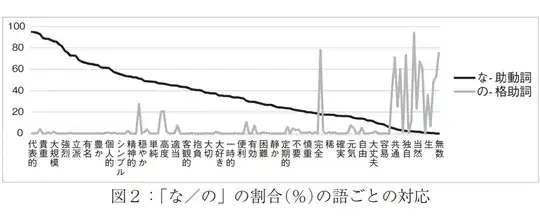
enter image description here

They are not inverse proportional, but anyway semantically similar enough words require different particles な/の. Thus no-adjective was invented as opposed to na-adjective.


FYI. Regarding replaceability with である, the best I've found is 瀕死の重傷 in the sense that 瀕死 is adjectival enough but cannot be replaced by である (重傷は瀕死である is nonsense).

sundowner
  • 36,445
  • 2
  • 19
  • 57
  • Comments have been moved to chat; please do not continue the discussion here. Before posting a comment below this one, please review the purposes of comments. Comments that do not request clarification or suggest improvements usually belong as an answer, on [meta], or in [chat]. Comments continuing discussion may be removed. – chocolate Oct 05 '23 at 00:37