8

In a previous question I wrote Credo che pressocché dovunque le persone parlino ..., but it was changed to Credo che pressocché ovunque le persone parlino ..., replacing dovunque with ovunque.

Can anyone explain the reason why one should prefer ovunque over dovunque in that case?

After consulting some dictionaries, I'm still unsure about what the difference is.

apaderno
  • 3,856
  • 14
  • 38
Kyriakos Kyritsis
  • 6,073
  • 10
  • 47
  • 74

2 Answers2

7

They are interchangeable, as they have exactly the same meaning.

However, since one starts with a vowel and one with a consonant, the usage of one of the two can be preferable in the way they sound.

Credo che pressocché dovunque le persone parlino ...

is completely fine and I wouldn't have bothered in correcting it. However I agree that

Credo che pressocché ovunque le persone parlino ...

pleases my ear a little better, since losing the consonant makes the whole sentence flow more smoothly.

That being said, I think ovunque is less common in the spoken language than dovunque and it is also a little bit more highbrow.

carlspring
  • 103
  • 4
Gabriele Petronella
  • 3,735
  • 1
  • 21
  • 33
7

They are interchangeable, as ovunque means dovunque. They are like tra and fra: Although they are synonyms, you generally avoid some word combinations, such as fra frati and tra travi.

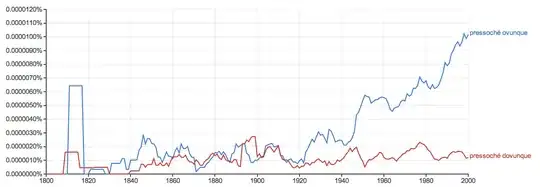
As for using pressoché dovunque or pressoché ovunque, Google NGrams shows the latter is used more often.

screenshot

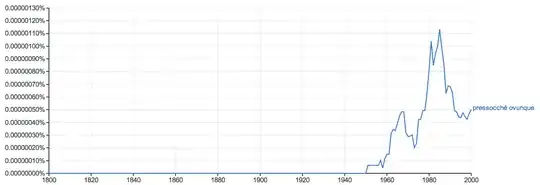
Furthermore, looking for pressocché dovunque versus pressocché ovunque, I get the following. (There are two c after presso.)

screenshot

apaderno
  • 3,856
  • 14
  • 38
  • 2
    Notare che i due grafici hanno scale molto diverse (contare gli zeri dopo la virgola). – Federico Poloni May 30 '19 at 23:18
  • Personally, I'd remove the graph with pressocché. With the same logic, we'd find in Ngram also graphs for qual'è, consegnamo or accellerare. – DaG Jun 01 '19 at 11:59
  • @DaG That graph is pertinent, since pressocché is the variant spelling some people use for pressoché and pressocché is used in the first revision of the question, which somebody wrongly edited. – apaderno Jun 01 '19 at 12:18
  • I know that, but since it is a dubious spelling, the graph only proves that someone uses it, which is marginally interesting, since it also would hold for every other dubious spelling, as in my examples. – DaG Jun 01 '19 at 13:40
  • @DaG It could be, but the OP expressly used pressocché, so it isn't that unrelated. – apaderno Jun 01 '19 at 14:41