10

Alcuni dizionari riportano il verbo votare, nella sua accezione più comune, quella che si riferisce all'esprimere preferenza elettorale per un partito o per un candidato, sia come transitivo che come intransitivo.

Per esempio, il dizionario del Corriere della Sera afferma che sia corretto dire:

Io voto per il candidato x;

e anche

Io voto il candidato x.

Il vocabolario Treccani non riporta esplicitamente esempi nella direzione della seconda frase qui citata, usando invece, nel senso specificato, solo la frase con preposizione.

Vorrei sapere se l'uso di votare così come è indicato nella seconda frase è di nuova fattura (un uso di recente accettazione), se le due forme siano equivalenti, e in quale misura o contesto.

abarisone
  • 20,307
  • 4
  • 30
  • 60
martina.physics
  • 3,594
  • 2
  • 23
  • 41
  • However, beyond the answers posted, I think that voto per X and voto X should be used in different contexts, and they are not entirely interchangeable, though. – Kyriakos Kyritsis Nov 16 '13 at 18:46
  • @KyriakosKyritsis Can you be more specific on the two contexts? – martina.physics Nov 16 '13 at 18:54
  • I would use io voto per Y to answer to someone else who tell me io voto X, as if that per emphasize my different opinion about the matter. Otherwise, if I don't want to express my opposition to X, I would answer no, io voto Y. – Kyriakos Kyritsis Nov 16 '13 at 19:29

3 Answers3

4

"Votare" derives from "promettere con voto" where "voto" has the original meaning of "solemn promise" (cf. "voto del silenzio", "devoto") and comes from the Latin "vovère" (cf. "to vow for").

The original meaning is mostly used with the reflexive form of the verb "votarsi", to (de)vote oneself, and this also makes it evident that a transitive form of the verb is acceptable and of old origin.

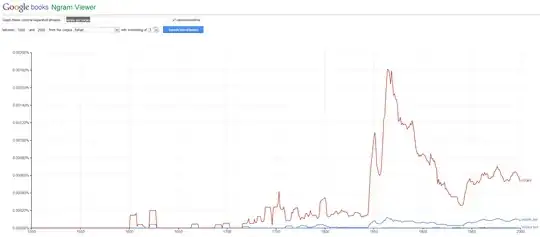
More interesting is to see if the intransitive form is a later way of using the verb. An ngram for "votare per" is not different enough from "votare" to draw any conclusions, although it shows a slighty earlier start for the verb in general in comparison with the "per" form. What is more interesting is that the usage of either form has become much more common since the Risorgimento in the 1850's.

ngram votare per vs votare

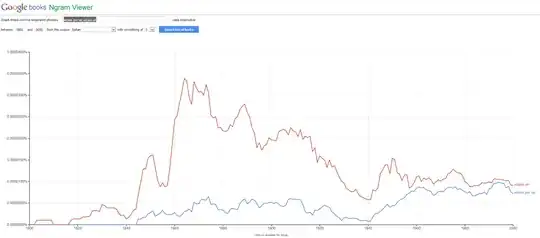
On the other hand "votare un" vs. "votare per un" also show very similar ngrams. I think that all we can deduce is that the transitive form is more commonly used, but I don't think there's enough difference to support they hypothesis that one is more recent than the other.

"votare un" vs. "votare per un"

Sklivvz
  • 2,752
  • 15
  • 31
  • 2
    I am not sure of the usefulness of confronting on Ngram “votare per” with just “votare”. The latter includes the former, to start with, as well as all the phrases in which the verb is used in an absolute way (“Domani vado a votare”, say). I tried something more specific with “votare per un candidato” vs. “votare un candidato”, and there is a clear preference for the former. – DaG Nov 16 '13 at 16:01
  • @DaG I am not disputing that. I am using ngram to show that "votare" has earlier usages than "votare per". – Sklivvz Nov 16 '13 at 16:04
  • Indeed. But, short of reading all of the early occurrences, we have no way of knowing whether “votare” is used transitively there or not, and I'd guess it isn't. In particular, my point is that we cannot conclude that “it shows a slighty earlier start for the transitive form”. – DaG Nov 16 '13 at 16:22
  • Ok, fixed. My main point was that it was "inconclusive" though. – Sklivvz Nov 16 '13 at 16:27
  • @martina, please do not change the meaning of answers through editing: improving an answer is not deleting half of it or changing it substantially. :-) – Sklivvz Nov 16 '13 at 16:42
  • @Sklivvz Don't you agree that the red curve includes the blue one and many other things so the confrontation is pointless? – martina.physics Nov 16 '13 at 16:47
  • @martina I disagree on the basis that an inconclusive proof is still a data point. If, for example, "votare per" was never used before 1900, that would have been meaningful. Not finding anything but marginal differences shows that the intransitive form is not earlier than the transitive one. – Sklivvz Nov 16 '13 at 16:48
  • @Sklivvz The transitive form you claim could easily be dominated by things like "votare una legge" which do not require any preposition, and you simply don't know so the claim is too bold in this way. – martina.physics Nov 16 '13 at 16:51
  • @martina how would "votare una legge" be different from "votare un candidato"? – Sklivvz Nov 16 '13 at 17:18
  • @Sklivvz Given the grammatical peculiarities involved, I'll answer in Italian. "Votare una legge" significa metterla al voto in parlamento (chiedere a tutti di votare in positivo o in negativo). Analogamente vale per "votare una proposta, un progetto...". Non dici certo "votare per una legge", perché non è un complemento di vantaggio, a differenza di "votare per il candidato Tizio". Si tratta invece di un semplice complemento oggetto. – martina.physics Nov 16 '13 at 17:25
4

The oldest vocabulary I have on hand, a 1948 Zingarelli, gives as a definition “Dare il voto” (hinting at the intransitive use) as well as “Approvare col suo voto” (hinting at the transitive one) and records transitive uses, such as “la lista del blocco ... la proposta”, but I guess the use is not much older.

Following the idea by Sklivvz, a search on Ngram viewer for “votare per un candidato” vs. “votare un candidato” suggests that the transitive form is more recent, with almost no results before WWII, while the intransitive one was well in use in the 1850s.

Finally, in the Vocabolario della Crusca, “votare” only appears (as variant of “botare”) in the meaning of “to vow” (and, of course, the homograph “votare” meaning “to empty” also appears).

DaG
  • 36,593
  • 6
  • 68
  • 128
  • 1
    I'd love to see this same confrontation with any peculiar x candidate and y party, summed by category (with and without "per"). But a shot of what happens with the one politician which stayed there for a sufficiently long time to give some temporal result is useless because of lack of data. – martina.physics Nov 16 '13 at 17:02
3

Just for reference, check this image search: https://www.google.it/search?q=volantino+1948+vota&tbm=isch Apparently, most leaflets for the 1948 elections were using the transitive form.

There is also another form that "sounds transitive" while it's not, like Vota comunista or Vota liberale, in which "comunista" and "liberale" are used as a sort of adverb. It's like Vesti giovane and similar commercial slogans. In English, you have Think pink.

Mauro Vanetti
  • 2,673
  • 11
  • 20